


Comparison among atl ttl and btl marketing activities





Try Before you Buy Download Free Sample Product
 Impress Your
 Audience
 100%
100% Editable
 Save Hours
 of Time


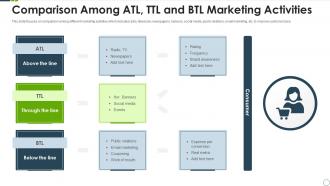
This slide focuses on comparison among different marketing activities which includes radio, television, newspapers, banners, social media, public relations, email marketing, etc. to improve customer base.
People who downloaded this PowerPoint presentation also viewed the following :
Comparison among atl ttl and btl marketing activities with all 6 slides:
Use our Comparison Among ATL TTL And BTL Marketing Activities to effectively help you save your valuable time. They are readymade to fit into any presentation structure.





FAQs for Comparison among atl ttl and
ATL focuses on mass reach through television, radio, and print advertising, while BTL targets specific audiences through direct mail, events, and promotional activities. TTL strategically combines both approaches, with retail brands using ATL for brand awareness, BTL for customer engagement, and TTL for integrated campaigns, ultimately delivering broader market penetration and enhanced customer experiences.
Marketers determine the appropriate approach by evaluating target audience reach, budget constraints, campaign objectives, and measurability requirements, with ATL suited for broad brand awareness, BTL for targeted conversions, and TTL for integrated campaigns. Strategic considerations include market maturity, competitive landscape, and customer journey stage, with many organizations finding that combining approaches based on specific business goals and audience segmentation delivers optimal ROI and comprehensive market coverage.
Successful ATL campaigns include Coca-Cola's "Share a Coke" personalization initiative, Nike's "Just Do It" messaging, Apple's minimalist product launches, McDonald's global "I'm Lovin' It" campaign, and Old Spice's humorous television commercials. These campaigns delivered significant brand recognition increases, enhanced customer engagement, and sustained market share growth, with many companies finding that consistent ATL messaging across television, radio, and print ultimately strengthens brand recall and drives long-term consumer loyalty.
Digital marketing serves as a strategic bridge between TTL and BTL by enabling personalized campaigns that combine broad reach with targeted precision, utilizing social media, email marketing, programmatic advertising, and data analytics. These digital tools allow marketers to seamlessly transition customers from awareness-building activities to direct engagement and conversion, ultimately delivering integrated customer journeys that enhance both brand visibility and measurable ROI across multiple touchpoints.
Businesses measure BTL marketing effectiveness through direct response metrics like conversion rates, lead generation, sales attribution, and customer acquisition costs, alongside engagement analytics from digital channels. Through CRM integration and campaign tracking tools, companies can analyze ROI more precisely than traditional advertising, with many retail and service businesses finding that BTL delivers measurable, immediate results.
Common ATL marketing mistakes include poor audience targeting, insufficient budget allocation, weak creative messaging, inadequate campaign measurement, and misaligned timing with business objectives. These oversights often result in wasted spending and missed opportunities, with many organizations finding that strategic planning, consistent brand messaging, and robust analytics frameworks ultimately deliver stronger market penetration and measurable ROI.
Consumer demographics significantly influence ATL versus BTL selection through age preferences, income levels, media consumption habits, and geographic distribution patterns. Younger demographics often respond better to BTL's targeted digital campaigns and experiential marketing, while older segments may favor ATL's traditional mass media approach, with many brands finding that income levels determine channel accessibility and message complexity requirements.
Budget considerations for ATL, TTL, and BTL activities include media costs, production expenses, distribution channels, measurement tools, and contingency reserves. ATL campaigns typically require substantial upfront investment for mass reach, while BTL activities offer more flexible spending with measurable ROI, and TTL strategies enable brands to optimize resource allocation across integrated touchpoints, ultimately delivering cost-effective customer acquisition.
Integrated marketing communications maximizes impact by strategically combining ATL's broad brand awareness, TTL's targeted engagement, and BTL's direct consumer interaction to create cohesive customer journeys. This strategic combination enables brands to reach audiences at multiple touchpoints, from initial awareness through purchase decision, ultimately delivering enhanced brand recall and improved conversion rates across diverse market segments.
Storytelling in ATL marketing creates emotional connections that transcend product features, enabling brands to communicate values, purpose, and aspirations through television, radio, and digital campaigns. These narrative-driven approaches enhance brand recall, foster customer loyalty, and differentiate offerings in competitive markets, with many organizations finding that compelling stories drive measurable engagement and long-term brand equity.
Social media can be incorporated into TTL strategies through targeted advertising campaigns, interactive content across multiple platforms, influencer partnerships, and integrated offline-online experiences that bridge digital engagement with physical touchpoints. These approaches enable brands to create personalized customer journeys while maintaining broad reach, with many organizations finding that social platforms deliver enhanced targeting capabilities, real-time customer feedback, and measurable engagement metrics that optimize both awareness and conversion outcomes.
Small businesses can effectively utilize BTL marketing through targeted local events, personalized direct mail campaigns, strategic partnerships with complementary businesses, and engaging social media activations that create direct customer interactions. These cost-effective approaches enable smaller companies to compete with larger competitors by building authentic community relationships, generating measurable engagement, and delivering personalized experiences that drive customer loyalty and word-of-mouth referrals.
Essential TTL marketing metrics include brand awareness lift, customer acquisition cost, conversion rates across channels, engagement metrics, and return on marketing investment (ROMI). These integrated measurements enable organizations to assess both upper-funnel brand impact and lower-funnel performance simultaneously, with many companies finding that TTL campaigns deliver stronger overall ROI when evaluated holistically rather than through isolated channel metrics.
Emerging technologies will revolutionize ATL marketing through AI-powered audience targeting, programmatic advertising automation, immersive AR/VR experiences, and real-time data analytics integration. These innovations enable broadcasters and advertisers to deliver personalized mass-market campaigns, optimize media spend across channels, and measure engagement more precisely, ultimately enhancing brand reach while reducing costs in an increasingly digital landscape.
Cultural differences significantly impact ATL campaign effectiveness through varying consumer behaviors, media consumption patterns, language nuances, religious sensitivities, and social values across global markets. These variations require strategic localization of messaging, imagery, and channel selection, with many multinational brands finding that culturally adapted campaigns deliver higher engagement rates and stronger brand resonance than standardized approaches.
-
Nice and innovative design.
-
Topic best represented with attractive design.