


Comparison Table Of Web Analytics Tools




Try Before you Buy Download Free Sample Product
 Impress Your
 Audience
 100%
100% Editable
 Save Hours
 of Time


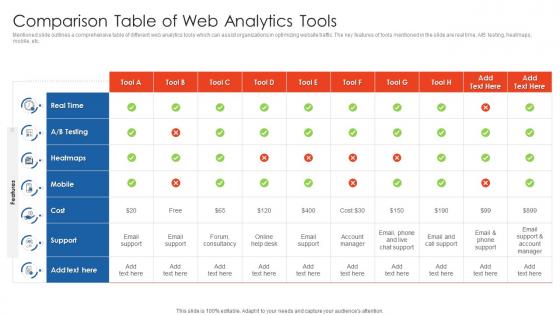
Mentioned slide outlines a comprehensive table of different web analytics tools which can assist organizations in optimizing website traffic. The key features of tools mentioned in the slide are real time, AB testing, heatmaps, mobile, etc.
People who downloaded this PowerPoint presentation also viewed the following :
Comparison Table Of Web Analytics Tools with all 6 slides:
Use our Comparison Table Of Web Analytics Tools to effectively help you save your valuable time. They are readymade to fit into any presentation structure.





FAQs for Comparison Table Of
Key features to look for in web analytics tools include real-time data tracking, comprehensive traffic analysis, conversion funnel monitoring, audience segmentation capabilities, and mobile analytics integration. These technologies streamline decision-making by providing actionable insights, identifying optimization opportunities, and tracking user behavior patterns, with many organizations finding that robust analytics ultimately deliver enhanced customer experiences and significantly improved ROI across digital channels.
Web analytics tools improve website performance by tracking user behavior, identifying high-traffic pages, monitoring bounce rates, and analyzing conversion paths. These insights enable organizations to optimize content placement, streamline navigation, and enhance user experiences, with many e-commerce and service businesses finding that data-driven improvements significantly increase engagement and reduce customer acquisition costs.
Real-time data shows current website activity as it happens, while historical data provides trends and patterns from past periods for analysis. Real-time insights enable immediate responses to traffic spikes or campaign launches, whereas historical data helps organizations identify seasonal trends, measure long-term performance, and make strategic decisions for future optimization.
Businesses leverage web analytics by tracking user behavior patterns, conversion funnels, content engagement metrics, traffic sources, and demographic data to understand customer preferences and pain points. Through advanced segmentation and heat mapping technologies, retailers optimize product placements, financial services personalize offerings, and healthcare providers enhance patient portals, ultimately delivering targeted experiences that increase conversion rates and customer satisfaction.
A/B testing enables web analytics tools to measure performance differences between webpage variations, content formats, user interface elements, and conversion pathways through controlled experimentation. These tests streamline optimization decisions by delivering statistical significance data, user behavior insights, and conversion rate improvements, with many e-commerce and SaaS companies finding that systematic testing enhances customer experiences while maximizing revenue outcomes.
Ensuring data privacy compliance involves implementing cookie consent mechanisms, anonymizing IP addresses, configuring data retention policies, and conducting regular privacy audits across your analytics platforms. Organizations increasingly adopt privacy-first analytics solutions, with many companies finding that transparent data practices, GDPR-compliant tracking configurations, and user consent management systems ultimately deliver enhanced customer trust while maintaining valuable insights for strategic decision-making.
The most popular web analytics tools include Google Analytics, Adobe Analytics, Mixpanel, Hotjar, and SEMrush, each offering distinct capabilities for tracking user behavior and website performance. These platforms enhance digital marketing strategies by providing real-time insights, conversion tracking, and audience segmentation, with many organizations finding that strategic analytics implementation ultimately delivers improved ROI and competitive advantage.
Web analytics tools track user behavior through JavaScript tracking codes, cookies, server log analysis, heatmap technology, and session recording software. These technologies capture page views, click patterns, scroll depth, and user journeys across websites, enabling businesses in e-commerce, media, and financial services to optimize user experiences, reduce bounce rates, and ultimately increase conversion rates.
Businesses should prioritize conversion rates, bounce rates, session duration, traffic sources, and page load speeds when analyzing website traffic. These metrics enable organizations to optimize user experiences, identify high-performing channels, and streamline customer journeys, with many companies finding that focusing on these core indicators ultimately delivers improved ROI and competitive advantage.
Web analytics tools assist in tracking digital marketing campaign effectiveness by monitoring key performance indicators, measuring conversion rates, analyzing traffic sources, and providing detailed attribution reporting across multiple touchpoints. Through platforms like Google Analytics and Adobe Analytics, marketers can optimize campaign performance, allocate budgets more strategically, and demonstrate clear ROI, ultimately delivering improved targeting precision and enhanced customer acquisition costs.
Common web analytics implementation challenges include data accuracy issues, privacy compliance requirements, tool integration complexities, staff training needs, and defining relevant KPIs. Organizations often struggle with cookie consent management, cross-platform tracking inconsistencies, and translating metrics into actionable insights, with many finding that establishing clear measurement frameworks and dedicated analytics expertise ultimately delivers more strategic decision-making capabilities.
Mobile web analytics differ from traditional web analytics by tracking touch interactions, device orientations, app usage patterns, location data, and mobile-specific conversion funnels. These specialized metrics enable businesses to optimize mobile experiences, enhance cross-device customer journeys, and improve mobile commerce performance, with many retailers finding that mobile analytics ultimately deliver higher engagement rates and streamlined purchasing processes.
Small businesses can effectively utilize free web analytics tools by focusing on key metrics like traffic sources, user behavior, conversion rates, and bounce rates to understand customer journeys and optimize marketing spend. Through tools like Google Analytics, small retailers, service providers, and local businesses can identify high-performing content, track campaign effectiveness, and make data-driven decisions that enhance customer experiences while maximizing limited resources and competitive positioning.
Web analytics tools significantly enhance SEO strategies by providing detailed insights into user behavior, keyword performance, traffic sources, and conversion patterns. Through comprehensive data analysis, businesses can identify high-performing content, optimize underperforming pages, and refine targeting approaches, with many organizations finding that data-driven SEO decisions deliver measurably better search rankings and organic traffic growth.
Visualizations in web analytics tools enhance data interpretation by transforming complex datasets into intuitive charts, graphs, and dashboards that reveal patterns, trends, and anomalies at a glance. These visual representations enable marketing teams and business analysts to quickly identify conversion bottlenecks, user behavior shifts, and performance opportunities, ultimately streamlining decision-making processes and delivering faster strategic insights.
-
Crisp and neat slides. Makes it fun and easier to curate presentations.
-
Their templates are super easy to edit and use even for the one like me who is not familiar with PowerPoint. Great customer support.