

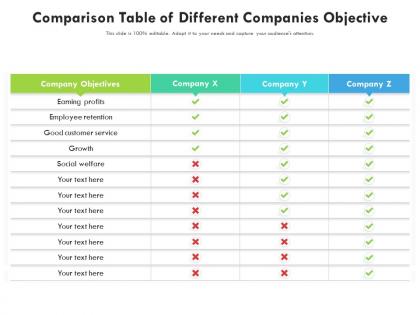
Comparison table of different companies objective




Try Before you Buy Download Free Sample Product
 Impress Your
 Audience
 100%
100% Editable
 Save Hours
 of Time


Our Comparison Table Of Different Companies Objective are topically designed to provide an attractive backdrop to any subject. Use them to look like a presentation pro.
People who downloaded this PowerPoint presentation also viewed the following :
Comparison table of different companies objective with all 2 slides:
Use our Comparison Table Of Different Companies Objective to effectively help you save your valuable time. They are readymade to fit into any presentation structure.
FAQs for Comparison table of
So basically, short-term stuff is what you're trying to knock out in the next few months to a year - think specific things like boosting sales 15% or getting that new product out the door. Long-term is your 3-5 year game plan, more big picture strategy stuff. Here's the thing though - I've watched too many teams get obsessed with hitting their quarterly numbers while completely ignoring where they actually want to end up. Your short-term goals need to feed into the bigger vision, otherwise you're just running in circles and burning out your team for nothing.
Look, your corporate strategy is the big picture stuff - like "we want to dominate this market." Company objectives are how you actually get there. They're the specific, measurable steps that break down that huge goal into things your teams can work on day-to-day. So if strategy is "bake a cake," objectives are your actual recipe steps. Each department should be able to look at these objectives and go "oh okay, here's exactly how my work fits into this whole thing." Honestly, most companies are terrible at connecting these dots. Take a hard look - do your current objectives actually support what you're trying to achieve strategically?
Dude, you gotta get specific about what winning actually looks like. Like instead of "improve sales," say "boost conversion by 3%." Your team can actually track that stuff and pivot when things aren't working. I've seen too many projects die because nobody knew if they were succeeding or failing. Short sentences keep everyone focused. Check your numbers weekly - it's crazy how fast you'll spot patterns. People make way better decisions when they're looking at real data instead of just winging it. The accountability alone will change how your team operates.
Honestly, stakeholder feedback is like your GPS for setting goals that actually make sense. Get input from customers, employees, investors - whoever matters to your business - before you start planning anything. I've watched companies crash and burn because they set objectives based on what *they* thought was important instead of asking the people who actually use their stuff. Set up regular check-ins, surveys, focus groups - whatever works. You don't want to be that company that spends months working toward something nobody cares about. Course-correct constantly based on what stakeholders tell you, not your internal gut feelings.
Honestly, I'd say every quarter minimum - that's what works for most places. If your business is pretty stable though, twice a year is totally fine. But here's the thing: sometimes stuff happens that forces your hand earlier. Like if your whole industry gets turned upside down or you get new leadership. The trick is staying flexible without driving everyone crazy with constant changes. I always tell people to put it on their calendar as a regular thing, but don't be afraid to move it up if the world decides to get weird on you.
Honestly, it really depends on what you're trying to achieve, but I'd go with a mix of leading and lagging indicators. Leading ones show if you're on the right track - stuff like weekly sales calls or how engaged customers are. Lagging metrics are your actual results like revenue and retention rates. Here's the thing though - don't go crazy with too many metrics or you'll lose focus completely. Pick maybe 2-3 key ones per goal that actually move the needle for your business. They need to be measurable with clear targets, and someone has to own tracking them. Start by figuring out what success looks like, then work backwards to find the best metrics.
Start from the top and work your way down - each level needs to translate those big goals into stuff that actually makes sense for their teams. All-hands meetings are fine, but the real conversations happen in smaller groups where people feel comfortable asking "okay but what does this mean for MY job?" Don't just blast emails everywhere either. Mix it up with dashboards, quick check-ins, maybe even those random hallway chats (or Slack conversations if you're remote). Honestly, repetition is your friend here. People need to hear it multiple times before it clicks, and it has to feel relevant to what they do every day, not some corporate nonsense from the C-suite.
Yeah, competing objectives are brutal for team morale. You'll have sales chasing quick deals while product obsesses over quality - suddenly nobody knows what actually matters. Resources get wasted, people feel confused about priorities. Honestly, it's exhausting when every decision feels like you're disappointing someone. Decision-making becomes this weird balancing act where you're constantly second-guessing yourself. Leadership needs to pick a lane first, then actually communicate what success looks like. Otherwise you're just spinning your wheels while departments fight over completely different goals.
Dude, cultural stuff totally changes how you set goals in global companies. Like, what Americans think is "ambitious" might actually piss off your European team who values work-life balance. Some cultures want everyone involved in goal-setting, others expect the boss to just decide. Time frames are weird too - we're obsessed with quarterly numbers while Asian companies think in decades. Oh, and communication styles? Some teams need super specific metrics, others work better with big-picture vision stuff. Honestly, just get your local managers involved instead of copy-pasting goals from HQ. They'll save you from looking like an idiot.
Try the MoSCoW method first - Must have, Should have, Could have, Won't have. Seriously cuts through all the BS. Then do those impact vs effort grids to find your easy wins. Don't let planning meetings drag on forever or you'll overthink everything. Get people from other departments involved too - they'll catch stuff you totally missed. Oh, and this is probably the hardest part: you have to be brutal about saying no to decent ideas that just aren't the right move right now. That's where most people mess up honestly.
Honestly, ditch the spreadsheets - they're such a pain to keep updated. Modern tracking tools are game-changers because everything updates automatically. Set up dashboards that show real-time progress, and you'll actually see what's working vs what's just busy work. The alerts are clutch too - they ping you when numbers hit your targets. I'd probably start small though. Pick one main goal and automate just that first. OKR platforms and project management tools pull data from everywhere, so you're not constantly bugging people for updates. Way less headache than the old manual stuff we used to do.
Honestly, your team's motivation is gonna tank if they don't get the "why" behind what they're doing. Clear objectives show people how their work actually matters - that's what gets them engaged. But here's the thing: vague goals or ones that keep changing? Total motivation killer. I've seen it happen so many times. You need objectives that connect to stuff people actually care about - career growth, helping customers, whatever. Short sentences work too. Just make sure your team gets it and believes in what you've set up, because if they don't buy in, you're basically screwed.
First thing - check if your goals actually follow the rules in your field. Employment law, data protection, environmental stuff, all that boring but necessary compliance. Beyond profits, think about who else gets affected. Setting targets that screw over employees or customers might work short-term but it's honestly pretty shortsighted. Don't create objectives that push people toward shady behavior just to hit numbers. I'd run big goals past your legal team first. Getting input from other departments helps too - they'll catch problems you might miss.
Honestly, cross-functional teams are a game changer for catching blind spots early. You get marketing, engineering, finance, and ops all poking holes in your plans before they blow up later. Way harder for executives to brush off feedback when it's coming from like four different departments instead of just yours. These mixed teams also help create goals that actually make sense across the company - not just boardroom fantasy land stuff that sounds good on paper. Oh, and they're surprisingly good at building buy-in since everyone had a voice. Try grabbing 4-5 people from different areas for your next planning thing.
You know what works? Mix it up. Big goals get everyone fired up and can lead to those crazy breakthrough moments. But if they're too out there, people just give up before they start. Realistic ones build confidence - though honestly, "realistic" sometimes just means we're scared to fail. I'd try something like 70% doable targets, 20% stretch goals, and throw in 10% total moonshots. That way you're not playing it safe but you're also not setting everyone up to feel like failures. The momentum from hitting those smaller wins actually helps fuel the bigger swings.
-
Unique and attractive product design.
-
Design layout is very impressive.
-
Great product with effective design. Helped a lot in our corporate presentations. Easy to edit and stunning visuals.
-
Attractive design and informative presentation.