

Comparison Between Security Incident And Security Event




Try Before you Buy Download Free Sample Product
 Impress Your
Audience
 100%
Editable
 Save Hours
of Time


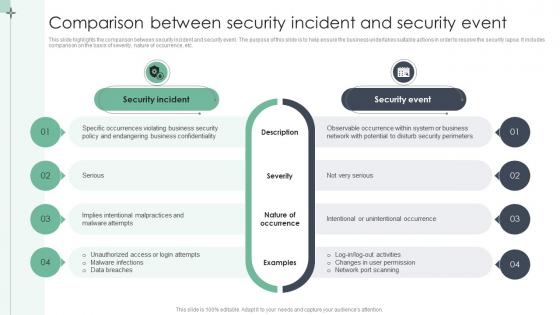
This slide highlights the comparison between security incident and security event. The purpose of this slide is to help ensure the business undertakes suitable actions in order to resolve the security lapse. It includes comparison on the basis of severity, nature of occurrence, etc.
People who downloaded this PowerPoint presentation also viewed the following :
Comparison Between Security Incident And Security Event with all 9 slides:
Use our Comparison Between Security Incident And Security Event to effectively help you save your valuable time. They are readymade to fit into any presentation structure.









FAQs for Comparison Between Security Incident
You'll want five main things in your security framework: threat modeling (figure out what you're up against first), vulnerability assessments to spot weak points, risk analysis for prioritizing, incident response planning, and continuous monitoring. Compliance mapping too if you're in a regulated space - trust me on that one, I've seen teams get burned. Honestly, the biggest mistake is letting these pieces work separately instead of connecting them. Threat modeling should be your starting point since everything else builds from there. Makes the whole process way more logical.
So basically threat modeling is like putting yourself in a hacker's shoes before they actually try to break in. You map out your system's weak spots and figure out how someone would realistically attack it. Way better than just crossing your fingers and hoping your security stuff works. I mean, you'd be surprised how many obvious vulnerabilities you'll spot once you start thinking this way. Focus on the biggest risks first instead of random security measures. Start by looking at your attack surface - basically everywhere bad actors could potentially get in - then work backwards from there.
So you're basically trying to think like a hacker but for defense. Start with automated tools - they'll catch obvious stuff like SQL injection pretty fast. Static analysis looks at your actual code, while dynamic testing hits the runtime vulnerabilities. I'd run the automated scans first, then manually dig into whatever gets flagged. Pen testing is where you actually try to break things in a safe environment. Tools are great but they miss context that you'd spot yourself. Oh, and don't just trust one method - combining different approaches gives you way better coverage than relying on just automated scanning.
So incident response is basically your reality check for security stuff. Each time something goes wrong, you're getting real data about what attackers actually do and where your defenses failed. Honestly, it's way more valuable than any theoretical analysis. You learn about attack patterns, detection blind spots, all that good stuff. Think of it like debugging code - except someone's actively trying to break your system while you figure it out. Document everything though, because those lessons are gold for improving your monitoring. Every incident shows you something new about your vulnerabilities, so don't waste that intel.
Honestly, machine learning is a game changer for security stuff. It'll chew through way more data than you could ever manually review - we're talking network traffic, malicious code patterns, the whole nine yards. What's really nice is how it learns your environment over time and gets better at catching weird behavior. Like if someone's suddenly accessing files they never touch, or system activity looks off. I'd probably start with some ML-powered SIEM tools first - they're not too hard to set up and you'll see results pretty quick. The anomaly detection alone will save you tons of headaches.
So there's a few different approaches you can take. Vulnerability assessments are basically scanning for known security holes in your systems. Penetration testing goes further - it's like hiring ethical hackers to actually try breaking in and see what damage they could do. Pretty cool stuff honestly. Threat modeling is more about mapping out potential attack scenarios before they happen. You've also got code reviews for app security and risk assessments that look at business impact. If you're just starting out, I'd probably go with vulnerability scanning first. It's straightforward and you'll spot the obvious problems quickly.
Look, compliance frameworks like SOC 2 or GDPR basically make you document everything you're already doing security-wise. Super annoying but weirdly helpful. You gotta maintain audit trails, do regular assessments, prove you're not just winging it. I actually think the worst part is mapping your current stuff to whatever framework applies - then you realize all the gaps where you need better processes. But honestly? It does force you to be more systematic about security instead of just hoping for the best. The paperwork sucks though.
Start with threat modeling when you're designing stuff - way easier to catch problems early than fix them later. Static code analysis should run every time devs commit code. During testing, throw in some dynamic analysis and pen testing. Security code reviews are clutch alongside your regular ones. CI/CD pipelines need automated security scanning built right in. Once you deploy, monitor for vulns and incidents constantly. Making security everyone's job instead of just dumping it on the security team is honestly a game changer. Don't go crazy though - pick one or two tools first and expand from there.
Honestly, start with defining your scope or you'll go crazy trying to test everything. Nessus or OpenVAS are great for vulnerability scanning. Web apps? Burp Suite or OWASP ZAP are solid choices. Nmap's perfect for network discovery stuff. The thing is, no single tool does it all - that's where most people mess up. You'll need 2-3 tools that work well together instead of some massive toolkit. Oh, and if you're doing code reviews, SonarQube's pretty decent for static analysis. STRIDE's worth looking into for threat modeling too, though that's more of a framework thing.
Honestly, start simple with just 2-3 metrics or you'll go crazy trying to track everything. MTTD and MTTR are your bread and butter - how fast you spot threats and respond to them. False positive rates matter too because nobody wants to chase ghosts all day. The real tell though? Compare what vulnerabilities you're catching versus what slips through. That gap is brutal but it's the truth. Don't forget about your team either - burnt out analysts miss obvious stuff. Oh, and track whether issues actually get fixed after you find them. Best detection in the world doesn't mean squat if nothing changes. Build from there once you've got the basics down.
Start with clear severity levels and step-by-step repro instructions - vague stuff like "this might be problematic" won't cut it. Screenshots help tons because people hate reading walls of text to figure out what's broken. Focus on business impact, not just the tech side. Like, "attackers can steal customer data" hits harder than "SQL injection vulnerability exists." Give specific fixes too - saying "add better validation" is pretty useless. Oh, and use some kind of tracking system so you can spot trends later. The whole point is making it dead simple for developers to actually fix things instead of scratching their heads.
So risk assessment is like figuring out "what could go wrong" - you're looking at threats, vulnerabilities, and doing probability math on different scenarios. Security analysis is more hands-on and technical. You actually dig into your systems and controls to see how they'd handle those risks. I usually think of risk assessment as the big picture view (honestly involves way too many spreadsheets), while security analysis gets into the nitty-gritty details. Most people do risk assessment first to prioritize what's urgent, then security analysis shows you exactly how to tackle it. Makes the whole process less overwhelming.
So zero-trust is basically everywhere now - nobody trusts perimeter defenses anymore. Runtime monitoring is way bigger than it used to be too. CSPM tools finally caught on (took forever honestly). AI threat detection isn't complete garbage like it was a few years ago. Your devs are probably already doing shift-left security in their pipelines. Container security is massive since everyone's containerizing everything. Oh and serverless security - that's blowing up too. I'd honestly just start with a CSPM audit of your configs first, then maybe look at runtime monitoring after that.
So basically, threat intel makes your security analysis way smarter. Pull in current data about what attackers are doing - their tactics, IOCs, campaign stuff. This gives you actual context instead of just staring at random alerts all day. You'll catch relevant threats faster because you know what's actually happening out there. Plus you can prioritize incidents better when they match known bad actor patterns. Honestly, most people overthink this part. Just start by plugging a few solid threat feeds into your SIEM and build detection rules around the indicators that matter for your setup.
Security analysis needs both tech skills and detective work, honestly. Get comfortable with network protocols, operating systems, and SIEM tools first. Python scripting is super useful too. The detective part is actually my favorite - you're constantly connecting dots between threats and figuring out attack patterns. Don't sleep on communication skills though. Half your job is translating scary technical stuff for executives who just want the bottom line. Oh, and grab Security+ certification to start. It's basic but gives you solid foundations before you dive deeper into whatever specialization catches your interest.
-
“Easy to use. I always wanted to have a quick search for products and SlideTeam has helped me have it.”
-
Like always a great experience with you guys. Always there on the drop of hat to help.