

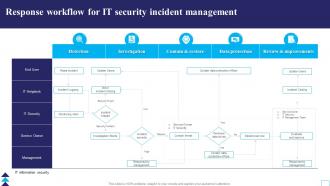
Response Workflow For It Security Incident Management





Try Before you Buy Download Free Sample Product
 Impress Your
 Audience
 100%
100% Editable
 Save Hours
 of Time


Our Response Workflow For It Security Incident Management are topically designed to provide an attractive backdrop to any subject. Use them to look like a presentation pro.
People who downloaded this PowerPoint presentation also viewed the following :
Response Workflow For It Security Incident Management with all 6 slides:
Use our Response Workflow For It Security Incident Management to effectively help you save your valuable time. They are readymade to fit into any presentation structure.





FAQs for Response Workflow For It
So you've got six main pieces to get right: prep work (playbooks, who does what), spotting threats early, containing the mess before it spreads, totally wiping out whatever hit you, getting everything back online, and - here's the big one - actually reviewing what went wrong afterward. Most teams are solid on the tech side but totally blow off that final step, which is honestly where you learn the most. Oh, and test your plan regularly! Map out roles beforehand because trust me, you don't want people arguing about responsibilities when you're already on fire. Clear ownership for each phase makes all the difference.
Run some tabletop exercises first - seriously, you'll be shocked how much your team freezes up compared to what's written down. Double-check that everyone actually knows their role and has current contact info (called a guy last month who'd quit ages ago, super awkward). Test your detection tools with fake incidents to see response times. Your documentation probably needs updating too. Short drills work better than massive quarterly tests, honestly. The whole point is catching problems before they bite you during a real emergency. Schedule these regularly but don't just go through the motions - actually fix what breaks.
Threat intel is a game-changer for incident response - gives your team actual context instead of flying blind. You can spot attack patterns fast, figure out what the bad guys usually do next, and honestly it makes prioritizing incidents way easier. Some alerts can wait, others need immediate attention. The trick is getting those threat feeds baked into your IR workflow ahead of time (trust me on this one). When something actually hits, you're not sitting there trying to piece together who's behind it or what their playbook looks like. Makes the whole process less chaotic.
Honestly, the worst thing is when nobody knows what they're supposed to do. Teams just scramble around like headless chickens. Poor communication kills you every time. And don't even get me started on jumping straight into fixes without actually understanding the problem first - I've seen that backfire so many times. Documentation? Forget about it. Everyone's in crisis mode so no one writes down what they tried or what worked. You really need a playbook that people actually practice, not some PDF buried in Slack somewhere. Otherwise you're just winging it when everything's on fire.
Dude, you gotta have your incident response plan ready way before stuff goes sideways. Make sure everyone knows their role and how to communicate when chaos hits. Honestly? The companies that recover fastest are always the ones doing those boring tabletop exercises - sounds lame but it actually works like muscle memory during real incidents. Keep your critical systems separate if you can, backup everything religiously, and have those rollback procedures written down somewhere accessible. Oh and definitely run practice drills regularly. I know it feels like busy work but trust me, when you're dealing with an actual outage at 2am you'll thank yourself.
Track MTTD and MTTR first - those show how fast you spot problems and respond. Way easier to pull from whatever monitoring you're already using. Also watch mean time to recovery and incident recurrence (because nothing's worse than the same fire happening twice). Customer impact duration matters too, obviously. Don't sleep on measuring whether your team actually completes those post-incident action items - I've seen so many orgs create great plans that just... sit there. Start simple though. You'll get overwhelmed trying to track everything at once.
Honestly, legal stuff runs the whole show when it comes to incident response. GDPR gives you 72 hours to report breaches - no wiggle room there. You can't just panic and delete everything either, because you might need that evidence later for court. HIPAA, PCI-DSS, whatever regulations apply to your industry will dictate who gets notified and when. The documentation requirements are a pain but absolutely critical. Your team has to know what data they're protecting and how to preserve chain of custody properly. I'd say build all these legal requirements into your procedures from day one, not as an afterthought.
Honestly, start with detection stuff - SIEM platforms and network monitoring are your bread and butter for catching weird activity. Then grab some forensic software and log analyzers (warning: forensics tools will absolutely destroy your budget, but whatever). Sandboxing environments are clutch too. Communication-wise, set up dedicated incident channels in Slack or Teams, plus a ticketing system so nothing falls through the cracks. Oh, and make sure your runbooks are actually accessible to everyone - can't tell you how many times I've seen teams scramble because documentation was buried somewhere. Just audit what you've got first, then tackle the biggest holes.
Honestly, you've gotta stop treating incident response like this big scary emergency-only thing. Regular tabletop exercises work great - just make them actually interesting, not those soul-crushing compliance meetings everyone dreads. Getting leadership involved is clutch because when the C-suite cares, everyone else follows. Build it into onboarding and those lunch sessions people actually attend. Oh, and tie it to what people already do daily - if they can't see how it connects to their job, they'll tune out. Short drills beat long theoretical sessions every time. Set up your next exercise this week while it's fresh in your head.
Okay first things first - pull the plug on those affected systems right now. Don't let this thing spread any further. Document what you're seeing before it disappears, then call your incident team immediately. Look, I get wanting to jump in and fix everything, but hold off on that for now. Focus on locking it down and saving evidence instead. Screenshots, logs, timeline - grab it all. Oh and whatever you do, don't let anyone else start "helping" until you've got containment sorted. Your playbook exists for a reason, so stick to it. You've got this.
Hit the revenue-generating stuff first - that's where the real pain lives. Customer-facing services and critical infrastructure come next. Speed matters too though, so factor in how fast things are spreading and what data might get exposed. Honestly feels like playing whack-a-mole sometimes, but having a scoring system saves your sanity. Set up criteria beforehand that weighs business impact against how many users are affected and how hard containment will be. Your team won't waste time arguing about priorities when everything's on fire. It's basically ER triage but for networks.
Honestly, the biggest lesson from major breaches? Companies get destroyed more by their terrible response than the actual hack. Look at how Equifax handled things vs Target - night and day difference. Fast and honest communication wins every time. Don't be those idiots who wait weeks to tell customers or try to sugarcoat everything. Have your crisis plan ready beforehand - like actually tested, not just sitting in some folder. Templates written, spokespeople trained, the whole thing. Trust me, you don't want to be scrambling to figure out media strategy when everything's on fire.
Here's the thing - pick one person to handle comms or it'll turn into chaos real quick. Have them own all the updates: internal team, customers, whoever needs to know. During big incidents, update every 30 minutes. Use the same channels every time - dedicated Slack channel, status page, whatever works for your team. Keep messages simple and timestamp everything. Oh, and this is clutch: assign someone to write down what's happening and decisions being made as you go. Trust me, you'll want that paper trail when you're doing the post-mortem later.
Post-incident reviews are honestly game-changers - they turn those awful outages into actual learning moments. Schedule yours within 48 hours while everyone still remembers the chaos. You're not hunting for someone to blame here, just figuring out what broke and why. I always think of it like watching game footage after a brutal loss (but with way higher stakes lol). Focus on what went wrong AND what went right. Document everything and turn those insights into real action items. Otherwise you'll just repeat the same mess next month.
Definitely do post-incident reviews after big outages - that's honestly where you learn the most. Write down what broke and what actually worked, then update your playbooks. Tabletop exercises are super underrated too, way more helpful than people think. Track your response times and how fast you're fixing stuff to catch patterns. The tricky part is making sure changes actually happen. Assign someone to own each improvement or it'll just sit there forever. Oh and schedule quarterly reviews of your whole process - keeps things from getting stale. Sometimes I forget to do this but it really makes a difference when you stay on top of it.
-
Use of icon with content is very relateable, informative and appealing.
-
The templates are the best in class. Very clear and innovative graphics! I am excited to explore and download more presentations.