


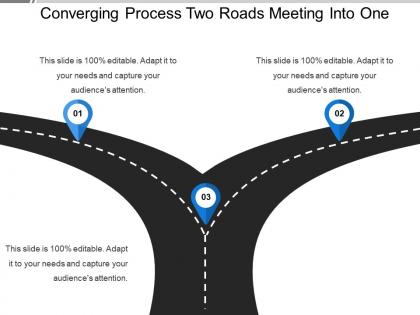
Converging process two roads meeting into one




Try Before you Buy Download Free Sample Product
 Impress Your
 Audience
 100%
100% Editable
 Save Hours
 of Time


Explain your evaluation with our Converging Process Two Roads Meeting Into One. Elaborate on every applicable factor.
People who downloaded this PowerPoint presentation also viewed the following :
Converging process two roads meeting into one with all 5 slides:
Decipher the happenings with our Converging Process Two Roads Meeting Into One. They help decode the event.


FAQs for Converging process two roads
Digital transformation and cloud stuff are the big ones driving this. Everything's getting software-enabled now, which is pretty crazy when you think about it. Industries that never talked to each other before are suddenly overlapping because they're all using similar tech. Mobile connectivity changed the game too - now any random device can be "smart." Your car company? They're basically a tech startup now. Wild, right? Plus customers expect everything to work together seamlessly across all their devices. That's pushing companies to blur those old industry lines even more. I'd definitely watch where your field crosses into others.
So Netflix syncs perfectly across your phone, TV, laptop right? Now people expect that same smoothness from their bank, shopping apps, everything. It's actually crazy how fast we get spoiled by good experiences. Your customers aren't just comparing you to competitors anymore - they're thinking about whatever app worked flawlessly for them yesterday. Banking gets compared to Instagram, healthcare to Spotify. Wild but true. This pushes every industry to connect their systems better and think about the whole customer journey. Quick tip: figure out where your experience feels clunky compared to the smoothest apps your customers use daily.
Honestly, the best way to get ahead is by mixing stuff that doesn't usually go together. Netflix basically took TV shows and threw data science at it - boom, they knew what you wanted before you did. Same with smartphones cramming a camera, computer, and phone into one thing. What you want to do is stop thinking inside your industry's box. Look at what's happening next door to your business - maybe there's tech or ideas you can blend in. The weird combinations are usually where the money is. When you blur those traditional lines, suddenly you're not fighting the same old competition anymore. It's like creating your own category.
Ugh convergence is such a pain for privacy. You've got data bouncing between systems that were never meant to talk to each other, which opens up way more attack points. Honestly, the worst part is losing track of where your data even lives anymore - like when you can't find your charger after staying at three different places. Compliance becomes a nightmare too since each system has its own rules. Before you connect anything new, map out every data flow first. Trust me on that one. Otherwise you'll be scrambling to figure out what's connected to what later.
So convergence is basically tearing down those old academic walls where everyone stayed in their corner. Like, biologists would do biology stuff, engineers would engineer, you know? Now they're forcing everyone to collaborate on the big messy problems - climate change, personalized medicine, whatever. Sure, it's chaotic at first. Picture a physicist trying to talk to a sociologist - total disaster initially! But honestly? That's where the cool hybrid disciplines come from. New research methods that wouldn't exist otherwise. For your grant stuff, hunt for problems that actually need multiple brains from different fields.
Dude, convergence is making marketers completely rethink everything. You can't just throw separate campaigns at different channels anymore - customers are bouncing between social, email, your website, apps, even stores. So your marketing has to feel like one smooth experience everywhere they go. Honestly? It's overwhelming but also kind of cool because you get way better data on what people actually do. I'd start by mapping out your customer journey first, then figure out which moments really matter and build everything around those. Makes way more sense than just winging it across random platforms.
Look, first thing - map out what systems you've got and where they're stepping on each other's toes. That's your starting point. Don't try to fix everything at once though, most companies do that and it's a disaster. Pick the stuff that'll actually impact your business, not whatever's hot right now. Your data setup needs to be rock solid before anything else works. Get different teams actually talking (shocking concept, I know). Oh, and don't skip the people side - they need to get why you're doing this whole thing. Start with small pilot projects to show it's worth the headache.
Disney's the obvious one - they totally nailed it by connecting their parks with apps, streaming, the whole thing. Tesla's another good example, mixing cars with software and energy tech. Netflix went from mailing DVDs to streaming to making their own shows, which is honestly wild when you think about it. The key thing? These companies didn't just slap digital stuff onto their old business. They completely rethought everything around convergence. Start by breaking down those internal walls between departments first. Then worry about the tech side.
Ugh, convergence totally screws with hiring. You can't just look for specialists anymore - now you need unicorns who know AI AND healthcare, or whatever weird combo your role needs. Traditional job postings become these frankenstein descriptions that make no sense. Honestly, most companies aren't ready for this shift. Your current team probably needs serious reskilling too since these merged fields create huge knowledge gaps. I'd start cozying up to universities with interdisciplinary programs. Also maybe think about cross-training people internally before you're scrambling to fill positions you can't even describe properly.
So AI's gonna start personalizing everything - your news, shows, whatever - based on how you actually use stuff. VR and AR are finally getting good enough to matter, like watching news while you're virtually there (pretty wild tbh). 5G makes all that real-time interactive content actually work smoothly. Everyone's becoming a content creator now anyway, so the whole consumer/producer thing is getting messy. Oh, and cross-platform storytelling is where things are going - definitely worth playing around with that stuff now if you're thinking about getting into media.
Convergence totally blows up traditional industry boundaries. Netflix is the perfect example - they went from mailing DVDs to suddenly competing with cable companies AND movie studios. Crazy, right? Your innovation strategy can't just focus on your own sector anymore. You're dealing with tech, customer expectations, and business models from completely different industries all smashing together. Honestly, it's kind of overwhelming but also exciting. The smart move? Figure out which random industries might bulldoze into yours next. Don't wait until it's already happening - you'll be scrambling to catch up while everyone else is already there.
Dude, the big three are consent, bias, and transparency. People don't always know they're chatting with AI - which is sketchy. Bias is huge too - these systems can screw people over in hiring or healthcare by copying our worst prejudices. The "black box" thing drives me nuts honestly - even creators can't explain their AI's decisions sometimes. Wild how fast this is all happening, right? Anyway, always tell people when AI's involved and keep checking your systems aren't being unfair to certain groups.
Honestly, the biggest thing is just getting people to actually talk to each other instead of staying in their little department bubbles. Mix up your project teams so different areas have to work together. Create spaces where people naturally run into each other - coffee stations work better than you'd think. Here's what really matters though: change how you reward people. Stop celebrating the lone wolf types and start recognizing teams that share knowledge and collaborate well. I'd try a few small pilot projects first where success literally depends on multiple departments working together. Once you see what clicks, then expand from there. The territorial stuff dies pretty quickly when collaboration becomes the path to recognition.
Ugh, the biggest pain is dealing with all these different regulatory systems that were never meant to mesh together. FCC stuff crashes into state broadcasting rules and privacy laws - it's chaos trying to figure out what applies where. Enforcement standards are all over the place too. Honestly, the compliance requirements shift constantly as regulators scramble to keep up with tech changes. I'd map out every regulatory angle upfront and maybe bring in specialists for each area instead of drowning your internal team. Trust me, this isn't something you want to wing.
So basically you get everything from one company - internet, TV, phone, streaming, the whole deal. No more dealing with three different customer service nightmares (ugh). Your phone and TV actually talk to each other, so you can start a show downstairs and finish it upstairs without any weird glitches. Content suggestions get way better since they see all your viewing stuff. Honestly the best part is just having one bill instead of like four random ones showing up. Just make sure they actually integrate everything properly - some companies just slap services together and call it "bundled."
-
Great quality product.
-
Graphics are very appealing to eyes.