

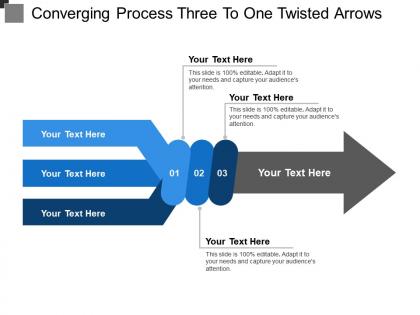
Converging process three to one twisted arrows




Try Before you Buy Download Free Sample Product
 Impress Your
Audience
 100%
Editable
 Save Hours
of Time


Avoid having to pull your hair with our Converging Process Three To One Twisted Arrows. Depend on them for fast action.
People who downloaded this PowerPoint presentation also viewed the following :
Converging process three to one twisted arrows with all 5 slides:
Bring about happy endings with our Converging Process Three To One Twisted Arrows. Generate action to fulfill demands.


FAQs for Converging process three to
Honestly, it comes down to three big things. Money's tight, so companies can't keep running separate systems anymore - way too expensive. Customers are also fed up with juggling different platforms that don't talk to each other. Cloud tech and AI have gotten good enough that everything can actually work together now (not just fancy marketing BS like before). I see it everywhere - my smart home stuff finally plays nice together, and even boring enterprise software is getting better at this. Quick tip though: when you're buying new tech, go for stuff that meshes with what you already have. Trust me on this one.
Dude, convergence totally changes what people expect from you. Like Netflix - you start watching on your phone, finish on TV, zero hiccups. That's the bar now. Everyone assumes their stuff should just work together seamlessly. Your customers don't care about your internal systems or whatever - they want smooth transitions between every touchpoint. So you gotta look at where you're making things clunky instead of smooth. It's crazy how fast these expectations become the norm, but here we are.
Look at smartphones - they basically swallowed up cameras, iPods, computers, everything. That's convergence in action. Find where different functions naturally overlap in your space and build something that hits multiple needs at once. Like if you're doing fitness stuff, why not bundle wearables with meal planning and maybe some coaching? I mean, people are already juggling all these separate apps anyway. The trick is spotting those connection points between things that used to be totally separate. Then package it so customers don't have to piece together five different solutions themselves.
Okay so data integration is literally what makes cross-sector stuff actually work instead of just being a cool concept. Like, ride-sharing apps had to combine transportation + payments + mapping data - none of that works alone, right? When healthcare can talk to fintech systems, or retail meshes with logistics, that's where you get those weird hybrid solutions that actually solve problems. The real breakthrough happens when your siloed data starts revealing patterns you never saw before. Honestly, I'd start by figuring out what data from completely different industries might help your current setup. Sometimes the most random connections work best.
Dude, social media completely flipped how marketing works. Instead of just throwing ads at people, your posts actually start real conversations now. Like, you'll post about a product and suddenly customers are asking questions, leaving reviews, or needing help right in the comments. It's kinda crazy honestly – one Instagram story can turn into a customer service situation super fast. Your marketing and support teams basically have to be joined at the hip these days because everything bleeds together. Customers expect to get help wherever they find you online, which makes sense but also... exhausting?
Honestly, the scariest part is watching your competition completely change overnight. Companies from totally random industries suddenly want your customers - like how Netflix came for Blockbuster's throat when nobody saw it coming. Your old competitive playbook? Useless. Now you're dealing with businesses that have different costs, relationships, everything. Plus customers get lost trying to figure out who does what anymore. You'll face tough calls about building new stuff in-house or just buying it. My take? Don't go crazy right away. Run some small tests first, see what actually works before betting the farm.
Oh man, convergence is such a headache for compliance teams. Companies end up stuck between regulatory frameworks that were never meant to work together. Take telecom giants jumping into financial services - suddenly they're juggling FCC rules AND banking regulations. It's honestly a mess. You get overlapping requirements, conflicting standards, plus those lovely gray areas where nobody knows what applies yet. The smart move? Get your legal team chatting with regulators early so you can help write the playbook instead of scrambling to follow it later.
Netflix nailed this - DVD rentals, then streaming, now they're making their own shows. Total domination. Disney's smart too, spreading their characters everywhere: movies, parks, toys, Disney+. Amazon bundled Prime Video with free shipping which honestly was brilliant. Even Fortnite hosts concerts now (weird but it works). The trick isn't just piling on random services though. Each piece has to make the others stronger somehow. Think about where your audience already spends time and figure out how to show up there naturally.
So convergence is basically grabbing tech from completely different industries to fix healthcare problems. Gaming AI for diagnostics. Car sensors for patient monitoring. Even blockchain from finance - though honestly, that one feels a bit overhyped sometimes. The cool part? You're not stuck with just medical solutions anymore. Your toolbox gets way bigger. Start looking at what other industries already figured out, then see if you can adapt it. Sometimes the best healthcare innovation comes from totally unrelated fields. It's all about connecting weird dots that nobody else thought to connect.
So convergence just means you gotta be more of a generalist while still being really good at your main thing. Job boundaries are getting super blurry now - tech's mixing with everything, industries are merging. It's actually pretty cool if you roll with it instead of fighting it. Think "T-shaped" skills: go deep in your specialty but understand the stuff around it too. I'd start by figuring out what trends are hitting your field hardest. Then grab some complementary skills through online courses or maybe volunteer for those cross-department projects at work (even if they're annoying sometimes). Your career becomes less about one path and more about connecting random dots.
So convergence is basically when all your devices - phone, laptop, VR stuff, even your actual classroom - start working together instead of being separate things. AI tutors will actually know how you learn best, and AR can make textbooks way more interactive. Pretty cool, right? Everything adapts to your pace and performance in real-time. The whole one-size-fits-all education thing is finally dying, which honestly is about time. Your learning path gets customized based on your strengths and schedule. I'd keep an eye on edtech companies doing multiple technologies at once rather than just focusing on one gimmick.
Honestly, you've gotta get comfortable with flexibility and team up with companies outside your usual space. Quick story - I watched so many businesses crash because they kept waiting for things to "make sense" instead of just adapting. Build teams that can pivot fast when industry lines get blurry. Your customers don't care about traditional boundaries anymore, so figure out what they actually need across all their different interactions with you. Oh, and invest in platforms that do multiple things rather than just one. Most crucial thing? Make sure your people feel safe testing out weird ideas from totally unrelated industries. That's where the magic happens.
Dude, convergence is making companies fight way outside their usual turf. Netflix competes with telecom now. Amazon's basically UPS at this point. Your real competition isn't who you think it is anymore - some random tech company could swoop in and steal your customers next year. Companies are scrambling to build skills they never needed before just to survive. Honestly, it's kind of chaos but also fascinating? Bottom line: figure out who's really going after your customers' money today, not just the obvious competitors from back in the day.
So basically convergence mixes different technologies together to make sustainability way more effective. Like when IoT sensors work with AI to cut energy waste in buildings, or blockchain tracks supply chains so you know stuff's ethically sourced. Data from multiple sources is where the magic happens - you'll spot waste patterns that would be impossible to catch otherwise. Smart buildings are probably my favorite example tbh. Look for ways your current systems can talk to each other or connect with green tech. It's like getting a sustainability boost without starting from scratch.
AI's like this crazy universal translator between industries. Machine learning stuff that started in tech now runs hospital diagnostics and factory quality checks - it's honestly pretty nuts how flexible these tools are. You've got banks using gaming AI, stores copying logistics tricks, hospitals borrowing from entertainment design. Short sentences work too. The cool part is AI creates these plug-and-play building blocks that any sector can just drop into their workflow. Makes it way easier for different industries to actually steal each other's best ideas instead of staying stuck in their own bubbles.
-
Unique research projects to present in meeting.
-
Top Quality presentations that are easily editable.