

Cross Functional Flowchart For Providing Customer Solution




Try Before you Buy Download Free Sample Product
 Impress Your
 Audience
 100%
100% Editable
 Save Hours
 of Time


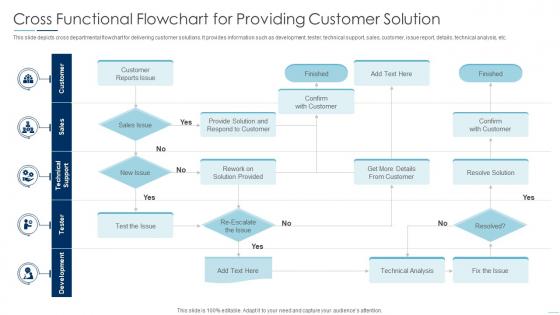
This slide depicts cross departmental flowchart for delivering customer solutions. It provides information such as development,tester,technical support,sales,customer,issue report,details,technical analysis,etc.
People who downloaded this PowerPoint presentation also viewed the following :
Cross Functional Flowchart For Providing Customer Solution with all 6 slides:
Use our Cross Functional Flowchart For Providing Customer Solution to effectively help you save your valuable time. They are readymade to fit into any presentation structure.





FAQs for Cross Functional Flowchart For
Oh hey! So there's basically five steps to this whole customer solutions thing. First you dig into what they actually need - like really figure out their pain points, not just what they say they want. Then analyze what's breaking. Design comes next, and honestly this part can make or break everything if you're not careful. After that you implement it together (don't just throw it at them and run lol). Finally, check back to see if it's actually working. But seriously, spend way more time on that first discovery phase than you think you need. I learned that the hard way - it saves you so much headache later when everything else just clicks into place.
Start with questions that actually dig deep - "what's broken right now?" and "what does winning look like to you?" work every time. Don't pitch anything yet, just listen. Like, really listen and take notes because you'll forget half of it otherwise. I always repeat back what I heard to make sure I didn't miss something obvious. The whole point is letting them spill their real problems, not the polite version they give everyone. Once you nail that down, then you can figure out if you can actually help them or not.
Honestly, customer feedback is like having a cheat sheet for what's actually broken. Users will tell you the real problems - not the ones you're imagining in your head. I've seen tiny complaints turn into game-changing fixes. Set up easy ways for people to complain: quick surveys, random check-ins, whatever works. Don't make them jump through hoops to give feedback. The trick is actually doing something with it fast, not letting it sit in some spreadsheet forever. Oh, and skip the formal review nonsense - just ask them straight up when something isn't working.
Response time and resolution time are your basic efficiency metrics - track those first. Customer satisfaction scores matter way more than most people realize though. I'd also watch first-call resolution rates and how often cases get escalated. Honestly, repeat issues drive me crazy because they show you're not really fixing the root problem. Agent utilization is useful too, plus cost per case if your boss cares about budget stuff. Start with maybe 3-4 metrics that actually align with what your company wants. You can always add more later once you've got the important ones figured out.
Honestly, tech can be a game-changer for customer support if you don't go overboard. Start with a decent CRM to track everything - way better than sticky notes everywhere. Chatbots handle the basic stuff, but people still want to talk to humans when things get messy. Analytics tools are clutch for spotting which problems keep popping up. AI routing gets tickets to the right person faster, and self-service portals work great for simple fixes. My advice? Pick maybe two tools that fix your worst headaches first. Don't try to revolutionize everything overnight - that's how you end up with expensive software nobody uses.
Honestly, the main mess I see is everyone thinks "customer solutions" means something totally different. Sales has their version, support's doing another thing, and don't even get me started on what product thinks it means. Then you've got this weird gap where companies have decent ideas but can't actually roll them out consistently - like, at all. Oh, and trying to personalize stuff when you're dealing with thousands of customers? That gets expensive fast. I'd probably just pick one thing to focus on first, nail that down, then worry about expanding later.
Start with weekly standups across sales, product, support, and implementation - gets everyone on the same page about customer wins and blockers. Slack channels for big customers work great (just don't let them turn into chaos). Oh, and definitely share the good stuff too, not just when things go wrong. Honestly, the magic happens when people actually see how their work impacts the customer journey. Makes them want to jump in rather than you having to drag them into meetings. Short answer: make it feel collaborative, not like another obligation on their plate.
Break down your customers by size, industry, and what's bugging them most. Then tailor everything. Big enterprise clients? They want ROI numbers and proof it'll integrate smoothly. SMBs just want something that works easily and shows results fast. Different industries need totally different messaging too - healthcare has zero overlap with retail concerns. Honestly, creating separate pitch decks for each segment sounds like extra work but it's worth it. I'd probably start with your top 3-4 customer types and build specific value props from there. Way more effective than the spray-and-pray approach.
Dude, post-implementation support is everything. Seriously - you can nail the perfect solution, but if you ghost them after launch? They'll hate you the second something breaks. And something always breaks, trust me on that one. This is honestly where you prove you're not just another vendor trying to hit quota. Good support gets people actually using your stuff, keeps them from bailing, and turns them into those customers who'll basically sell for you. Oh, and build those support check-ins right into your project plan from the start - don't wing it.
Impact vs effort mapping works really well - just plot each customer need by value versus difficulty. MoSCoW is another good one (Must have, Should have, etc.) and honestly saves so much arguing when everyone thinks their thing is "critical." I'd also look at actual customer feedback scores and usage data instead of just guessing what matters. The Kano model helps too, though it's a bit more complex. Whatever method you pick, make sure your whole team uses it consistently. Otherwise you'll be back to random prioritization pretty quickly.
Honestly, the best way is to treat it like telling a story to a friend. Start with the customer's problem - that's your drama right there. Then walk through how you solved it, and finish with the win. Real examples work way better than hypotheticals, btw. Get specific with details that'll actually stick in their heads. Oh, and focus on how it affected real people, not just the boring technical stuff. People need to *feel* the problem first - then they'll actually care about your solution. It's like... show the pain, then be the hero.
Look, when you solve real customer problems, you're basically getting a cheat sheet for your entire business strategy. Those solutions show you exactly where the market opportunities are hiding. Your product roadmap? Pricing? Where to spend your budget? Customers are literally telling you what matters most. Honestly, it's some of the best business intel you can get - way better than guessing what might work. Plus these solutions end up driving revenue and making you stand out from competitors. Everything from your marketing messages to who you hire gets influenced by this stuff. My advice? Figure out which solutions are actually moving the needle, then double down on those insights for your next moves.
Honestly, I'd just start with something simple like Lucidchart or Miro for mapping out your whole process. They're pretty user-friendly for flowcharts showing each step from when customers first contact you to final resolution. Smaply's also solid if you want more of the customer's actual perspective throughout everything. Don't overthink it though - sometimes grabbing a whiteboard and getting everyone in a room works just as well (maybe better for getting buy-in). The real trick is finding whatever tool your team will actually keep using instead of creating some fancy diagram once and never touching it again.
Get your team asking "what if we did this totally different?" when they're dealing with customers. Set aside brainstorming time for the crazy ideas - honestly, those weird ones sometimes work best. People need to know it's cool to fail quickly and figure out what went wrong. When someone nails a creative solution, shout about it! Share those customer wins where your team tried something innovative. Oh, and give them actual time to test stuff out, not just permission to think differently. That's the part most managers forget.
Honestly, data analytics is a game-changer for figuring out what customers actually want instead of what we assume they want. Look at their behavior patterns and where they're getting stuck - that'll show you real trends to build solutions around. I learned this the hard way on a project last year, but anyway... Track everything from the start, not just after you launch. Pull customer data before you even brainstorm ideas. Short bursts of analysis work better than waiting until the end. Then you can actually see if your solutions are doing anything useful, which half the time they're not without proper measurement.
-
Thank you SlideTeam for such an excellent service.
-
The templates are handy and I can personalize them as per my needs. Glad to be your subscriber!