

DApps Development Powerpoint Presentation Slides





Try Before you Buy Download Free Sample Product
 Impress Your
 Audience
 100%
100% Editable
 Save Hours
 of Time


Decentralized applications are developed for a lot of purposes that run on a blockchain network of computers and are outside the control of a single authority. DApps are run on a peer-to-peer computer network and fulfill different agendas like finance, gaming, etc. Here is a professionally designed DApps Development template that will depict decentralized apps benefits and development process. The presentation template displays information about the DApp development services, reasons to choose your company to create your DApps, etc. Moreover, the PPT presents the benefits of decentralized app development, the need for DApps, and more. This template also exhibits four characteristics of DApps, the development process of DApp, development of DApps on Ethereum, key features of Ethereum DApp development, Ethereum blockchain network, etc. Furthermore, the DApp template highlights details for the EOS.IO blockchain network, Tron blockchain network, NEO blockchain network, and cosmos blockchain network, along with their features, types, key factors, benefits, development of DApp through them, etc. The insightful deck also illustrates the difference between decentralized and conventional apps, reasons to choose DApp development over conventional app development, and more. Download the template now.
People who downloaded this PowerPoint presentation also viewed the following :
Content of this Powerpoint Presentation
Slide 1: This slide displays the title DApps Development.
Slide 2: This slide displays the title Agenda for DApps Development.
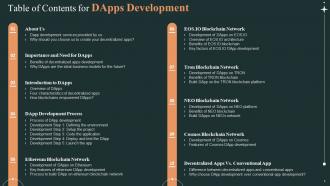
Slide 3: This slide exhibit table of content.
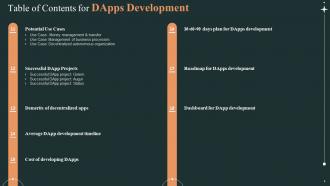
Slide 4: This slide exhibit table of content.
Slide 5: This slide exhibit table of content- About Us.
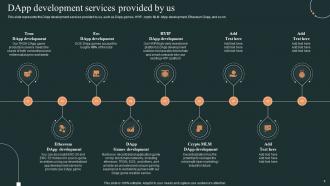
Slide 6: This slide represents the DApp development services provided by us, such as DApp games, HYIP, crypto MLM dApp development, Ethereum DApp, and so on.
Slide 7: This slide highlights the grounds on which you should choose us for the development of your decentralized app based on the experience, delivery timings, and so on.
Slide 8: This slide exhibit table of content- Importance and Need for DApps.
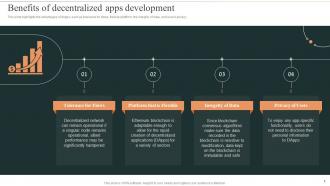
Slide 9: This slide highlights the advantages of dApps, such as tolerance for flaws, flexible platform, the integrity of data, and user's privacy.
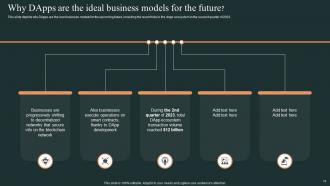
Slide 10: This slide depicts why DApps are the best business models for the upcoming future, including the recent hike in the dApp ecosystem in the second quarter of 2023.
Slide 11: This slide exhibit table of content- Introduction to DApps.
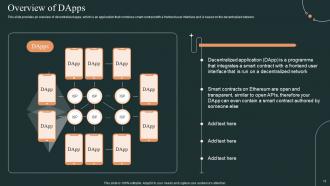
Slide 12: This slide provides an overview of decentralized apps.
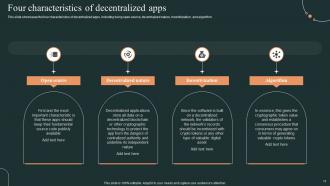
Slide 13: This slide showcases the four characteristics of decentralized apps, including being open-source, decentralized nature, Incentivization, and algorithm.
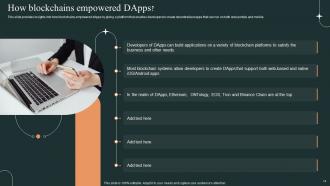
Slide 14: This slide provides insights into how blockchains empowered dApps by giving a platform that enables developers to create decentralized apps.
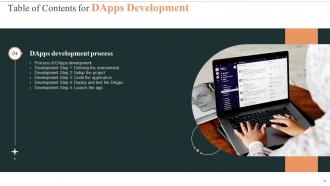
Slide 15: This slide exhibit table of content- DApps development process.
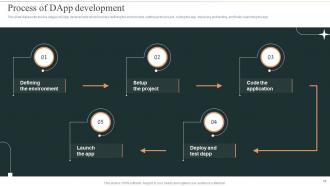
Slide 16: This slide represents the five stages of DApp development.
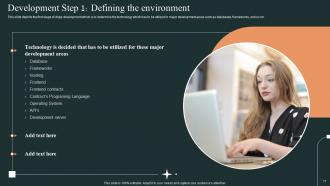
Slide 17: This slide depicts the first stage of dApp development which is to determine the technology.
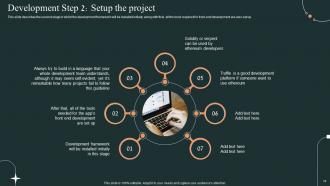
Slide 18: This slide describes the second stage in which the development framework will be installed initially.
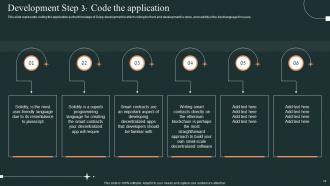
Slide 19: This slide represents coding the application as the third stage of DApp development in which coding for front-end development is done.
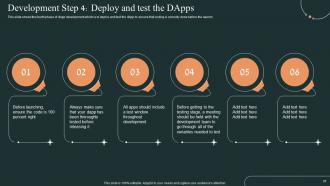
Slide 20: This slide shows the fourth phase of dApp development which is to deploy and test the dApp to ensure that coding is correctly done before the launch.
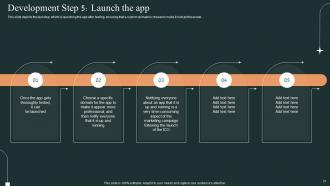
Slide 21: This slide depicts the last step, which is launching the app after testing, ensuring that a custom domain is chosen to make it look professional.
Slide 22: This slide exhibit table of content- Ethereum blockchain network.
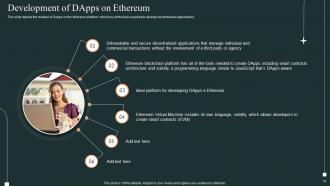
Slide 23: This slide depicts the creation of DApps on the ethereum platform, which has all the tools required to develop decentralized applications.
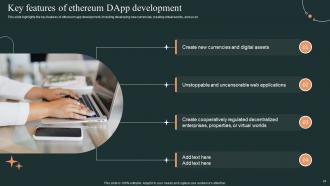
Slide 24: This slide highlights the key features of ethereum app development, including developing new currencies, creating virtual worlds, and so on.
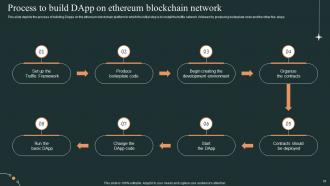
Slide 25: This slide depicts the process of building DApps on the ethereum blockchain platform.
Slide 26: This slide exhibit table of content- EOS.IO Blockchain Network.
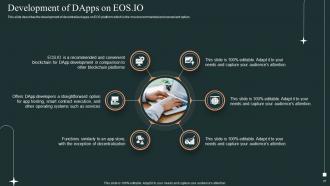
Slide 27: This slide describes the development of decentralized apps on EOS platform which is the most recommended and convenient option.
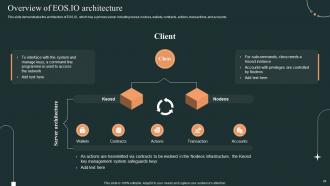
Slide 28: This slide demonstrates the architecture of EOS.IO, which has a primary server including keosd, nodeos, wallets, contracts, actions, transactions, and accounts.
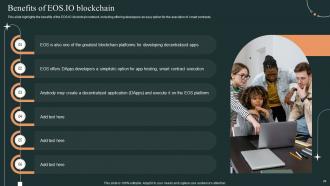
Slide 29: This slide highlights the benefits of the EOS.IO blockchain network, including offering developers an easy option for the execution of smart contracts.
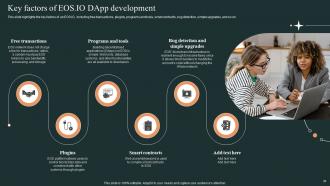
Slide 30: This slide highlights the key factors of an EOS.IO.
Slide 31: This slide exhibit table of content- TRON blockchain network.
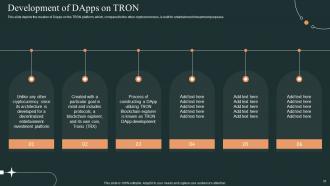
Slide 32: This slide depicts the creation of DApps on the TRON platform, which, compared to the other cryptocurrencies, is built for entertainment investment purposes.
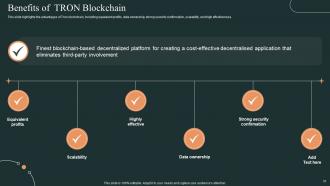
Slide 33: This slide highlights the advantages of Tron blockchain.
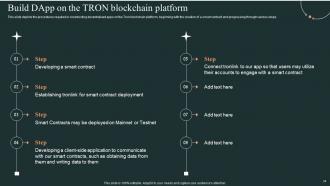
Slide 34: This slide depicts the procedures required in constructing decentralised apps on the Tron blockchain platform.
Slide 35: This slide exhibit table of content- NEO Blockchain Network.
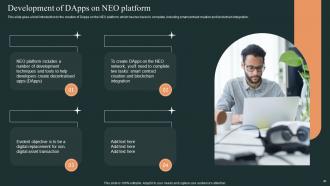
Slide 36: This slide gives a brief introduction to the creation of DApps on the NEO platform.
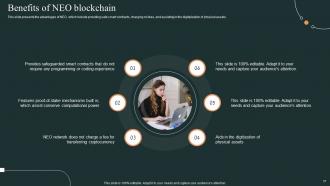
Slide 37: This slide presents the advantages of NEO, which include providing safe smart contracts, charging no fees, and assisting in the digitalization of physical assets.
Slide 38: This slide exhibit table of content- Cosmos Blockchain Network.
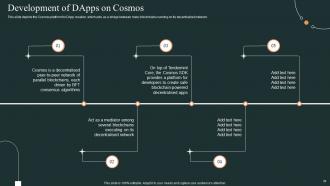
Slide 39: This slide depicts the Cosmos platform for DApp creation, which acts as a bridge between many blockchains running on its decentralized network.
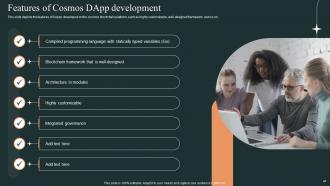
Slide 40: This slide depicts the features of DApps developed on the cosmos blockchain platform, such as highly customizable, well-designed framework, and so on.
Slide 41: This slide exhibit table of content- Decentralized Apps Vs. Conventional App.
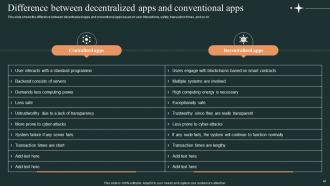
Slide 42: This slide shows the difference between decentralized apps and conventional apps based on user interactions, safety, transaction times, and so on.
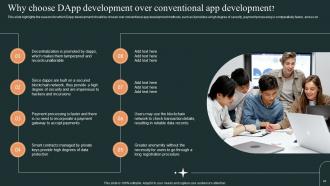
Slide 43: This slide highlights the reasons for which DApp development should be chosen over conventional app development methods.
Slide 44: This slide exhibit table of content- Potential use cases.
Slide 45: This slide depicts the money management and transfer use case of decentralized apps; its benefits have been evident in the growth of crypto tokens.
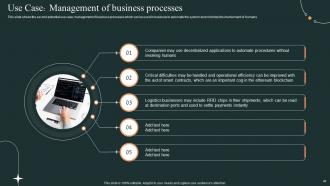
Slide 46: This slide shows the second potential use case; management of business processes which can be used in business.
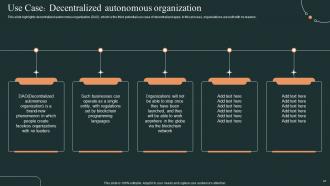
Slide 47: This slide highlights decentralized autonomous organization (DAO), which is the third potential use case of decentralized apps.
Slide 48: This slide exhibit table of content- Successful DApp Projects.
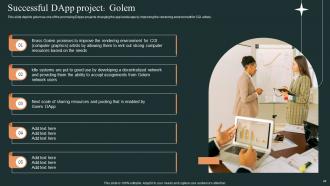
Slide 49: This slide depicts golem as one of the promising DApps projects changing the app landscape by improving the rendering environment for CGI artists.
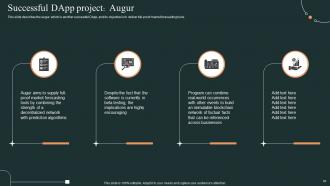
Slide 50: This slide describes the augur, which is another successful DApp, and its objective is to deliver full-proof market forecasting tools.
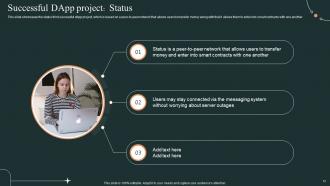
Slide 51: This slide showcases the status third successful dApp project.
Slide 52: This slide exhibit table of content- Demerits of decentralized apps.
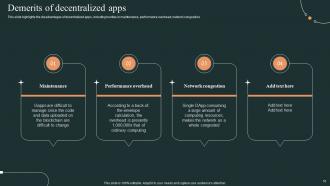
Slide 53: This slide highlights the disadvantages of decentralized apps, including hurdles in maintenance, performance overhead, network congestion.
Slide 54: This slide exhibit table of content- Average DApp development timeline.
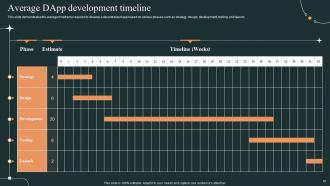
Slide 55: This slide demonstrates the average timeframe required to develop a decentralized app based on various phases.
Slide 56: This slide exhibit table of content- Cost of developing DApps.
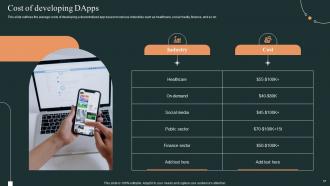
Slide 57: This slide outlines the average costs of developing a decentralized app based on various industries such as healthcare, social media, finance, and so on.
Slide 58: This slide exhibit table of content- 30-60-90 days plan for DApps development.
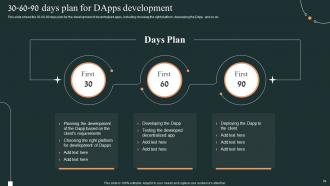
Slide 59: This slide shows the 30-60-90 days plan for the development of decentralized apps, including choosing the right platform, developing the DApp, and so on.
Slide 60: This slide exhibit table of content- Roadmap for DApps development.
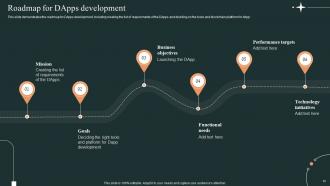
Slide 61: This slide demonstrates the roadmap for DApps development.
Slide 62: This slide exhibit table of content- Dashboard for DApp development.
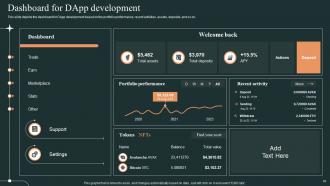
Slide 63: This slide depicts the dashboard for DApp development based on the portfolio performance, recent activities, assets, deposits, and so on.
Slide 64: This is the icons slide.
Slide 65: This slide presents title for additional slides.
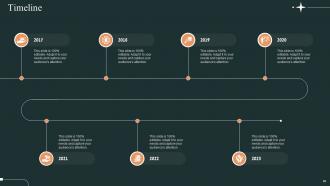
Slide 66: This slide exhibit Timeline.
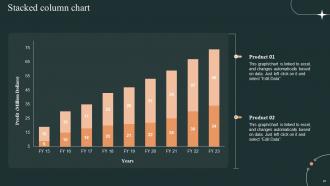
Slide 67: This slide showcase Stacked column chart for different products.
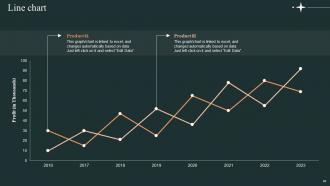
Slide 68: This slide showcase Line chart for differnt products.
Slide 69: This slide shows puzzle for displaying elements of company.
Slide 70: This slide exhibits ideas generated.
Slide 71: This slide showcase Magnifying glass.
Slide 72: This is thank you slide & contains contact details of company like office address, phone no., etc.
DApps Development Powerpoint Presentation Slides with all 77 slides:
Use our DApps Development Powerpoint Presentation Slides to effectively help you save your valuable time. They are readymade to fit into any presentation structure.










FAQs for DApps Development
So basically, regular apps run on company servers that they totally control. DApps are different - they're spread across blockchain networks with tons of nodes. You can't just push updates whenever either, the network has to agree on changes which is honestly kind of a pain. Your users need crypto wallets instead of normal sign-ups too. But here's the thing - there's no single failure point and users actually own their stuff. If you're thinking about building one, learn Solidity first and pick a blockchain where gas fees won't kill your budget.
So smart contracts are what actually make your DApp work automatically - no servers needed. You can build your business logic right into the blockchain. Payments happen on their own, users get authenticated, data gets validated. It's pretty sweet honestly. The whole thing becomes trustless since anyone can check out your contract code. You get transparency and everything runs automatically without middlemen screwing things up. Start by figuring out which parts of your app could run themselves, then code those into contracts first.
You'll probably want to start with **Solidity** for Ethereum contracts and **JavaScript/TypeScript** for the frontend stuff. Most people go the Ethereum route first since there's way more resources and tutorials out there. Frontend's basically just normal web dev - React, Vue, whatever you're into already. **Rust** and **Go** are good if you want to mess around with newer chains like Solana or Cosmos, but honestly that's getting ahead of yourself. **Python's** useful too for backend work and testing. My advice? Just pick Solidity + JavaScript to begin with. Don't try to learn everything at once or you'll burn out fast.
Ethereum's still the obvious choice - huge ecosystem, tons of developers, but man those gas fees will kill your wallet. Solana's been blowing up because it's lightning fast and dirt cheap to use. Polygon's pretty solid too, gives you Ethereum compatibility without the crazy costs. There's also BNB Chain, Avalanche, Cardano floating around but honestly their communities are way smaller. My take? Start with Ethereum since once you get that down, everything else is basically the same concepts. Then you can mess around with others depending on what you're actually trying to build.
Smart contract audits are your first priority - most hacks happen because of code vulnerabilities. Don't be that person who thinks they can skip the security review, even if you're a solid developer. OpenZeppelin's libraries are your friend here instead of writing your own security stuff from scratch. Test the hell out of everything on testnets first. Access controls and input validation are non-negotiable. Once you're live, set up monitoring for weird activity. Oh, and security isn't a "deploy and forget" thing - you'll need to bake it into your entire workflow.
Honestly, the trickiest part is hiding all the blockchain weirdness from users. Nobody wants to deal with gas fees or wait around wondering if their transaction went through. Make your loading states super clear and don't sugarcoat error messages - stuff breaks constantly in web3. Wallet connection should feel natural, not like they're about to get hacked. Oh, and build some offline features if you can since networks are unreliable. Here's my rule: if your non-techy friends can't use it without asking questions, you've overcomplicated things. Map out flows without any crypto jargon first.
Yeah, decentralized storage is definitely slower than regular cloud stuff. IPFS can take a few seconds just to grab files - kinda annoying when people expect everything instant. The whole distributed nodes thing creates more latency than hitting one fast server. But you get censorship resistance, which is pretty cool honestly. I'd probably cache the stuff people access a lot. Maybe do a hybrid setup? Keep your main UI assets on a regular CDN for speed, then put user content on the decentralized networks. That way you don't sacrifice too much performance but still get the benefits.
So for DApp stuff, I'd definitely go with **Hardhat** over Truffle these days - the debugging is just way better. **Ethers.js** pairs nicely with it too. You'll need **MetaMask** for wallet connections, obviously. **IPFS** handles the storage side. **Remix** is perfect when you want to mess around with quick prototypes. Frontend-wise, React or Vue work fine - nothing special there. Honestly, Web3.js vs Ethers.js doesn't matter *that* much, but I think Ethers has cleaner docs. Start with Hardhat + Ethers and you'll be solid.
So governance is basically who gets to call the shots on your DApp - upgrades, treasury stuff, parameter tweaks, whatever. Token holders can vote, or you keep it centralized with your core team. Your choice affects response time to problems and how decentralized things really are. Plus whether people actually care about your project long-term. I've watched teams completely botch this by treating it like an afterthought. Figure it out early because switching later? Total nightmare. It's like... imagine rewiring your house while you're still living in it.
So tokens are like your DApp's whole economy rolled into one thing. Users can pay fees with them, earn rewards, vote on stuff - pretty much everything runs through your token. It's kinda like those arcade tokens but way smarter. They keep people invested because they actually own a piece of what you're building. The tricky part? You really need to nail your tokenomics upfront. Once you launch, changing the rules becomes a total nightmare - learned that one the hard way! Creates this engagement loop where users aren't just using your app, they're stakeholders in it.
Honestly, the gas fees alone will make you want to cry - especially during network congestion. Scalability becomes a real headache fast, and don't get me started on the UX nightmare. Users hate dealing with wallet connections and waiting for confirmations. Learning Solidity isn't terrible but it's definitely different from regular programming. Smart contracts scare me the most though - you can't just push a hotfix if something breaks. Oh, and regulations change weekly it seems. Start with something super simple first. Test everything twice, then test again. Get an audit before you go live or you'll regret it.
So scalability is a real pain point right now. Layer 2 solutions are your best bet - think state channels, sidechains, rollups. They handle transactions off-chain which is clutch. Sharding's another route where the network gets split into parallel chunks. Gas fees are absolutely insane lately (don't even get me started), so this isn't just theoretical anymore. You could also jump ship to faster chains like Solana or Polygon instead of dealing with Ethereum mainnet. Oh, and clean up your smart contract code while you're at it - less computational overhead means better performance. I'd start with layer 2s though, easiest quick win.
Start with unit tests using Truffle or Hardhat - these frameworks are solid. Then hit up testnets like Sepolia for integration testing. Test everything users might do: wallet connections, transactions, error handling when stuff breaks. Gas optimization matters because expensive transactions suck honestly. Ganache's great for local blockchain simulation. For critical contracts, formal verification isn't overkill. Don't forget testing different wallets and network conditions - they all act weird in their own ways. Before going live, get an audit if you're dealing with real money. Oh, and test on mobile too since everyone's using their phone now.
Okay so you definitely need both technical and business stuff. Track your transaction volume, active wallets, gas efficiency - the usual suspects for making sure things actually work. Business-wise though, retention and daily active users matter way more than TVL imo. TVL looks impressive but can be super misleading if people aren't really engaged. Focus on whether users are completing the main actions your DApp was built for. Monthly actives is probably your best north star metric. Start simple with those basics, then get more detailed once you're growing.
Honestly, I think DApps are about to explode in mainstream tech. Companies like Meta and Microsoft are already messing around with blockchain stuff. The game-changer will be when gas fees aren't insane anymore and the UX gets so smooth people don't even know they're using blockchain - kinda like how nobody thinks about the technical stuff when scrolling Instagram, you know? Layer 2 solutions are fixing the scalability nightmare that's been the main roadblock. If I were you, I'd start learning about those now since they're gonna be everywhere soon.
-
I am glad to have come across Slideteam. I was searching for some unique presentations and templates for my business. There are a lot of alternatives available here.
-
Requested a complete pitch deck. Delivered immediately and with high quality well researched content.