


Dashboard For Monitoring Fraud And Money Preventing Money Laundering Through Transaction




Try Before you Buy Download Free Sample Product
 Impress Your
 Audience
 100%
100% Editable
 Save Hours
 of Time


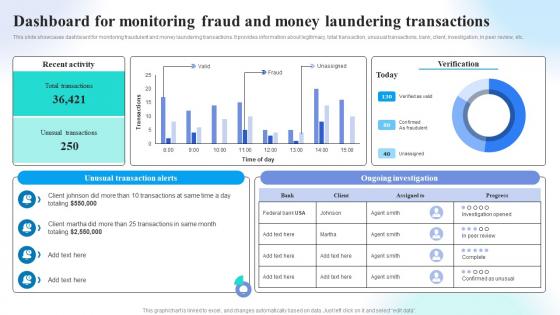
This slide showcases dashboard for monitoring fraudulent and money laundering transactions. It provides information about legitimacy, total transaction, unusual transactions, bank, client, investigation, in peer review, etc.
People who downloaded this PowerPoint presentation also viewed the following :
Dashboard For Monitoring Fraud And Money Preventing Money Laundering Through Transaction with all 7 slides:
Use our Dashboard For Monitoring Fraud And Money Preventing Money Laundering Through Transaction to effectively help you save your valuable time. They are readymade to fit into any presentation structure.





FAQs for Dashboard For Monitoring Fraud And Money Preventing Money
Start with fraud detection rate and false positives - trust me, customers will lose their minds if you block legitimate purchases too often. Track transaction velocity and actual dollar losses too. I'd throw in risk score distributions and break down fraud patterns by location or payment method - super helpful for spotting trends. Real-time updates are clutch, plus you need historical data for comparison. Oh, and keep it simple at first! You can always add more specialized stuff once you figure out what fraud looks like for your business specifically.
So real-time data integration basically flips your fraud dashboard from playing catch-up to actually preventing stuff. You'll spot sketchy patterns instantly instead of finding out days later when it's too late. When transaction volumes go crazy or you see weird geographic stuff happening, boom - immediate alerts. Fraudsters are ridiculously fast these days, so you need to be faster. The trick is getting all your data sources talking to each other - payment processors, user behavior, device fingerprinting, all that. Oh and start with your riskiest transaction types first for the real-time feeds. Way easier than trying to do everything at once.
Honestly, ML is a game-changer for catching fraud. Your system learns from tons of historical data and spots patterns you'd never see manually. The cool part? It adapts constantly, so fraudsters can't just figure out your rules and work around them. You'll catch way more bad transactions while cutting down false positives that piss off real customers. It analyzes thousands of variables at once and flags stuff instantly. I'd start with basic transaction scoring models - the difference is pretty obvious right away. Plus the algorithms actually get better over time, which is wild.
Dude, spreadsheets are the worst for catching fraud - your eyes just glaze over after like 10 minutes. Heat maps and time series charts make sketchy patterns pop out immediately. Geographic plots are clutch too for spotting weird location clusters. Our brains are wired to process visuals way faster than endless number rows. Set up automatic alerts on your main metrics so you're not glued to dashboards 24/7. Then you can drill down into specific transactions when something actually looks off. Way more efficient than manually combing through everything hoping to catch something suspicious.
Payment fraud, account takeovers, and identity theft are the main ones you'll see on most dashboards. Synthetic identity fraud gets tracked a lot too - honestly that one's become such a headache lately. Wire fraud and phishing usually have their own dedicated sections, especially for financial companies. The dashboards group everything by risk level and how often it happens, which makes it way easier to spot weird patterns. Short answer though - look at what fraud types hit your industry the most. That's gonna help you set up the right alerts without getting spammed with false positives all day.
So it really depends on what kind of fraud hits your industry the most. Banks are all about watching transaction speeds and account takeovers. E-commerce? They're tracking chargebacks and weird buying patterns. Healthcare's got their own mess with insurance fraud and stolen identities - honestly such a nightmare for them. Retail focuses on return scams and people gaming loyalty programs. Here's what I'd do: figure out your top 3 fraud types first. Then build your dashboard around those specific things. Don't try to monitor everything at once or you'll just get overwhelmed with alerts.
Oh man, the biggest headache is dealing with data from like 5 different sources that hate each other. Your transaction feeds, risk systems, third-party stuff - they're all in different formats updating at random times. Data lag will kill you - alerts showing up hours late are completely pointless for catching fraud in real-time. False positives mess up all your metrics too, which is super annoying. One corrupted feed can tank your whole dashboard. Definitely set up quality checks that run automatically and have backup data sources ready. Trust me, your main feeds will go down at the worst possible moment.
Get regular feedback sessions going with your fraud analysts - like weekly check-ins or whatever works. Also throw some quick feedback buttons right into the dashboard so they can flag issues on the spot. Make it dead simple for them to complain about stuff that's bugging them. I've watched so many teams build these "perfect" dashboards that nobody actually wants to use because they never bothered asking what people needed day-to-day. Focus on their workflow: Can they spot alerts fast? Investigate cases without jumping through hoops? Got the right data there when they need it? Then actually fix the problems and circle back.
Monthly or quarterly views work way better than daily - too much noise otherwise. Show fraud rates as percentages, not raw numbers, and definitely include volume context so a spike doesn't look apocalyptic when it's really just Tuesday. Rolling averages help smooth out weird seasonal stuff too. Mark your baselines clearly and add notes for major changes like new controls. Oh, and year-over-year comparisons are clutch - they'll show you if something's actually broken or just business as usual. Line charts are your friend here.
Look, fraud dashboards are honestly a lifesaver for compliance stuff. They automatically create that audit trail regulators want to see - shows you're actually catching suspicious activity instead of just hoping for the best. Real-time monitoring helps you hit BSA, AML, PCI DSS requirements without scrambling. The best part? When examiners show up, you're not frantically digging through spreadsheets because everything's already organized. Reports generate themselves, investigation timelines are tracked, documentation lives in one spot. I'd start by figuring out what compliance boxes you need to check first, then map those to whatever dashboard features make sense.
Honestly, start with your data pipeline - Kafka's solid for streaming stuff in real-time. For storage, I'd go with Elasticsearch or ClickHouse since they're crazy fast for queries. Grafana's pretty standard for dashboards, though some teams I know swear by building custom React ones (bit overkill imo but whatever works). Python's your friend for the ML side - scikit-learn handles most anomaly detection pretty well. Oh, and don't sleep on alerts! PagerDuty or just Slack notifications work fine. My advice? Pick one data source first and get that working perfectly before you add more complexity.
Okay so dashboards are like a translator between your fraud team and the suits upstairs. Instead of getting those annoying "so what's happening with fraud?" questions, everyone's looking at the same visual data. Your analysts can pull up real numbers instantly without scrambling to make reports every week. Management sees their big picture stuff, fraud team dives into details when needed. Honestly the best part is setting up those regular review meetings - suddenly everyone's speaking the same language and you're not constantly explaining basic trends. Makes your life way easier.
Ugh, high false positives are the worst - you're basically blocking legit customers left and right. People get super annoyed when their cards get declined for normal purchases. Your support team ends up drowning in angry calls too. Meanwhile your fraud team's stuck reviewing perfectly fine transactions instead of catching actual scammers. Oh, and it tanks your conversion rates since customers start losing trust. Honestly, I'd mess around with your detection settings first - maybe dial them back a bit? Adding some ML could help too, though that's obviously more work. The goal is finding that sweet spot where you catch fraud without being overly paranoid.
Honestly, you've got to bake adaptability into your dashboard right from day one. Machine learning algorithms are your best friend here - they'll spot weird transaction patterns automatically, even brand new fraud schemes you haven't dealt with before. Static rules are basically useless because fraudsters always figure out workarounds (it's like a cat and mouse game that never ends). Your dashboard needs to pull in fresh data sources on the fly and tweak detection thresholds instantly. Dynamic beats fixed every single time. Set up weekly rule reviews and keep experimenting with new pattern recognition models. It's tedious but worth it.
PayPal slashed their fraud losses by 50% with real-time monitoring dashboards, and Netflix cut account takeovers by 70%. JPMorgan catches fraudulent transactions in seconds now instead of days - honestly crazy how much faster that is. The game-changer is getting instant alerts when weird patterns pop up, so your team can jump on it right away. No more finding out about problems weeks later when you're doing reconciliation (ugh, the worst). Just make sure you're setting up alerts for your actual risk patterns, not some cookie-cutter rules that don't fit your business.
-
I’ve been your client for a few years now. Couldn’t be more than happy after using your templates. Thank you!
-
“Thanks to SlideTeam. Now I can make smart presentations in a fraction of time without any hassle.”