

Devops engineer skills powerpoint presentation slides




Try Before you Buy Download Free Sample Product
 Impress Your
 Audience
 100%
100% Editable
 Save Hours
 of Time


To balance needs throughout the software development process, it is essential that DevOps engineers possess the necessary skills to carry out the entire development lifecycle efficiently. This presentation walks you through the top skills a DevOps engineer should have, such as communication, collaboration, automation, and security skills. In addition to such skills, the presentation talks about Linux fundamentals and scripting, knowledge of DevOps tools, continuous integration and delivery, infrastructure as code, key DevOps concepts, etc. DevOps is about breaking down silos and collaborating between production, operations, and business. equipment to quickly produce a high-quality product. This editable DevOps skills PowerPoint presentation will help the engineer to focus more on customer satisfaction. Pack this deck now.
People who downloaded this PowerPoint presentation also viewed the following :
Content of this Powerpoint Presentation
Slide 1: This is the cover slide of DevOps Engineer Skills PowerPoint Presentation.
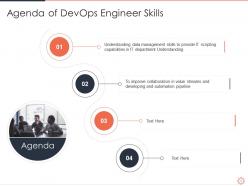
Slide 2: This is an Agenda of DevOps Engineer Skills slide.
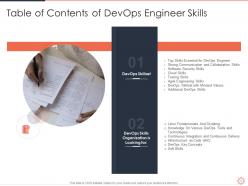
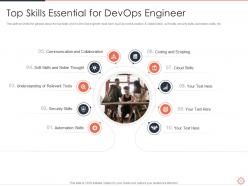
Slide 3: This slide presents Top Skills Essential for DevOps Engineer.
Slide 4: This slide talks about DevOps Skill Set.
Slide 5: This slide provides the glimpse about the top skills which a DevOps engineer must have such as communication & collaboration, soft skills, security skills, automation skills, etc.
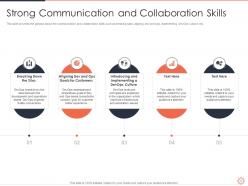
Slide 6: This slide provides the glimpse about the communication and collaboration skills such as breaking silos, aligning dev and ops, implementing DevOps culture, etc.
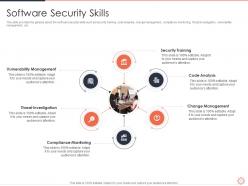
Slide 7: This slide provides the glimpse about the software security skills such as security training, code analysis, change management, compliance monitoring, threat investigation, vulnerability management, etc.
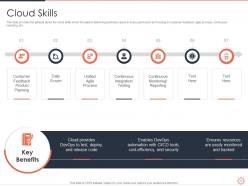
Slide 8: This slide provides the glimpse about the cloud skills which focuses on delivering business values in every sprint such as focusing on customer feedback, agile process, continuous reporting, etc.
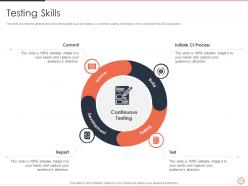
Slide 9: This slide provides the glimpse about the testing skills such as initiating CI process, building, developing, etc. to automate the DevOps pipeline.
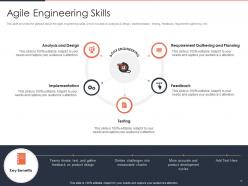
Slide 10: This slide provides the glimpse about the agile engineering skills which focuses on analysis & Design, implementation, testing, feedback, requirement gathering, etc.
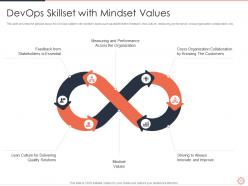
Slide 11: This slide provides the glimpse about the DevOps skillset with mindset values such as stakeholders feedback, lean culture, measuring performance, cross organization collaboration, etc.
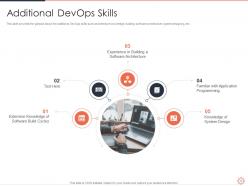
Slide 12: This slide provides the glimpse about the additional DevOps skills such as extensive knowledge, building software architecture, system designing, etc.
Slide 13: Table of Contents of DevOps Engineer Skills.
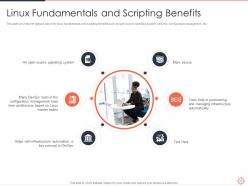
Slide 14: This slide provides the glimpse about the linux fundamentals and scripting benefits such as open source operating system, security, configuration management, etc.
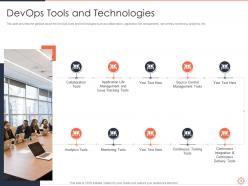
Slide 15: This slide provides the glimpse about the DevOps tools and technologies such as collaboration, application life management, serverless, monitoring, analytics, etc.
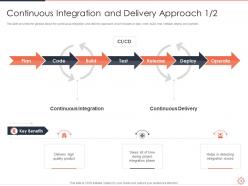
Slide 16: This slide provides the glimpse about the continuous integration and delivery approach which focuses on plan, code, build, test, release, deploy and operate.
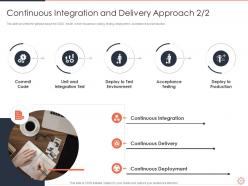
Slide 17: This slide provides the glimpse about the CI/CD model which focuses on coding, testing, deployment, acceptance and production.
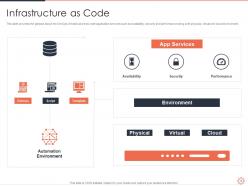
Slide 18: This slide provides the glimpse about the DevOps infrastructure as code application services such as availability, security and performance along with physical, virtual and cloud environment.
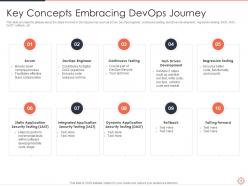
Slide 19: This slide provides the glimpse about the steps involved in DevOps journey such as scrum, DevOps engineer, continuous testing, test driven development, regression testing, SAST, IAST, DAST, rollback, etc
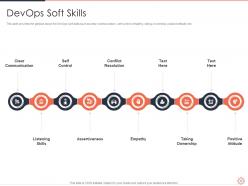
Slide 20: This slide provides the glimpse about the DevOps soft skills such as clear communication, self control, empathy, taking ownership, positive attitude, etc
Slide 21: This is an Icon slide. Use it as per your needs.
Slide 22: This is an Additional Slide.
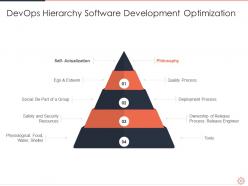
Slide 23: This slide showcases DevOps Hierarchy Software Development Optimization.
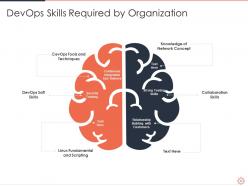
Slide 24: This slide talks about DevOps Skills Required by organizations.
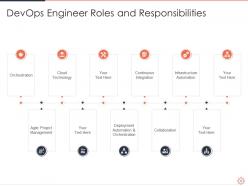
Slide 25: This slide talks about DevOps Engineer Roles and Responsibilities.
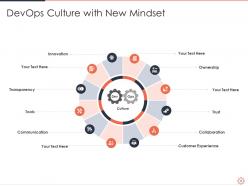
Slide 26: This slide presents DevOps Culture with New Mindset.
Slide 27: This is Our Team slide with name and designation to fill.
Slide 28: This is Our Mission slide to state your mission and vision.
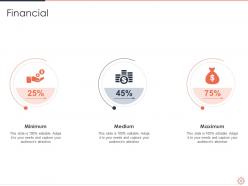
Slide 29: This is Financial score slide that can be used to present your company's financial aspects.
Slide 30: This is a 30 60 90 Days Plan slide that can be used to create robust plans.
Slide 31: This is a Post it Notes slide that can be used to keep important information at one place.
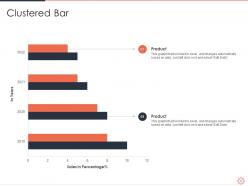
Slide 32: This is a Clustered Bar chart slide that can be used to present comparison between different elements.
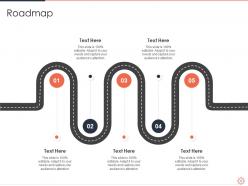
Slide 33: This is a Roadmap slide that can be used to present chronological sequence of events.
Slide 34: This is a Thank You slide for acknowledgment.
Devops engineer skills powerpoint presentation slides with all 35 slides:
Use our DevOps Engineer Skills Powerpoint Presentation Slides to effectively help you save your valuable time. They are readymade to fit into any presentation structure.

FAQs for Devops engineer skills
So DevOps is basically half tech, half people skills. Learn CI/CD pipelines first - that's your bread and butter. Then pick up Docker/Kubernetes for containers and something like Terraform for infrastructure as code. AWS or Azure, doesn't matter which you start with. You're gonna be staring at monitoring dashboards constantly (Grafana becomes your best friend, I swear). But here's the thing - communication matters just as much since you're constantly dealing with both dev and ops teams. They don't always get along, so you become the translator. Start small with one cloud platform.
Dude, scripting is a total game changer for DevOps. Instead of clicking through endless menus, you just write scripts that handle deployments, server configs, monitoring - all that repetitive stuff. Python and Bash are your best friends here. I swear, once you start automating things, going back to manual work feels painful. What used to eat up your whole afternoon becomes like a 5-minute thing you can run while grabbing coffee. Pick one annoying task you do every day and script it first. Trust me, you'll get addicted to the time savings pretty quick.
Dude, cloud computing IS DevOps these days. Most of your time you'll be on AWS, Azure, or GCP spinning up infrastructure instead of touching actual servers. Automating deployments, scaling stuff when traffic spikes, monitoring everything - that's the daily grind. All your CI/CD pipelines and container orchestration runs on cloud-native tools anyway. Honestly can't picture doing this job without it anymore, which is kinda crazy when you think about it. If you don't know at least one platform yet, get an AWS or Azure cert ASAP.
Yeah, you definitely need to learn containerization - it's like top 3 skills for DevOps now. Docker's literally everywhere because it fixes so many deployment nightmares. Kubernetes became the go-to for orchestration at scale too. Most companies either already use this stuff or they're planning to switch over. Even if your current job doesn't do much with containers, you'll hit them in interviews for sure. Start with Docker basics first, then once that clicks, move into Kubernetes fundamentals. Trust me, you'll thank yourself later - I wish I'd started learning this stuff sooner than I did.
Honestly, just automate everything you can - tests, builds, deployments, all of it. Run automated tests on every commit and use feature flags so you're not gambling with production. Make your builds repeatable across environments (learned this one the hard way). Version control literally everything, even your infrastructure code and deployment scripts. Trust me on this - when stuff breaks at 2am, you'll be so glad you can just rollback quickly. Start with one service though, don't try to boil the ocean. The whole point is making deployments boring instead of panic-inducing.
Dude, get your dev and ops people talking from the start. No more of that "build it, ship it, not my problem" BS that tanks projects. Devs start writing code that actually deploys smoothly, ops gets what the app really needs. You'll catch problems early instead of at 2am when everything's on fire (ugh, worst feeling ever). Honestly, just throw both teams in your planning meetings - the difference is night and day. Way fewer rollbacks, less drama when stuff breaks, and everyone's actually working toward the same goal instead of blaming each other.
Start with Prometheus and Grafana - they're basically the gold standard for metrics. ELK stack is great for logging but honestly such a headache to configure at first. If you're already using AWS or Azure, just go with their native stuff like CloudWatch. Way easier. APM tools like New Relic or Datadog are clutch for tracking app performance too. Oh and Splunk's solid if your company has the budget for it. My advice? Pick one monitoring tool and one logging solution first. Don't try to learn everything at once or you'll burn out fast.
Dude, Git is like the foundation of everything in DevOps. Every code change you make kicks off your automated builds and deployments through CI/CD. I always set up branch protection rules first thing - saves you so much headache later. Pull requests become your safety net where people actually review code before it goes live. GitFlow or whatever branching strategy you pick helps manage releases without losing your mind. Honestly, trying to do DevOps without proper version control? That's just asking for disaster. Oh, and definitely get those automated triggers working if you haven't yet.
Dude, build security into your pipeline from day one - don't be like those teams who bolt it on later and hate their lives. Start with automated scanning tools like SonarQube or Snyk to catch vulnerabilities before they go live. Container image scanning too if you're using Docker. Never hardcode API keys (seriously, just don't). Set up proper access controls with least privilege. Infrastructure as code scanning is clutch. Oh and always have rollback plans ready because stuff breaks. My advice? Pick one or two tools first, then add more gradually. Going all-in at once is a recipe for burnout.
Honestly, IaC completely changes what you do day-to-day. Instead of clicking around AWS consoles (which gets mind-numbing anyway), you're writing actual code - Terraform, CloudFormation, whatever. Everything becomes version controlled like regular software. Code reviews for infrastructure changes? Yep, that's your life now. You'll be testing deployments automatically and making sure everything's documented so your teammates aren't totally lost. The cool part is everything becomes reproducible. Oh, and definitely get comfortable with Git workflows for infra code - you're gonna need it.
Look, communication is probably the biggest thing - you'll constantly be translating tech speak for business people and vice versa. Patience is absolutely massive too because trust me, you'll get so many "this is broken, help!" messages. Being adaptable matters since you're literally trying to get teams that traditionally hate each other to work together. Empathy helps a ton when dealing with stressed developers at 2am or frustrated ops people. Oh, and get really good at explaining complex stuff simply - seriously, that skill will make you everyone's favorite person. Breaking down silos is the whole point, so collaboration isn't optional.
Okay so three things you gotta nail: infrastructure automation, monitoring, and redundancy. Load balancers will spread your traffic across servers, auto-scaling spins up new instances when things get crazy. Health checks automatically swap out anything that breaks. Most people totally bomb the monitoring part though - you need alerts firing for literally everything. Build across multiple zones, use something like Kubernetes for container stuff. Oh and always have a rollback plan ready because Murphy's law is real. Start by listing where you're screwed if one thing dies, then fix those first.
Honestly, just track four things that actually tell you something useful: how often you deploy, lead time for changes, mean time to recovery, and change failure rate. DORA metrics aren't just buzzwords - they work. Lead time shows how fast code goes from commit to production. MTTR is your bounce-back speed when stuff breaks (and it will break). Change failure rate? That's the percentage of deployments that go sideways. I'd start checking these weekly - you'll spot your bottlenecks pretty quick and can actually do something about them.
Dude, automation is a game changer. You'll stop wasting time on boring stuff like manual deployments and actually solve real problems. I used to burn whole afternoons clicking through deployment steps - honestly such a waste. Now I just write scripts and set up tools to handle the repetitive crap automatically. CI/CD pipelines are where it gets fun though. Your team goes from deploying once a month to multiple times daily. Infrastructure setup becomes instant too. My advice? Pick whatever task annoys you most and automate that first. Build up from there.
Honestly, AI/ML ops is where things are heading - everyone's automating their deployment pipelines now. GitOps is everywhere too, so you'll want to get familiar with that if you haven't already. Platform engineering is blowing up right now. Companies are building these internal developer platforms to make everything smoother. Security's shifting left hardcore, so DevSecOps isn't optional anymore. Infrastructure as Code is getting weird though - moving past Terraform into more declarative stuff. Kind of confusing but whatever. Just pick something that doesn't make you want to cry and go deep. Maybe build a personal project with GitOps or mess around with AI monitoring tools. You'll figure it out.
-
Attractive design and informative presentation.
-
Great designs, Easily Editable.
-
Professional and unique presentations.