

Devops infrastructure design and deployment proposal it powerpoint presentation slides




Try Before you Buy Download Free Sample Product
 Impress Your
 Audience
 100%
100% Editable
 Save Hours
 of Time


The PowerPoint template helps present DevOps design and deployment proposals to transform IT infrastructure through automation. This template includes slides about the project overview and project context. It also showcases current issues, project objectives, and DevOps infrastructure transformation benefits in a crisp and digestible format. This editable PowerPoint infographic displays the firms capabilities, such as offerings and processes depicting the scope of deliverables. Infrastructure design, deployment process roadmap, and timeframe for DevOps infrastructure design and deployment can also be elucidated by incorporating this PPT template. Not only this, but it also covers the slides about the firms investment for DevOps infrastructure design and deployment. It showcases the importance of selecting DevOps-enabled IT infrastructure and gives a brief detail about the firm. One can also light the industry verticals catered by the firm and the team associated with DevOps infrastructure development. It covers the slides displaying experience showcasing existing client testimonials and case studies highlighting infrastructure automation through DevOps. It also highlights the statement of work, contract, and next steps for infrastructure design and deployment. Download this DevOps Infrastructure Design and Deployment IT proposal or ask for a FREE demo.
People who downloaded this PowerPoint presentation also viewed the following :
Content of this Powerpoint Presentation
Slide 1: This is a DevOps Infrastructure Design and Deployment Proposal (IT) slide.
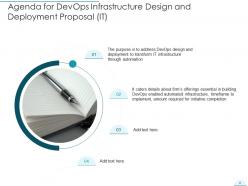
Slide 2: This is an Agenda slide for DevOps Infrastructure Design and Deployment Proposal (IT).
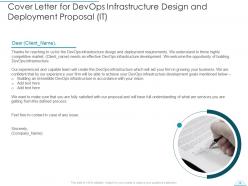
Slide 3: This slide illustrates the Cover Letter for DevOps Infrastructure Design and Deployment Proposal (IT).
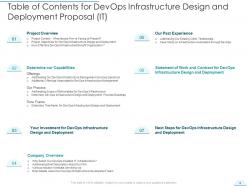
Slide 4: This is a Table of Contents slide illustrating the components of the DevOps Infrastructure Design and Deployment Proposal (IT) template.
Slide 5: This is another Table of Contents slide illustrating the Project Context, and the Issues Firm is Facing at Present.
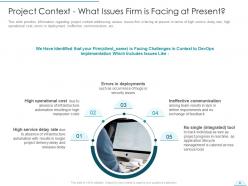
Slide 6: This slide provides information regarding various issues that the firm is facing at present including, high service delay rate, high operational cost, errors in deployment, ineffective communication, etc.
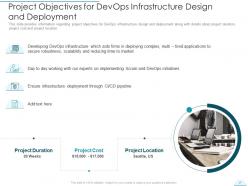
Slide 7: This slide provides information regarding project objectives for DevOps infrastructure design and deployment along with details about project duration, project cost, and project location.
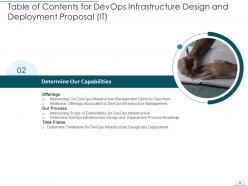
Slide 8: This is a Table of Contents slide representing the topic “Determine Our Capabilities.”
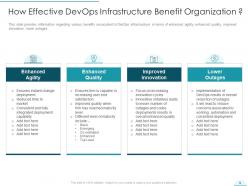
Slide 9: This slide provides information regarding various benefits associated with DevOps infrastructure, covering enhanced agility, enhanced quality, improved innovation, and lower outages.
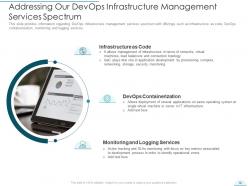
Slide 10: This slide provides information regarding the DevOps infrastructure management services spectrum with offerings, such as infrastructure as code, DevOps containerization, monitoring, and logging services.
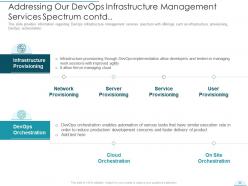
Slide 11: This slide provides information on the DevOps infrastructure management services spectrum covering offerings, such as infrastructure provisioning and DevOps orchestration.
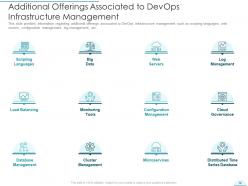
Slide 12: This slide provides information regarding additional offerings associated with DevOps infrastructure management, such as scripting languages, web servers, configuration management, log management, etc.
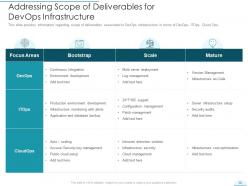
Slide 13: This slide provides information regarding the scope of deliverables associated with DevOps infrastructure in terms of DevOps, ITOps, and Cloud Ops.
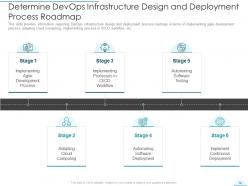
Slide 14: This slide provides information regarding DevOps infrastructure design and deployment process roadmap including, implementing agile development process, adapting cloud computing, implementing the process in CI/CD workflow, etc.
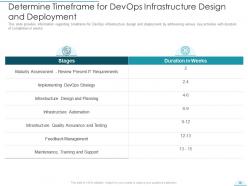
Slide 15: This slide provides information regarding a timeframe for DevOps infrastructure design and deployment by addressing various key activities with duration of completion in weeks.
Slide 16: This is a Table of Contents slide illustrating the topic “Your Investment for DevOps Infrastructure Design and Deployment.”
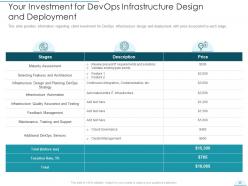
Slide 17: This slide provides information regarding client investment for DevOps infrastructure design and deployment, covering the prices associated with each stage.
Slide 18: This is a Table of Contents slide illustrating the topic “Company Overview.”
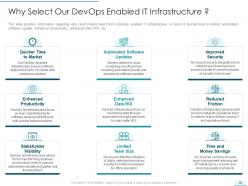
Slide 19: This slide provides information regarding why clients should select a firm’s DevOps-enabled IT infrastructure, illustrating quicker time to market, automated software update, enhanced productivity, enhanced data ROI, etc.
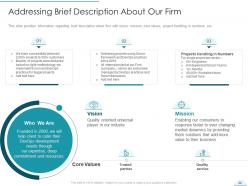
Slide 20: This slide provides information regarding a brief description of a firm with vision, mission, core values, project handling in numbers, etc.
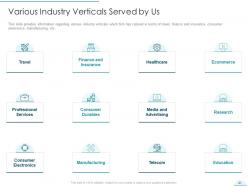
Slide 21: This slide provides information regarding various industry verticals to which the firm has catered including, travel, finance, insurance, consumer electronics, manufacturing, etc.
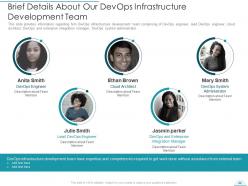
Slide 22: This slide provides information regarding the firm's DevOps infrastructure development team comprising DevOps engineer, lead DevOps engineer, cloud architect, DevOps/enterprise integration manager, and DevOps system administrator.
Slide 23: This is a Table of Contents slide illustrating the topic “Our Past Experience.”
Slide 24: This slide provides information regarding our existing client testimonials providing their valuable feedback for the services rendered by the firm.
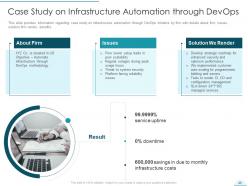
Slide 25: This slide provides information regarding a case study on infrastructure automation through the DevOps initiative by a firm with details about the firm, issues, solutions the firm rendered, and benefits.
Slide 26: This is a Table of Contents slide illustrating the topic “Statement of Work and Contract for DevOps Infrastructure Design and Deployment.”
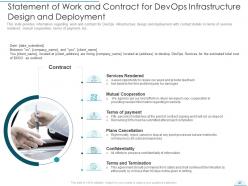
Slide 27: This slide provides information regarding work and contracts for DevOps infrastructure design and deployment with contact details covering services rendered, mutual cooperation, terms of payment, etc.
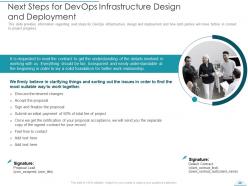
Slide 28: This is a Table of Contents slide illustrating the topic “Next Steps for DevOps Infrastructure Design and Deployment.”
Slide 29: This slide provides information regarding the next steps for DevOps infrastructure design and deployment and how both parties will move further in context to project progress.
Slide 30: This is a 100% editable icon slide illustrating the topic “DevOps Infrastructure Design and Deployment Proposal (IT).”
Slide 31: This is a template illustrating the topic “Additional Slides.”
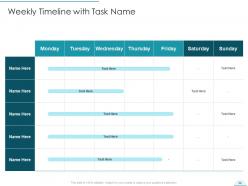
Slide 32: This is a slide illustrating the Weekly Timeline with Task Name.
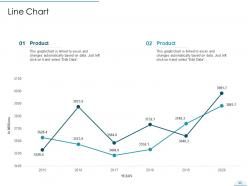
Slide 33: This is a Line Chart slide that is linked to Excel and changes automatically based on data.
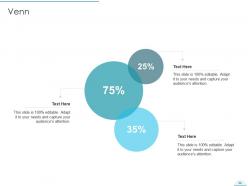
Slide 34: This slide provides a Venn diagram that can be used to show interconnectedness and overlap between various departments, projects, etc.
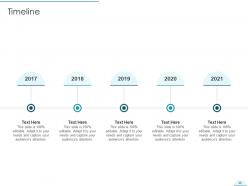
Slide 35: This slide is a Timeline template to showcase the progress of the steps of a project with time.
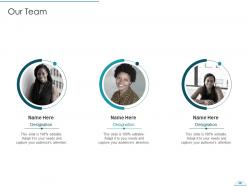
Slide 36: This is an “Our Team” slide illustrating the employee names and designation.
Slide 37: This is a 100% editable Puzzle slide to represent various interesting topics.
Slide 38: This is a 100% editable Post It Notes slide where you can share the important pointers.
Slide 39: This is a 30-60-90-Day Plan slide that can be used to represent the process sequentially.
Slide 40: This is a Roadmap slide that can be used to illustrate the process flow.
Slide 41: This is a Thank You slide illustrating the company address, contact number, e-mail, and more.
Devops infrastructure design and deployment proposal it powerpoint presentation slides with all 41 slides:
Use our DevOps Infrastructure Design And Deployment Proposal IT Powerpoint Presentation Slides to effectively help you save your valuable time. They are readymade to fit into any presentation structure.

FAQs for Devops infrastructure design and deployment proposal it
Honestly, just focus on three things: automation, scaling, and keeping everything consistent. Put literally everything in code - your infrastructure, configs, deployments, all of it. Things WILL break (learned this the hard way), so build redundancy and monitoring from the start. Make your environments identical so you don't get nasty surprises during releases. Version control is non-negotiable. Your deployments need to be repeatable, and you better be able to roll back fast when stuff hits the fan. Start small though - pick one thing you do manually each week and automate that first.
Dude, automation is a total lifesaver for deployments. No more sitting around clicking buttons all day - your code changes just trigger everything automatically. Builds, tests, the whole pipeline runs without you babysitting it. The best part? Everything happens the same way each time, so you won't get those annoying "but it worked fine yesterday" moments that make you want to throw your laptop out the window. You'll catch bugs way earlier too since tests fire off right away. Honestly, just start with whatever you're doing most often. Those repetitive tasks are perfect candidates.
Honestly, containerization is a game changer for DevOps. Docker packages your app with everything it needs, so that annoying "works on my machine" thing becomes ancient history. Same container runs everywhere - dev, staging, prod, whatever. They spin up crazy fast too, which makes scaling so much smoother. Your CI/CD pipeline just becomes more predictable because you're not dealing with environment weirdness anymore. I mean, once you get used to it, deploying without containers feels like going backwards. Definitely start with Docker if you haven't messed around with it yet.
Look, horizontal scaling is where it's at from the start - add more servers instead of beefing up one massive machine. Docker containers plus Kubernetes will save your sanity when traffic spikes hit. Auto-scaling groups are honestly a game changer, wish I'd known about them earlier. Monitor everything and get solid load balancing in place so you can catch problems early. Think 10x growth even if you're starting tiny. Your CI/CD should deploy smoothly across environments without you babysitting it constantly.
Version control everything - seriously, treat your configs like code. Don't hardcode secrets though, use Vault or whatever secret manager your cloud has. I learned this the hard way after a config drift took down our staging environment for like 3 hours. Environment-specific stuff goes in separate files or env vars. Tools like Terraform and Ansible will save you tons of headaches once you set them up. Oh, and test your configs before deploying - automated validation catches the stupid mistakes. Start small, maybe just automate the stuff that breaks most often.
So CI/CD pipelines automate your whole software delivery thing - no more manual building, testing, deploying every single time. You just set up triggers that kick in when devs push code changes. Way faster releases, less human screwups, and deployments don't suck anymore. Honestly, manual deployments feel barbaric once you've tasted the automation life. Your team gets to actually write code instead of watching builds all day. Oh, and don't try to do everything at once - start with automated testing first, then slowly add deployment stuff as you figure it out.
Dude, build security in from the start - don't be like those teams who slap it on later and hate their lives. Focus on secrets management, network segmentation, and least privilege access first. Encrypt everything in transit and at rest, obviously. Your CI/CD pipeline needs code scanning, and you'll want centralized logging to monitor what's happening. Oh, and if you're doing containers, don't forget container security (learned that one the hard way). Keep everything as infrastructure as code so you can actually track changes. Start with a threat model for your specific situation and work backwards.
Oh man, microservices are wild - you go from one big deployment to juggling like 30+ separate services. Each one can deploy independently which is awesome but also kinda terrifying. You'll definitely need Kubernetes or similar for orchestration, plus way beefier CI/CD since every service has its own cycle. Monitoring becomes your best friend because when stuff breaks, it's scattered everywhere. Honestly? Go hard on automation from day one. I learned this the hard way - manual deployments will kill you once you scale up.
Honestly, start with Prometheus + Grafana - that combo is solid for metrics and dashboards. You'll also want log aggregation, so ELK stack or Splunk work well. If you don't want to manage all that yourself, DataDog and New Relic are pretty decent SaaS options that just handle everything. Oh, and if you're doing microservices, definitely look into Jaeger for tracing - trust me on that one. I'd say begin with basic alerts and monitoring, then add more sophisticated stuff as things get messier. Way better than trying to build some massive monitoring system right off the bat.
Honestly, the biggest thing is just getting dev and ops people to actually talk to each other instead of working in separate bubbles. Joint planning sessions help a ton - so does putting them in the same Slack channels and having developers sit in on deployment stuff while ops folks weigh in on architecture choices. I mean, shared monitoring dashboards are pretty clutch too. Cross-functional teams work way better than the whole "build it and throw it over the fence" approach. Oh, and joint retrospectives! Both sides need to get what's making the other team's life hell. It's really about shared ownership of the whole process.
So there's these DORA metrics that are basically the go-to now for tracking DevOps stuff. You've got deployment frequency - just how often you're shipping code. Then lead time, which is commit to production time. Change failure rate tells you what percentage of deployments break things (fun times). Mean time to recovery is how fast you fix incidents when they happen. I'd honestly just pick one to start with instead of trying to track everything perfectly right away. Get a baseline first, see where you're at now, then gradually work on improving. The whole "measure all the things" approach usually ends up being overwhelming anyway.
Honestly, APIs are your best bet for wrapping those old systems - turns them into bridges to your newer stuff. Docker can containerize even ancient apps, which is pretty wild. Your CI/CD can deploy everything together no problem. Focus on the most critical legacy pieces first and build lightweight interfaces around them. Short sentences work. This whole approach is really just buying you time while you plan what to replace next. Don't think of it as permanent though - it's more like a stepping stone so you don't blow everything up at once.
Honestly, cloud services are what make DevOps actually work these days. You get instant scaling, automated deployments, and all those managed services handle your databases and monitoring stuff. Nobody wants to deal with physical servers anymore - what a nightmare that would be. The cool part is how everything connects through APIs and tools like Terraform. Your whole deployment process just flows better. Oh, and definitely try moving your staging environment first. Way less risky if something breaks, and you'll learn the ropes without stressing about production going down.
Dude, orchestration tools are lifesavers - they automate all that boring coordination stuff between your infrastructure pieces. So like Kubernetes, Terraform, Ansible... they handle the sequencing and scaling automatically. No more babysitting servers or stressing about deployment order. The orchestrator spins everything up right, deals with failures, scales when needed. Your infrastructure gets way more solid. Honestly took me forever to finally try Kubernetes but once I did? Total game changer. You'll actually have time to build cool features instead of constantly putting out deployment fires.
Honestly, you'll probably get hit with scaling issues first - traffic spikes that either crash everything or cost way too much. Configuration drift is another pain point I see all the time. Terraform's your friend for keeping environments from becoming snowflakes. Set up monitoring early so you're not finding out about problems from angry users (been there). Security scanning should be automated from day one. Kubernetes is cool but maybe overkill if you're just starting out? Build solid CI/CD first, then add complexity when you actually need it.
-
Thanks for all your great templates they have saved me lots of time and accelerate my presentations. Great product, keep them up!
-
Innovative and Colorful designs.
-
Content of slide is easy to understand and edit.
-
Excellent design and quick turnaround.
-
Excellent template with unique design.