

Devops services development proposal it powerpoint presentation slides




Try Before you Buy Download Free Sample Product
 Impress Your
 Audience
 100%
100% Editable
 Save Hours
 of Time


The PowerPoint template is a useful tool in presenting proposals for DevOps services development for firms and address how these services are beneficial. It covers details about project overview in terms of various issues faced by firm, overall project objectives for DevOps services development. One can also showcase how successful DevOps services development is beneficial for organization. The template caters details about firms capabilities in terms of service offerings such as service spectrum including continuous integration, continuous deployment, ChatOps, staging, and automated infrastructure through IaaC, etc. The template arms you elucidate various phases of DevOps development, scope of services or deliverables, prerequisites for DevOps development, and DevOps development process roadmap. Having an access to this amazingly designed slide you would be able to focus on timeframe for DevOps Service Development. The template covers details about client investment for developing DevOps services, along with firm overview such as selecting DevOps development services, brief description about firm, industry verticals firm served and details about DevOps development team. Showcase client testimonials, and case studies taking the assistance of this DevOps development PowerPoint template. It also covers statement of work and contract for DevOps services development template. Highlight the next steps for further progress with collaboration by utilizing this DevOps development template.
People who downloaded this PowerPoint presentation also viewed the following :
Content of this Powerpoint Presentation
Slide 1: This slide introduces DevOps Services Development Proposal. State Your Company Name and begin.
Slide 2: This slide shows Agenda for DevOps Services Development Proposal.
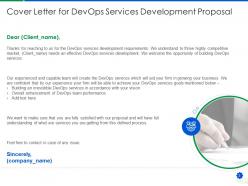
Slide 3: This slide shows Cover Letter for DevOps Services Development Proposal.
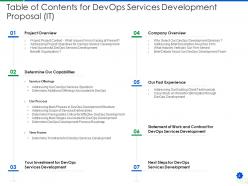
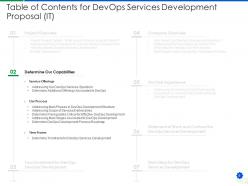
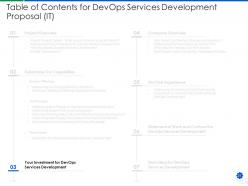
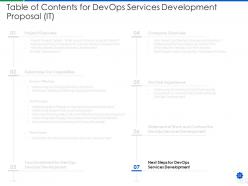
Slide 4: This slide shows Table of Contents for DevOps Services Development Proposal.
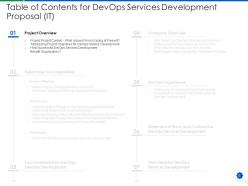
Slide 5: This is another slide showing Table of Contents for DevOps Services Development Proposal.
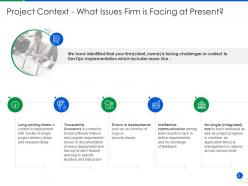
Slide 6: This slide shows challenges in context to DevOps implementation.
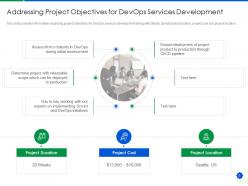
Slide 7: This slide shows Addressing Project Objectives for DevOps Services Development.
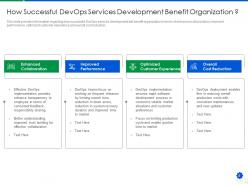
Slide 8: This slide provides information regarding how successful DevOps services development will benefit organization in terms of enhanced collaboration, improved performance, optimized customer experience and overall cost reduction.
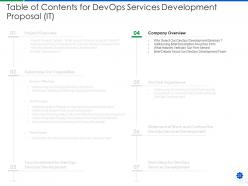
Slide 9: This slide shows Table of Contents for DevOps Services Development Proposal.
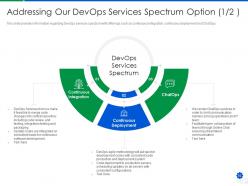
Slide 10: This slide shows Addressing Our DevOps Services Spectrum Option.
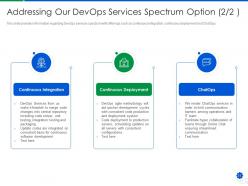
Slide 11: This slide provides information regarding DevOps services spectrum with offerings such as continuous integration, continuous deployment and ChatOps.
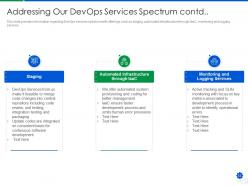
Slide 12: This slide provides information regarding DevOps services spectrum with offerings such as staging, automated infrastructure through IaaC, monitoring and logging services.
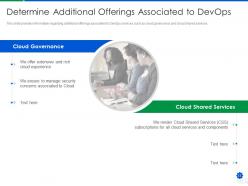
Slide 13: This slide provides information regarding additional offerings associated to DevOps services such as cloud governance and cloud shared services.
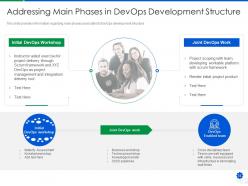
Slide 14: This slide provides information regarding main phases associated to DevOps development structure.
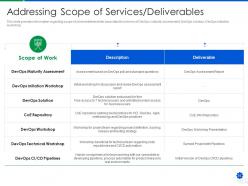
Slide 15: This slide provides information regarding scope of service/deliverables associated to in terms of DevOps maturity assessment, DevOps solution, DevOps initiation workshop.
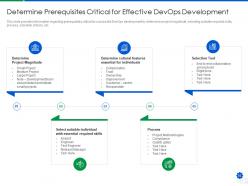
Slide 16: This slide provides information regarding prerequisites critical for successful DevOps development by determine project magnitude, selecting suitable required skills, process, selection of tools, etc.
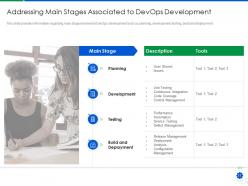
Slide 17: This slide provides information regarding main stages involved in DevOps development such as planning, development, testing, build and deployment.
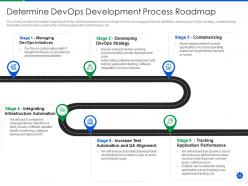
Slide 18: This slide provides information regarding DevOps development process roadmap in terms of managing DevOps initiatives, developing DevOps strategy, containerizing, integrating infrastructure automation, tracking application performance, etc.
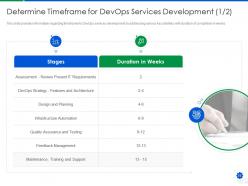
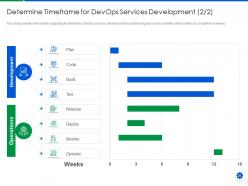
Slide 19: This slide provides information regarding timeframe for DevOps services development by addressing various key activities with duration of completion in weeks.
Slide 20: This slide provides information regarding timeframe for DevOps services development by addressing various key activities with duration of completion in weeks.
Slide 21: This slide shows Table of Contents for DevOps Services Development Proposal.
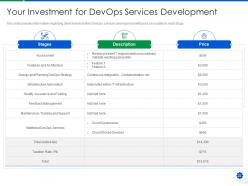
Slide 22: This slide provides information regarding client investment for DevOps services development with price associated to each stage.
Slide 23: This slide shows Table of Contents for DevOps Services Development Proposal.
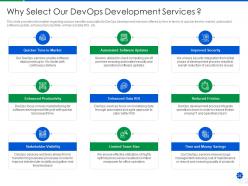
Slide 24: This slide provides information regarding various benefits associated to DevOps development services offered by firm in terms of quicker time to market, automated software update, enhanced productivity, enhanced data ROI, etc.
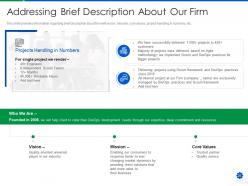
Slide 25: This slide provides information regarding brief description about firm with vision, mission, core values, project handling in numbers, etc.
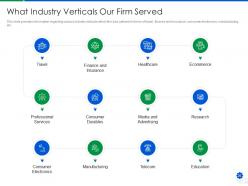
Slide 26: This slide provides information regarding various industry verticals which firm has catered in terms of travel, finance and insurance, consumer electronics, manufacturing, etc.
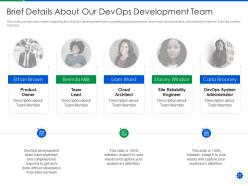
Slide 27: This slide provides information regarding firm DevOps development team comprising of product owner, team lead, cloud architect, site reliability engineer, DevOps system engineer.
Slide 28: This slide shows Table of Contents for DevOps Services Development Proposal.
Slide 29: This slide provides information regarding our existing client testimonials providing their valuable feedback for the services rendered by firm.
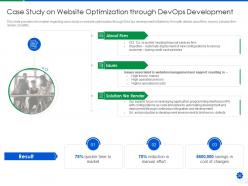
Slide 30: This slide provides information regarding case study on website optimization through DevOps development initiative by firm with details about firm, issues, solution firm render, benefits.
Slide 31: This slide shows Table of Contents for DevOps Services Development Proposal.
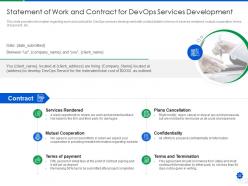
Slide 32: This slide provides information regarding work and contract for DevOps services development with contact details in terms of services rendered, mutual cooperation, terms of payment, etc.
Slide 33: This slide shows Table of Contents for DevOps Services Development Proposal.
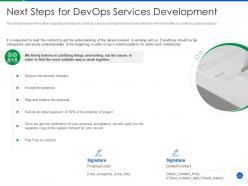
Slide 34: This slide provides information regarding next steps for DevOps services development and how both firms will move further in context to project progress.
Slide 35: This slide shows Icons for DevOps Services Development Proposal.
Slide 36: This slide is titled as Additional Slides for moving forward.
Slide 37: This is About Us slide to show company specifications etc.
Slide 38: This is Our Mission slide with related imagery and text.
Slide 39: This slide shows Road Map with additional textboxes.
Slide 40: This slide shows Weekly Timeline with Task Name.
Slide 41: This slide shows 30 60 90 Days Plan with icons and text.
Slide 42: This slide shows Post It Notes. Post your important notes here.
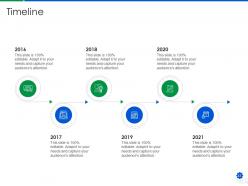
Slide 43: This is a Timeline slide. Show data related to time intervals here.
Slide 44: This slide shows Puzzle with text boxes.
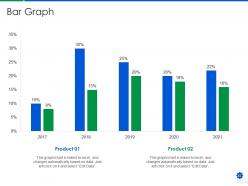
Slide 45: This slide shows Bar Graph with two products comparison.
Slide 46: This is Our Goal slide. State your firm's goals here.
Slide 47: This is a Thank You slide with address, contact numbers and email address.
Devops services development proposal it powerpoint presentation slides with all 47 slides:
Use our DevOps Services Development Proposal IT Powerpoint Presentation Slides to effectively help you save your valuable time. They are readymade to fit into any presentation structure.


FAQs for Devops services development proposal it
So DevOps is basically about getting dev and ops teams to actually work together instead of being in separate bubbles. No more devs throwing code over the fence and ops dealing with whatever breaks. Both teams share responsibility for the whole software lifecycle - which honestly makes way more sense when you think about it. The big things are automating boring repetitive stuff, monitoring everything that matters, and failing fast so you learn quickly. It's really more of a culture change than just new tools. Teams start talking constantly, sharing metrics, solving problems as a unit instead of the usual blame game. My advice? Pick one small shared project first and build trust from there.
Track your deployment frequency and lead time first - those DORA metrics aren't just buzzwords, they actually tell you if things are moving faster. Mean time to recovery and change failure rate matter too. But here's the thing: don't forget business stuff like customer satisfaction and revenue impact. Also measure if your team's actually happy because burned-out developers aren't shipping great code, you know? My advice? Pick maybe 3-4 metrics that actually matter to your company instead of going crazy trying to measure everything. Way easier to stay consistent that way.
Dude, automation is what makes DevOps actually work - it cuts out all those tedious manual steps that slow everything down. Start with CI/CD stuff like Jenkins or GitLab CI, then move into infrastructure with Terraform or Ansible. Testing automation with Selenium is clutch too. Honestly, I'd just pick whatever manual task is annoying you most right now and automate that first. Once you see how much time it saves, you'll want to automate everything (which... maybe don't go overboard immediately). Your team needs time to get used to the new tools anyway. But seriously, manual deployments after automation feel like going back to dial-up internet.
So basically DevOps automates all the tedious stuff and gets your dev and ops teams actually talking to each other. CI/CD pipelines handle testing and deployment automatically, which speeds everything up like crazy. Infrastructure as code is honestly a lifesaver - no more environment inconsistencies messing things up. The monitoring piece catches problems before they blow up into major incidents, which your future self will thank you for. Oh, and start small - just pick whatever manual process annoys you most and automate that first. Trust me, once you see how much time it saves you'll be hooked.
Honestly, the toughest part is dealing with people who hate change - and I mean *really* hate it. Cultural resistance is huge. Plus your teams are probably working in silos, just tossing stuff to each other without actually talking. My advice? Don't go big right away. Pick one small pilot project to show it actually works. Get people trained up properly - that's half the battle right there. Oh, and you'll need decent tools eventually, but focus on the team dynamics first. Once you've got one cross-functional group clicking, then you can spread those wins around.
So CI/CD is what actually makes DevOps work in practice. It automates your whole code pipeline - testing, building, deploying - instead of those painful manual handoffs between teams. Once you see it running, you'll get why people are obsessed with it. Your team can push changes way faster and catch bugs before they hit production. Plus you're not constantly putting out fires anymore, which honestly saves your sanity. The feedback loop keeps everything moving smoothly. I'd say just start with automated testing first - even that small step shows you how much time it saves.
Honestly, DevOps is a game-changer for catching bugs early instead of discovering them on release day (ugh, the worst). Automated testing in your CI pipeline gives you those quick feedback loops - no more issues sitting around getting worse. The deployment automation cuts down on stupid human mistakes too. Monitoring helps you catch production problems before angry users start calling. Oh, and dev/ops teams actually talk to each other now, so less of that "works fine on my laptop" nonsense. My advice? Start with just automated testing - seriously, it'll save your sanity.
DevSecOps is just integrating security throughout your development process rather than slapping it on at the end. Automated security scanning in your CI/CD pipelines is key, plus infrastructure as code with security templates. Never hardcode credentials - learned that one the hard way once! Regular vulnerability assessments are crucial too. That "shift left" concept actually works. Finding security issues early beats getting woken up at 2 AM by angry customers. Trust me on this one. I'd start simple - add basic security scans to your build process first, then expand gradually.
Dude, you NEED observability tools - they're game changers. Real-time visibility means catching problems before they explode in your face. Track performance, spot deployment bottlenecks, get instant alerts when stuff breaks. Honestly beats the hell out of flying blind and praying nothing goes wrong. When things do break (spoiler: they will), you'll find the root cause in minutes instead of spending hours playing detective. Oh, and the data helps with release planning too. Start simple with basic app monitoring, then expand from there. Trust me on this one.
Honestly, cloud computing makes DevOps so much easier. You can spin up environments in minutes instead of waiting forever for hardware. CI/CD pipelines work great when you've got that instant scaling - resources go up and down as needed without you babysitting everything. The best part? Your teams can actually experiment without dropping serious cash upfront. Auto-scaling handles most of the annoying stuff for you. I'd stick with one provider first though - their toolchains are pretty solid once you get the hang of it. Way better than the old days of racking servers.
Honestly, the biggest thing is getting dev and ops to actually work together instead of throwing each other under the bus when stuff goes wrong. Leadership needs to stop just talking about change and actually do something - I've watched so many companies fail at this because they kept the same toxic blame game going. Start with small pilot projects to show it works. Build cross-functional teams where people feel safe admitting they screwed up (which we all do). Oh, and don't forget to train everyone on new tools and processes. Celebrate wins as a team, not just individual heroes saving the day.
So basically, old-school IT is super rigid - everything needs approval, changes take forever, you know the drill. DevOps throws that out the window. Speed and automation become your best friends. Instead of waiting around for committees to sign off (honestly, who has time for that?), you're pushing code through CI/CD pipelines constantly. Testing happens automatically, infrastructure gets coded instead of manually configured. The whole mindset shifts too - rather than avoiding failures at all costs, you fail quickly and bounce back fast. My advice? Pick your worst bottleneck first and automate the hell out of it.
Dude, Docker and Kubernetes are game-changers for deployment headaches. No more "works on my machine" BS when you containerize everything. Your whole pipeline from dev to production becomes way smoother. Kubernetes automatically handles all the orchestration stuff across your clusters, which is pretty sweet. Scaling up or rolling back? Way less stressful now. Honestly took me forever to wrap my head around K8s at first, but now I can't imagine doing CI/CD any other way. Just pick one tiny service to containerize first - don't go crazy trying to do everything at once.
Dude, look at Netflix - they totally transformed from mailing DVDs to streaming everywhere because DevOps let them deploy fast and scale like crazy. Amazon's honestly insane, pushing code every 11.7 seconds on average. Etsy went from deploying twice a week to 50+ times daily, which cut their downtime way down. Spotify's pretty smart too - their teams can ship stuff independently without breaking each other's work. These companies prove you'll see real results: faster launches, better uptime, lower costs. Honestly just start tracking your metrics now so you can show similar wins later.
Honestly, just automate your CI/CD pipeline and get continuous testing running throughout development. Catches bugs early when they're way cheaper to fix instead of finding them right before you launch - been there, it's brutal. Focus on automated testing, infrastructure as code, and feature flags so you can deploy bit by bit without freaking out. Quality checks need to happen early in your dev cycle, not at the end like some final exam. Oh, and start small with just one team first. Prove it works, then roll it out everywhere else.
-
Very well designed and informative templates.
-
Informative design.
-
The content is very helpful from business point of view.
-
Commendable slides with attractive designs. Extremely pleased with the fact that they are easy to modify. Great work!
-
Attractive design and informative presentation.
-
Presentation Design is very nice, good work with the content as well.
-
Excellent products for quick understanding.
-
Wonderful templates design to use in business meetings.
-
Excellent work done on template design and graphics.