

Dos and donts for social media marketing





Try Before you Buy Download Free Sample Product
 Impress Your
Audience
 100%
Editable
 Save Hours
of Time


Our Dos And Donts For Social Media Marketing are topically designed to provide an attractive backdrop to any subject. Use them to look like a presentation pro.
People who downloaded this PowerPoint presentation also viewed the following :
Content of this Powerpoint Presentation
Description:
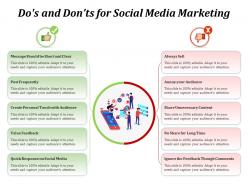
The image presents a set of guidelines titled "Do's and Don'ts for Social Media Marketing," clearly divided into positive (green) and negative (red) advisories, with corresponding thumbs up or down icons.
On the Do's side:
1. "Message Should be Short and Clear" implies the importance of concise and understandable communication.
2. "Post Frequently" suggests maintaining an active presence to keep the audience engaged.
3. "Create Personal Touch with Audience" encourages building a connection that feels individualized and genuine.
4. "Value Feedback" stresses the need to consider and appreciate user feedback.
5. "Quick Response on Social Media" highlights the importance of timely interaction to keep audiences engaged and supported.
On the Don'ts side:
1. "Always Sell" warns against the constant promotion which can be off-putting.
2. "Annoy your Audience" brings attention to the adverse effects of irritating content or spammy behavior.
3. "Share Unnecessary Content" emphasizes avoiding irrelevant posts that could dilute brand message.
4. "No Share for Long Time" indicates the negative impact of infrequent updates, which may cause loss of audience interest.
5. "Ignore the Feedback Through Comments" advises against neglecting user comments as it can harm reputation and engagement.
Use Cases:
These guidelines are versatile and can be applied across different industries that use social media for marketing, customer engagement, or brand building. Here are seven industries where these slides can be particularly relevant:
1. E-commerce:
Use: Crafting effective social media campaigns to boost sales and customer engagement.
Presenter: Marketing Team Lead
Audience: Social Media Managers
2. Hospitality:
Use: Engaging with customers to promote destinations, deals, and customer service.
Presenter: Social Media Strategist
Audience: Hotel Marketing Staff
3. Healthcare:
Use: Sharing valuable health tips and connecting with patients in a personable manner.
Presenter: Communications Manager
Audience: Hospital Administrators
4. Entertainment:
Use: Promoting new releases, events, and interacting with the fan base.
Presenter: Social Media Coordinator
Audience: Public Relations Team
5. Education:
Use: Interacting with current and prospective students and sharing educational content.
Presenter: Admissions Director
Audience: University Social Media Committee
6. Non-profit:
Use: Mobilizing supporters and sharing success stories to inspire action and donations.
Presenter: Outreach Manager
Audience: Non-profit Staff and Volunteers
7. Technology:
Use: Launching new products, offering tech support, and collecting user experiences for improvement.
Presenter: Product Manager
Audience: Customer Support Team
Dos and donts for social media marketing with all 2 slides:
Use our Dos And Donts For Social Media Marketing to effectively help you save your valuable time. They are readymade to fit into any presentation structure.

FAQs for Dos and donts for
Honestly, focus on four things: solid goals, really understanding who you're trying to reach, posting stuff that's actually useful, and talking back to people who comment. Most people screw up the content bit - they just throw random posts out there. Pick like 2-3 platforms instead of being everywhere at once, trust me on that one. Track the metrics that actually matter for your business, not just how many followers you have (though I get it, those numbers are tempting to watch). Start by looking at what you're doing now and figure out which platforms are actually working for you.
Start with the people already buying from you - check their demographics and what they're into online. Facebook Insights is honestly amazing for this stuff, same with Instagram Analytics. See who's commenting on your posts and which content actually gets engagement. I'd also peek at your competitors' followers (yeah, a little stalking but whatever). Build some buyer personas from all this - basically just detailed profiles of who you want to reach. Then test small campaigns on different groups. Some will flop, others might surprise you. The data doesn't lie though, so go with what converts.
Dude, content quality is everything when it comes to getting people to actually engage with your stuff. Like, you scroll past boring posts too, right? Good content gets more likes, comments, and shares because it actually gives people something useful. Trust me on this - your followers can tell when you're just phoning it in. Posts that teach something new or make people laugh always do better. Oh, and make sure your photos don't look like garbage because that matters way more than people think. Write captions that actually add value instead of just describing what's in the picture.
Honestly, analytics are a game changer because you'll actually see what's working instead of just throwing stuff at the wall. Like, I was shocked when I found out my audience was way more active at 2pm than evenings - totally changed my posting schedule. You can track engagement on different posts, see who's actually following you (spoiler: might not be your target demo), and figure out which content types hit. The cool part is spotting patterns over time. Maybe your carousel posts always flop but videos kill it. Then you just do more of what works and drop the rest. I'd start with just one metric though so you don't get overwhelmed.
Honestly, start with decent lighting if you're using your phone - makes such a huge difference. Keep your brand colors and fonts consistent across everything. White space is your friend; cluttered posts just get scrolled past. I always make my text way bigger than I think I need because people are scrolling fast on mobile. Bold colors with good contrast help you pop in feeds. Oh, and create a couple simple templates you can reuse - saves me so much time and everything looks cohesive without trying too hard. Quality images are a must, but don't overthink it.
Honestly, you've gotta stay on top of what people are saying about your brand 24/7. Google Alerts are your friend here - plus those social listening tools that catch stuff across all platforms. If someone complains publicly, acknowledge it but then move the real conversation to DMs. Nobody wants to see brands getting into comment wars (learned that one the hard way). Stay professional even when they don't. Here's the thing though - don't just wait for problems. Share customer wins and behind-the-scenes stuff regularly so you've got some goodwill banked when things go sideways.
Ok so branded hashtags are huge - just make sure you're actually using them consistently. Contests work crazy well because people will literally do anything for free stuff lol. I'd definitely repost customer photos in your stories and tag them, makes people feel special. Also ask direct questions in captions to get responses going. Micro-influencers are great too since their followers trust them more than big accounts. Oh and don't try everything at once - pick one thing first and see what actually works for your specific audience before moving on.
Honestly, it makes a huge difference. When people scroll past your content, you want them to instantly know it's yours - even without the logo showing. Your brand should feel like the same person across every platform. Sure, you'll be more casual on TikTok than LinkedIn (duh), but that core personality stays consistent. It's like how you text differently to your mom vs your best friend, but you're still... you, you know? I'd write down your main brand traits and share them with anyone making content. Trust me, it'll save you so much back-and-forth later.
Okay so first thing - always disclose your sponsorships and partnerships. The FTC doesn't mess around with that stuff. Don't buy fake followers either, it's so obvious and just looks desperate. Be upfront about what your products actually can't do too. Privacy matters - get consent before grabbing people's data. And honestly? Skip the fear-mongering tactics. Nobody likes being manipulated into buying something. I always think about how I'd want brands to talk to me, you know? Take a look at your current campaigns and see where you might be cutting corners ethically.
Honestly, just pick 1 or 2 platforms where your customers actually are - don't spread yourself thin everywhere. I spend way too much time on platforms where nobody even sees my stuff lol. Behind-the-scenes content works amazing and costs literally nothing. Quick tips, customer features, that kind of thing. Post regularly even if it's not perfect. That consistency thing is so real. I'd rather see someone post mediocre content daily than perfect posts once a month. Just do like 15-20 minutes a day to start. And actually respond to comments! Your personality is what makes people want to follow you anyway.
So AI content tools are everywhere now, which is honestly pretty crazy. Short videos are still crushing it - basically everything's becoming TikTok at this point. Forget the big celebrity partnerships though, micro-influencers with actual engaged audiences are where it's at. Oh, and social commerce is huge - people literally buy stuff without leaving Instagram or whatever. But here's the thing: you really want to focus on building actual communities. Private groups, live Q&As, polls that people actually care about. It's way better than just shouting into the void hoping someone double-taps. Start testing this stuff now before everyone else catches on.
Honestly, speed is everything here - don't let those comments just sit there getting worse. Jump in fast, acknowledge what they're saying publicly, then try moving it to DMs for the real conversation. I've watched companies completely blow this by getting all defensive or using those obviously copy-pasted responses (customers can smell that from a mile away). Own up if you screwed something up. Offer an actual fix, not just words. Other people are definitely watching how you handle it, even if the original person stays mad. Oh, and set up notifications so you're not finding out about drama three days later!
So influencers are basically like having someone with a loyal following shout about your stuff to people who actually care what they think. You want to find ones whose audience matches who you're trying to reach - don't just chase follower counts, that's a rookie mistake I definitely made before. Their content feels way more like a friend's recommendation than some random ad. Honestly, micro-influencers are where it's at. They'll engage better with their people and won't completely drain your marketing budget either.
Focus on metrics that actually make you money - conversion rates from social traffic, cost per acquisition, customer lifetime value. UTM parameters are your friend here, they'll show you in Google Analytics which posts drive real sales. Honestly, follower count is such a trap (been there!). Track the stuff that matters: email signups, demo requests, purchases. I always get distracted by likes and shares but those don't pay the bills. Pick maybe 2-3 metrics max and stick with them. Way easier than drowning in data.
Honestly, the scariest thing is when negative comments blow up or you accidentally post something that makes everyone mad. Privacy stuff can bite you too if you're sloppy with data. Here's what actually works: Monitor everything obsessively - set up Google alerts and have someone ready to jump on problems fast. Don't just delete angry comments unless they're genuinely awful; respond instead. Learned that one the hard way! Get a solid approval process going, especially for anything remotely controversial. Oh, and definitely have a crisis plan ready before you need it. Trust me on that.
-
Awesomely designed templates, Easy to understand.
-
Content of slide is easy to understand and edit.
-
Very unique and reliable designs.