


Ecological Footprints Components Breakdown Analysis




Try Before you Buy Download Free Sample Product
 Impress Your
 Audience
 100%
100% Editable
 Save Hours
 of Time


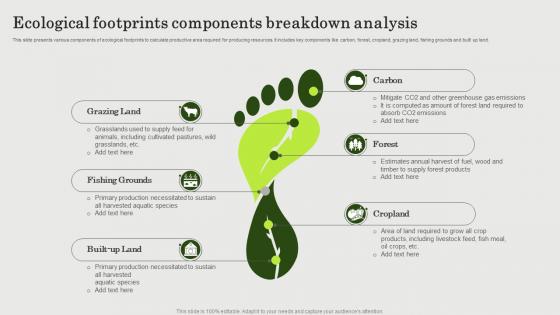
This slide presents various components of ecological footprints to calculate productive area required for producing resources. It includes key components like carbon, forest, cropland, grazing land, fishing grounds and built up land.
People who downloaded this PowerPoint presentation also viewed the following :
Ecological Footprints Components Breakdown Analysis with all 6 slides:
Use our Ecological Footprints Components Breakdown Analysis to effectively help you save your valuable time. They are readymade to fit into any presentation structure.





FAQs for Ecological Footprints
The primary components contributing to an individual's ecological footprint include energy consumption, transportation choices, food production and consumption, housing and infrastructure demands, and waste generation patterns. These factors collectively determine resource usage through daily activities like commuting, dietary preferences, and consumption habits, with many sustainability-focused organizations finding that strategic lifestyle modifications across these areas deliver significant environmental impact reductions and long-term cost savings.
The ecological footprint measures humanity's demand on nature versus Earth's regenerative capacity, directly informing sustainable development by identifying resource consumption limits, environmental impact thresholds, and conservation priorities. Through footprint analysis, organizations streamline resource allocation, enhance operational efficiency, and minimize environmental costs while delivering competitive advantages, with many companies finding that sustainable practices ultimately reduce expenses and strengthen market positioning.
Urban areas can reduce their ecological footprints through green building standards, public transportation expansion, renewable energy adoption, waste reduction programs, and urban agriculture initiatives. These strategies streamline resource consumption while enhancing operational efficiency, with many cities finding that integrated approaches like smart grid systems and vertical farming ultimately deliver significant cost savings and improved quality of life for residents.
Consumer behavior significantly influences ecological footprints through purchasing decisions, energy consumption patterns, transportation choices, dietary preferences, and waste generation habits. These behaviors directly impact resource demand and environmental pressure, with many individuals finding that strategic shifts toward sustainable consumption, local sourcing, and circular economy practices ultimately deliver meaningful footprint reductions while enhancing long-term resource security.
Ecological footprints vary dramatically between countries, with developed nations like the United States, Australia, and Canada consuming 3-5 times their biocapacity, while developing countries often maintain footprints below global averages. These disparities reflect differences in energy consumption, industrial activity, and lifestyle patterns, with many organizations finding that resource-intensive economies face increasing sustainability pressures and competitive disadvantages in environmentally conscious markets.
Individuals can lower their ecological footprint through energy conservation, sustainable transportation choices, waste reduction, mindful consumption, and water efficiency measures. These approaches streamline environmental impact by minimizing resource usage, choosing renewable alternatives, and adopting circular economy principles, with many households finding that simple changes like LED lighting, public transit, and reduced meat consumption deliver significant reductions while lowering utility costs.
Businesses calculate ecological footprints through carbon audits, resource consumption tracking, waste analysis, supply chain assessments, and environmental management systems. Through these comprehensive evaluations, organizations identify reduction opportunities like energy efficiency upgrades, sustainable sourcing, and waste minimization programs, ultimately delivering cost savings and competitive advantages while meeting increasingly stringent environmental expectations.
Food consumption significantly impacts ecological footprints, with meat-based diets requiring substantially more land, water, and energy resources compared to plant-based alternatives, while generating higher greenhouse gas emissions. Organizations in hospitality, healthcare, and corporate catering increasingly find that strategic menu shifts toward plant-forward options deliver cost reductions, operational efficiency, and enhanced sustainability credentials.
Renewable energy use significantly reduces a community's ecological footprint by decreasing carbon emissions, minimizing resource extraction, and reducing waste generation from fossil fuel consumption. Through solar, wind, and hydroelectric systems, communities achieve lower environmental impact, enhanced energy independence, and cost savings, with many municipalities finding that strategic renewable adoption delivers both sustainability goals and long-term economic advantages.
Education about ecological footprints drives policy change by raising public awareness, creating voter demand for environmental legislation, and providing policymakers with data-driven insights for decision-making. Through educational campaigns, citizens increasingly pressure governments for sustainable policies, carbon taxation, and resource management regulations, with many municipalities finding that informed communities actively support green infrastructure investments, ultimately delivering both environmental protection and economic competitiveness.
Ecological footprint limitations include oversimplified calculations, exclusion of pollution and toxicity impacts, lack of regional variations, and inability to capture resource quality differences. While organizations increasingly use this metric for sustainability reporting, many businesses find that combining ecological footprint data with lifecycle assessments and carbon tracking delivers more comprehensive environmental insights, ultimately enabling better strategic decisions for sustainable operations.
Transportation significantly impacts ecological footprints through fuel consumption, emissions production, and infrastructure demands, with personal vehicles, air travel, and freight transport being primary contributors. Alternative approaches include public transit systems, electric vehicles, cycling infrastructure, carpooling programs, and remote work policies, with many cities finding that integrated transportation networks reduce individual carbon impacts while delivering cost savings and improved urban air quality.
Ecological footprint measures total environmental impact including land, water, and resource use, while carbon footprint specifically tracks greenhouse gas emissions. Carbon footprint represents a significant component within the broader ecological framework, with organizations increasingly finding that reducing carbon emissions through energy efficiency, sustainable transportation, and renewable technologies simultaneously minimizes their overall ecological impact and operational costs.
Technology reduces ecological footprints through smart sensors, AI-powered energy management, IoT monitoring systems, automation platforms, and data analytics tools. These solutions streamline resource consumption, optimize supply chains, and minimize waste across manufacturing, transportation, and agriculture, with many organizations finding that strategic technology integration delivers both environmental sustainability and operational cost reductions.
Biodiversity significantly influences a region's ecological footprint by determining ecosystem resilience, resource productivity, and natural service efficiency. Diverse ecosystems like rainforests and coral reefs support more life with less resource consumption per unit, while regions with declining biodiversity often require increased external inputs for agriculture, water purification, and climate regulation, ultimately expanding their ecological demands.
-
Great work on designing the presentation. I just loved it!
-
Eye-catching PPT designs, outstanding team, and best customer service. I’m a super satisfied customer here!