

Economic Feasibility Dashboard Covering Cost Benefit Analysis





Try Before you Buy Download Free Sample Product
 Impress Your
Audience
 100%
Editable
 Save Hours
of Time


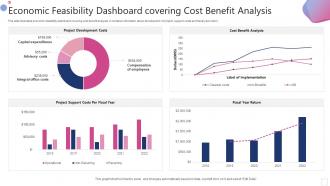
This slide illustrates economic feasibility dashboard covering cost benefit analysis. It contains information about development of project, support costs and fiscal year return.
People who downloaded this PowerPoint presentation also viewed the following :
Economic Feasibility Dashboard Covering Cost Benefit Analysis with all 7 slides:
Use our Economic Feasibility Dashboard Covering Cost Benefit Analysis to effectively help you save your valuable time. They are readymade to fit into any presentation structure.






FAQs for Economic Feasibility Dashboard Covering
Okay so basically you start by figuring out your project scope and who's getting impacted. List every single cost and benefit - even the random small stuff that doesn't seem important. Some benefits are a pain to put dollar signs on, but do your best to quantify what you can. Calculate net present value with whatever discount rate makes sense. Then run sensitivity analysis to see how different scenarios play out. Oh and seriously, this always takes way longer than you think it will, so pad your timeline. I learned that one the hard way lol.
Look for proxy measures or compare to market rates. Reduced turnover costs work well for employee satisfaction - or see what competitors spend on retention. Customer goodwill is honestly such a pain to measure, but everyone agrees it matters. Try willingness-to-pay surveys or see how brand reputation affects market share. Contingent valuation surveys are another option where you straight-up ask people what they'd pay for improvements. Oh, and work backwards from whatever data you've already got. Sometimes the best proxy is hiding in plain sight.
So risk assessment is basically accounting for all the stuff that could go sideways in your cost-benefit analysis. You can't just assume everything goes perfectly - that'd be amazing but totally unrealistic. What you do is look at different scenarios and figure out how likely each one is. Run some sensitivity tests, map out best and worst cases, maybe weight different outcomes by probability. Honestly, the whole point is just being honest about uncertainty. Because when reality hits (and it always does), you want your recommendation to actually make sense instead of falling apart.
Honestly, cost-benefit analysis is your friend here. List out everything first - dev costs, time, resources, then potential revenue and efficiency gains. The tricky part is putting dollar amounts on stuff (some things are just hard to quantify, you know?). Once you've got numbers, calculate net present value or a simple benefit-cost ratio. If benefits beat costs, you're golden. What's nice is you can compare different projects this way too. Just don't do it once and forget - revisit those numbers as things change. Makes it way easier to sell stakeholders on why your project matters.
Honestly, the worst thing you can do is be way too optimistic about costs and benefits - I've seen so many projects crash because of this. Don't ignore the weird stuff either, like how pissed off your employees might get or if it'll trash your company's reputation. Those things matter more than people think. Also, remember that money in the future isn't worth what it is today, so discount those cash flows properly. The other trap? Only looking at data that backs up what you already decided you want to do. Include everyone early on and actually listen to them.
The discount rate basically controls your whole CBA - it's what converts future money into today's value. Higher rates make future benefits worth way less, so long-term stuff like green projects get screwed over. Lower rates flip that around. Honestly, picking the "right" rate is such a pain because economists argue about it constantly. There's no perfect answer. What I'd do is test a few different ones - maybe 3%, 7%, and 10% - just to see if your project still makes sense across the board. If it only works at super low rates, that's... probably not great.
Look at three main buckets: direct costs (salaries, materials, equipment - the obvious stuff), opportunity costs, and indirect costs like overhead. Most people totally ignore opportunity cost but that's where you get burned later. Break down implementation vs ongoing operational costs too - they're different beasts. Implementation might be expensive upfront but if operational costs are low, could still be worth it. Start by dumping everything into those categories, then put dollar signs on what you can. Don't stress if some numbers are rough estimates at first.
Get stakeholders involved from day one - they'll spot costs and benefits you'd never think of. Map out everyone who's impacted first. Then hit them up with surveys, workshops, whatever works to get their input on trade-offs. Honestly, I've seen analysts miss huge hidden costs that stakeholders knew about all along. Share your methodology upfront and definitely run draft findings by them before you wrap up. Treat them like actual partners, not just people to extract info from. Regular check-ins keep everyone engaged too. Trust me, their buy-in makes all the difference in the end.
So financial CBA is just about your company's bottom line - what you spend vs what you make. Pretty straightforward stuff. Economic CBA though? That's where it gets interesting because you're looking at the whole picture. Environmental impact, public health, social benefits - all that messy real-world stuff that doesn't show up on your balance sheet. Honestly, I'd start with the financial angle first to see if your project even makes sense for your budget. Then if you need to sell it to bigger stakeholders or prove it's worth doing for society, that's when you'd dive into the economic analysis.
Honestly, cost-benefit analysis is clutch for stuff with clear numbers - like infrastructure projects or tech upgrades where you can actually calculate ROI. Historical data makes it way more accurate too. But don't even bother with creative projects or fuzzy strategic stuff where the value is all over the place. I learned this the hard way trying to use it for everything at my old job lol. Works great for operational decisions though. Just make sure everyone agrees on what "success" means first, or you'll be arguing about metrics forever.
Ugh, regulatory changes are such a pain - they can totally wreck your cost-benefit analysis without warning. You might suddenly face compliance costs you never saw coming, or the whole timeline gets pushed back. Sometimes the competitive landscape shifts too, which messes with your benefit projections. Honestly, I think it's one of the hardest things to predict in any analysis. Your discount rates need adjusting if uncertainty goes up. Market conditions change. And if regulations fundamentally alter how your project works? You're basically starting over with the framework. Build in scenario planning early and watch those regulatory pipelines like a hawk.
Honestly, just start with Excel - it's what everyone uses and handles the math fine. Most people way overthink this stuff. If you need fancier risk analysis later, @RISK and Crystal Ball are solid for Monte Carlo simulations. TreeAge works great for decision trees too. But seriously, a good Excel template covers like 90% of what you actually need for CBA work. Once you're doing this stuff regularly though, maybe look into CostBenefit or build some Tableau dashboards. I'd stick with the basics first and see what gaps you hit before spending money on specialized tools.
So basically, cost-benefit analysis lets you slap dollar signs on your strategic options and actually compare them properly. Super helpful for prioritizing stuff and showing leadership real numbers instead of just "trust me on this." Yeah, some benefits are impossible to quantify (like employee morale - good luck with that), but it's way better than winging major decisions. Be honest about your assumptions though. Work with finance to build solid models. The whole thing falls apart if you're too optimistic about timelines or benefits. Start by listing everything - both the obvious costs and the weird indirect impacts you might miss.
Look at who's actually getting heard in your analysis vs who's getting ignored. CBA is notorious for screwing over vulnerable groups - they can't pay much for benefits and don't have lobbying power. A park in a rich neighborhood will always seem more "valuable" than one in a poor area if you're just measuring willingness to pay, which is honestly pretty messed up. Some stuff probably shouldn't be turned into dollar signs anyway. Ask yourself: who wins, who loses, and does your data actually reflect what the affected communities care about? That's where you'll spot the real ethical issues.
Oh man, culture totally changes how people read CBA results. Different societies care about completely different stuff - like some cultures prioritize individual money gains while others are all about what's best for the whole community. Time preferences are wild too - some groups want quick returns, others think in like 50-year spans. Your stakeholders' backgrounds will totally shift how they view risk and what counts as "success." Even intangible benefits get weighted differently. Honestly, I'd always run your findings past someone from that cultural background before presenting. You don't want to miss something obvious that could tank your whole argument.
-
World-class PowerPoint designs that are fully customizable!
-
Extensive range of templates! Highly impressed with the quality of the designs.