


Budget Vs Actual Cost Comparison Dashboard




Try Before you Buy Download Free Sample Product
 Impress Your
 Audience
 100%
100% Editable
 Save Hours
 of Time


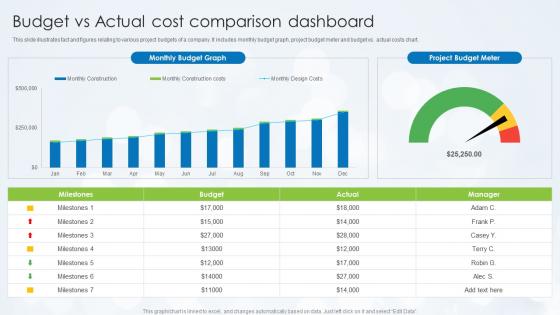
This slide illustrates fact and figures relating to various project budgets of a company. It includes monthly budget graph, project budget meter and budget vs. actual costs chart.
People who downloaded this PowerPoint presentation also viewed the following :
Budget Vs Actual Cost Comparison Dashboard with all 7 slides:
Use our Budget Vs Actual Cost Comparison Dashboard to effectively help you save your valuable time. They are readymade to fit into any presentation structure.





FAQs for Budget Vs Actual
Budgeted costs are just your best guess at what you think you'll spend - based on past projects, estimates, whatever data you had at the time. Actual costs? That's reality hitting you in the face. Things always come up that mess with your original plan. Labor runs over, materials cost more than expected, scope creep happens (it always does). Honestly, I've never seen a project where these two numbers matched perfectly. Keep tracking both so you can catch problems early. Way easier to fix things when you spot the gap right away instead of at the end.
Look, budget variances are basically your financial red flags - they tell you when something's going sideways before it gets really messy. Big differences mean you need to dig into why costs went crazy and figure out your next move. Maybe reallocate some money, tweak future budgets, or honestly just change direction entirely. Nobody wants financial surprises (learned that one the hard way). The trick is catching this stuff early with regular check-ins. Otherwise you're just crossing your fingers until the quarterly report hits and by then it's too late to do much about it.
Do regular variance analysis - compare what you budgeted vs what you actually spent each month. Percentages work better than raw dollar amounts for context. Excel's totally fine for smaller stuff, but bigger projects? Get QuickBooks or proper project management software. Only sweat the big variances, like 10%+ differences. Minor stuff will drive you crazy if you obsess over it. Pick your tracking system and actually stick with it (this is where most people fail). Oh, and set up alerts when you hit certain spending thresholds - way easier to fix things early than scramble later.
Look at your past budget vs actual numbers from the last year or two - you'll start seeing patterns pretty quickly. Maybe marketing always goes over in Q4, or office supplies consistently come in way under. Most people just guess at this stuff, which is kinda crazy when you think about it. Pull the data and make simple reports showing percentage differences by category. Check for seasonal trends too - like do you always spend more on travel in spring? External stuff matters as well, so note when weird events threw everything off. Honestly, once you categorize the variances, the patterns become super obvious and you can actually plan for them.
Think of forecasting as your budget's best friend - it uses past data and trends to predict what you'll actually spend. Good forecasts mean your budget won't be wildly off when reality hits. I've learned this the hard way, honestly. Compare your actual costs to what you budgeted later and you'll see how accurate your predictions were. Smaller gaps = better forecasting skills. This whole process helps you make smarter decisions and avoid those "wait, we spent HOW much?" moments. Keep notes on which methods work best for you - it'll make next year's budget way less stressful.
So variance analysis is basically your treasure map for spotting where things go wrong operationally. Consistent overruns in certain spots? That's where you dig. Maybe procurement's being slow so you're getting hit with rush fees, or you're short-staffed and drowning in overtime costs. Honestly, I'm kind of a nerd about this stuff because numbers tell the real story. Don't get hung up on random one-time spikes though - look for actual patterns across several periods. The trick is asking "why" behind each big variance, then fix the actual problem instead of just putting a band-aid on it.
Honestly, the worst thing people do is assume everything will go perfectly - like nothing will break or go over budget. Companies just copy last year's numbers without thinking about what's actually changed. Big mistake not getting department heads involved from the start since they're the ones actually spending the money. I'd throw in a 10-15% buffer for when stuff inevitably goes sideways. Track monthly instead of waiting until December to realize you're screwed. Your budget isn't set in stone either - you gotta be ready to tweak it when reality hits. Trust me on this one.
Honestly, just grab something like Monday or Asana - they'll sync straight from your bank accounts and credit cards so you don't have to mess with spreadsheets anymore. Set up alerts when you're hitting your budget limits. The dashboards are pretty solid too, lots of visual stuff that actually makes sense. I'd probably start with just one expense category though, don't go crazy right away. QuickBooks works too if you're already using it for other stuff. Way better than manually tracking everything like some kind of masochist.
Make your variances super obvious with visual charts - color coding is your friend here (red/green, though some people get touchy about red meaning "bad"). Show percentages AND dollar amounts because honestly, a $10k overrun means nothing without context. Is that on a $50k budget or $500k? Huge difference. Don't just dump numbers on people. Explain what actually caused the big variances in normal language. The most important part? Come with solutions, not just problems. Nobody wants to sit through a meeting where you just list everything that's broken without a plan to fix it.
So budget vs actual analysis is basically your early warning system for cash flow problems. When you spot variances - like blowing 30% more on marketing than planned - you know that cash won't be there for other stuff. Timing's huge too though. You could be under budget overall but still get screwed if all your expenses hit in week one instead of spreading out over the month. I learned this the hard way last year! Track both what you're spending and when it actually leaves your account. Short sentences help you catch issues faster.
Honestly, variance analysis is like your financial GPS for making better calls. You're comparing what you budgeted versus what actually happened - super useful for spotting patterns. Say marketing always goes over budget while IT consistently comes in under. Now you know where to reallocate next time. Track these trends over a few cycles and you'll see which departments need more cash, which revenue streams are worth doubling down on. It's way better than just guessing where your money should go. The whole point is using that historical data to make your next budget way more realistic.
Ugh, going over budget repeatedly is such a mess - it totally kills your credibility with stakeholders and makes getting future funding way harder. Your team starts treating budgets like rough guidelines instead of actual limits, which honestly makes sense from their perspective. The worst part? You get stuck putting out fires instead of actually planning ahead, so the cycle just continues. I'd start tracking where these overruns happen most. Are you being too optimistic upfront? Is scope creep sneaking in? Sometimes it's just external stuff you can't control, but you need to figure out the pattern first.
So budget variances only tell half the story, right? You need those non-financial metrics to figure out if your overspending was actually smart or just wasteful. Like yeah, maybe you blew 20% more on labor costs, but check your productivity rates and quality scores first. Were there supply chain issues that slowed things down? Sometimes extra spending keeps your standards high when everything else is falling apart. I always look at cycle times and defect rates alongside the money stuff. That way you can tell the difference between necessary costs and actual inefficiency that needs fixing.
Honestly, the biggest game-changer is getting your hands on solid historical data and actually talking to the people doing the work. Seriously, I've watched so many budgets crash because someone made them up in a conference room! Build in some buffer money for the weird stuff that always pops up. Review your numbers every quarter instead of ignoring them for a year. Oh, and definitely track where you're consistently wrong - those patterns will surprise you. Maybe start with just one department first? Way easier than trying to fix everything at once and then realizing you've created a mess.
Ugh, external economic stuff is such a pain for budgets. Inflation hits way harder than you think it will. Interest rates shift, supply chains get messed up - suddenly your costs are nothing like what you planned months back. Currency changes are the worst because they sneak up on you. Revenue drops while expenses go crazy, and boom - your budget's completely off. Honestly, I learned this the hard way last year. You've gotta build in some wiggle room and check your assumptions every few months. Otherwise you're just flying blind when everything shifts.
-
SlideTeam was so customer-centric and quick service-provider that I doubted the amount I was paying and literally re-checked the transaction.
-
Amazing product with appealing content and design.