


Effective Sales Prospecting Techniques Training Ppt




Try Before you Buy Download Free Sample Product
 Impress Your
 Audience
 100%
100% Editable
 Save Hours
 of Time


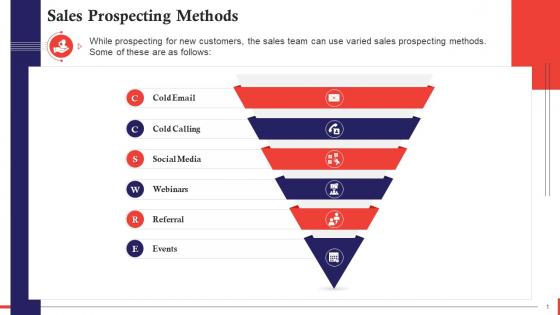
These slides depict the methods of sales prospecting for professionals. The sales team employs many sales prospecting methods while prospecting for new customers. Cold email, cold calling, social media, webinars, referrals, and events are some of the methods mentioned.
People who downloaded this PowerPoint presentation also viewed the following :
Content of this Powerpoint Presentation
Slide 1
This slide depicts the methods of sales prospecting. It emphasizes that the sales team employs many sales prospecting methods while prospecting for new customers. Cold email, cold calling, social media, webinars, referrals, and events are some of the methods mentioned.
Slide 2
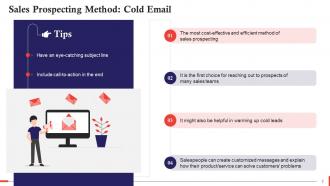
This slide discusses cold email in the context of sales prospecting. It emphasizes that cold email is the most cost-effective and efficient method of sales prospecting, and it is many sales teams' first choice for reaching out to prospects. It also mentions that salespeople can create customized messages and explain how their product/service can solve their customers' problems.
Slide 3
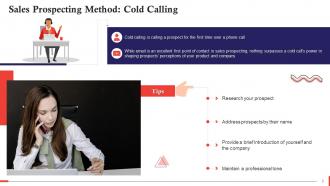
This slide discusses cold calling in the context of sales prospecting and mentions that cold calling is the first time you call a prospect. While email is a great first point of contact for sales prospects, nothing surpasses the power of a cold call in shaping prospects' perceptions of your product and company.
Slide 4
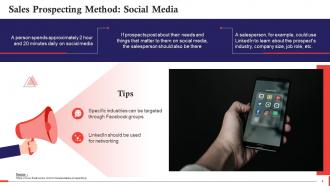
This slide explains social media in the context of sales prospecting. It highlights that the average person spends about two hours and twenty minutes daily on social media. It also states that if prospects post about their needs and what is important to them on social media, the salesperson should be present there too.
Slide 5
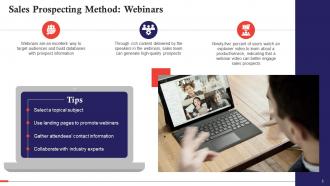
This slide describes webinars in terms of sales prospecting. It highlights that webinars are an excellent way to target audiences and build prospect databases. It also mentions that the high-quality prospects are generated by the rich content delivered by the speakers in the webinars.
Slide 6
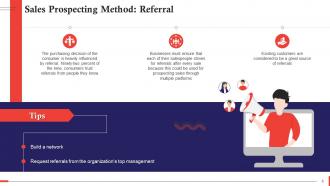
This slide describes referrals in terms of sales prospecting. It emphasizes that referrals significantly impact a consumer's purchasing decision and that existing customers are a great source of referrals. It also mentions that businesses must ensure every salesperson strives for referrals after each sale.
Slide 7
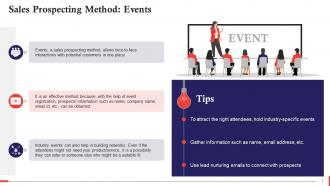
This slide describes events in terms of sales prospecting. It highlights that events, as a sales prospecting method, allows face-to-face interactions with potential customers in one location. It also mentions that industry events can help with network building. Even if the attendees do not require your product or service, they may be able to refer someone who does.
Effective Sales Prospecting Techniques Training Ppt with all 23 slides:
Use our Effective Sales Prospecting Techniques Training Ppt to effectively help you save your valuable time. They are readymade to fit into any presentation structure.








FAQs for Effective Sales Prospecting
Honestly, LinkedIn Sales Navigator is gold for finding the right people. Ask your current customers for referrals too - that stuff converts like crazy compared to cold calls. Content marketing works if you're patient, but cold outreach is brutal now since everyone's drowning in emails. Industry events are solid, and I've had decent luck with ZoomInfo for contact info. Online communities where your prospects actually spend time? Worth checking out. Mix warm and cold approaches though - you can't rely on just one thing anymore. Oh, and seriously, start with your happy customers asking who else they know.
Honestly, tech can save you tons of time on prospecting if you don't go crazy with it. Start with a good CRM - it'll handle your follow-ups and track who you've talked to. LinkedIn Sales Navigator is gold for finding the right people based on whatever criteria you need. I'd grab an email automation tool too, but don't sound like a complete robot when you use it. Social selling platforms help you connect on their turf first before jumping into your pitch. Here's the thing though - pick ONE tool that fixes your biggest headache and actually learn it before adding more stuff.
Dude, social media is where it's at for finding prospects these days. You can stalk people (in a good way lol), see their connections, and jump into conversations they're already having. LinkedIn's obviously king for business stuff, but Twitter works too - even Instagram if that's where your people are. Here's the thing though: don't be that annoying sales guy who slides into DMs immediately. Actually follow them first. See what problems they're complaining about, check out their posts. Then engage for real for a couple weeks before you even think about pitching anything. Social listening beats cold outreach every time.
BANT framework is your friend here - Budget, Authority, Need, Timeline. Start by making sure they actually feel pain around the problem you're solving. Do they have budget set aside or can they get approval? Super important to talk to someone who can actually make decisions - I've wasted so many hours with people who have zero buying power, ugh. Check if their timeline makes sense with how long your sales process takes. Hit 3 out of 4 and you're golden to keep pursuing them.
Dude, biggest rookie moves are sending those generic copy-paste messages and not doing any homework on who you're contacting. Also being super pushy immediately - like chill. Don't blast people across LinkedIn, email AND phone at the same time either. Makes you look desperate honestly. Actually listen when they respond instead of just waiting to jump into your pitch. Oh, and forget your quota exists for a hot second. Be genuinely curious about what problems they're dealing with. Treat them like actual people, not just potential commission checks.
Dude, personalization is a game changer because it proves you actually looked into their company instead of copy-pasting to everyone. Reference their recent funding round or that article about their expansion - suddenly you're not just another spam email. Those "Dear [FIRST_NAME]" messages? Straight to trash. But drop something specific about their industry challenges and boom, you're actually worth their time. Honestly, even swapping out one generic sentence for something tailored to their business will boost your response rates. It's wild how much difference that small effort makes.
Track your call/email activity first - basic stuff like how many touches you're making. But honestly? Most people get obsessed with those numbers and miss the important part. Response rates matter way more. Look at your meeting conversion rates and how much pipeline you're actually generating from all that prospecting work. Time from first contact to qualified opp is huge too. I'd check these weekly - you'll figure out pretty fast what's bombing and what's crushing it. Quality beats quantity every time.
Hit them up 5-7 times over a couple weeks, but don't be that person who just says "following up on my last email" - honestly those make me cringe. Switch between email, LinkedIn, and calls every 2-3 days at first, then go weekly. Each time, mention something new about their company or reference what you talked about before. Shows you're actually paying attention, not just blasting everyone. Most deals don't happen until after the 5th attempt anyway, so stick with it. Just make sure each message adds something useful instead of being annoying.
Just ask your happy clients straight up: "Who else do you know dealing with this stuff?" Way better than that vague "know anyone who might need this" thing everyone does. Once they give you a name, see if they'd make a quick intro over email or LinkedIn. Most people will totally do it if you don't make it weird. I actually write the intro message myself sometimes - takes all the work off them. Then follow up fast and mention the referral right away. Instant street cred, honestly. Oh and the warm intro thing works way better than cold outreach, obviously.
Dude, content marketing is seriously where it's at for getting leads. Instead of cold calling people (ugh), you create stuff that actually helps them with their problems. So when they're googling around trying to figure things out, they find your blog posts or videos. Then they're like "oh this company gets it" and boom - qualified lead. These people are way better than random prospects too since they've done their homework already. I always tell people to start by figuring out what keeps their customers up at night, then write about that. Works every time.
Honestly, most people just wing it and wonder why cold calling sucks. Do some actual research first - find something specific about their company or industry problems before you call. Your opening should be under 30 seconds, then get them talking by asking questions about their situation. Don't launch into your pitch right away. Think conversation, not presentation. Have a simple next step ready that doesn't feel pushy - maybe just a quick follow-up call. Oh, and practice your opener until it doesn't sound like you're reading a script. That's probably the biggest giveaway.
Dude, prospecting tools are a game changer. HubSpot and Salesforce help organize your leads - though Salesforce can be overkill if you're just starting out. For LinkedIn stuff, Sales Navigator is clutch for targeted outreach. ZoomInfo and Apollo work great for contact info and list building. Email automation is where things get interesting. Outreach and Salesloft let you set up sequences so you're not manually hitting send all day. Honestly? Pick one tool per category first. I made the mistake of trying five different platforms at once and got nowhere fast. Master the basics, then expand.
Dude, buyer personas are a game changer. Instead of blasting generic messages everywhere, you actually know what makes your customers tick. Their problems, what they're trying to achieve, how they decide stuff. Your messages will hit different when you speak their language - no more sounding like every other salesperson cluttering their inbox. Honestly, I used to think it was just marketing fluff until I tried it. Interview your best customers first. That's where the real insights are. You'll stop wasting time on dead-end leads and your response rates will actually improve.
Look, most people screw this up by jumping straight into features nobody cares about. Do your homework first - mention something specific about their company so they know you're not just blasting everyone. Then focus on their actual problem and how you fix it. I always use a concrete example they can picture themselves in. Here's the thing though - don't end with some weak "let me know if you're interested." That's basically asking them to ghost you. Instead, suggest a specific meeting time or demo. Way better response rate when you give them something concrete to say yes to.
You gotta match your approach to how each industry actually buys stuff. B2B tech? LinkedIn and conferences work best since everything takes forever and involves like 10 people. Healthcare folks prefer calls over social media - they're big on relationships and compliance stuff. Retail moves super fast, so stick with quick emails and phone outreach. Real estate agents basically live off referrals and local networking (seriously, it's wild how much they depend on word-of-mouth). Just figure out how your target industry likes to communicate, then don't fight it.
-
They helped us design the pamphlets for our church’s food drive! The people loved the design, and I’m happy to say it was successful. Thank you, SlideTeam!
-
Amazing slides! Unique, attractive, and easy to understand.