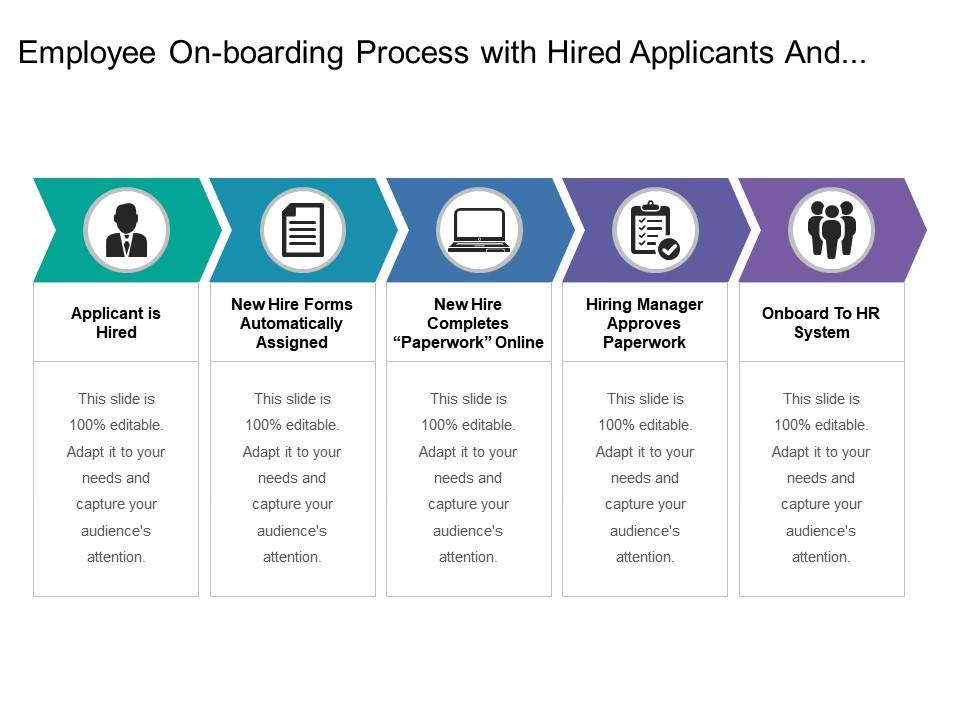
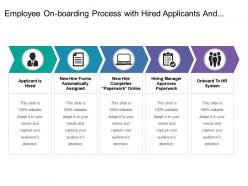
Employee on boarding process with hired applicants and on board to hr system

Rating:
80%
Slide 1 of 5

or

Favourites Favourites

Try Before you Buy Download Free Sample Product

Audience Impress Your
Audience
Editable 100%
Editable
Time Save Hours
of Time
The Biggest Sale is ending soon in
0
0
:
0
0
:
0
0
Rating:
80%
Presenting the Employee onboarding process PPT slides. This template is crafted by our PowerPoint professionals. This stunning visual PowerPoint design can be easily edited. The fonts, colors, and slide background can be easily changed according to your vision. Easily download the PPT layout in both widescreen and standard screen aspect ratios. The PowerPoint slide is compatible with Google Slides and can be introduced in JPG and PDF format.

FAQs for Employee on boarding process with hired applicants and on board

Key components of an effective employee onboarding process include pre-boarding preparation, comprehensive orientation programs, role-specific training modules, mentorship assignments, and structured feedback systems. These elements work together by establishing clear expectations, accelerating productivity timelines, and enhancing retention rates, with many organizations finding that strategic onboarding delivers improved employee engagement and reduced turnover costs.

Digital tools enhance onboarding by automating paperwork, delivering interactive training modules, providing mobile access to resources, and enabling real-time progress tracking. Through platforms offering virtual tours, chatbot support, and integrated communication systems, organizations streamline administrative tasks, accelerate time-to-productivity, and create engaging experiences, ultimately reducing turnover while improving new hire satisfaction and organizational efficiency.

Companies should track metrics including time-to-productivity, employee retention rates, engagement scores, manager satisfaction ratings, and completion rates for onboarding activities. These measurements enable organizations to identify bottlenecks, enhance new hire experiences, and streamline integration processes, with many finding that comprehensive tracking ultimately delivers faster ramp-up times and significantly improved long-term retention.

Organizations can ensure inclusive onboarding by implementing personalized welcome programs, providing diverse mentorship opportunities, offering flexible training formats, and creating cultural awareness initiatives that celebrate different backgrounds. Through structured feedback sessions and resource groups, companies streamline integration while addressing unique needs, with many finding that inclusive practices enhance employee retention, accelerate productivity, and ultimately deliver stronger team cohesion and competitive advantage.

Company culture shapes employee expectations, integration speed, and long-term retention by establishing shared values, communication norms, and behavioral standards from day one. Organizations effectively communicate culture through mentorship programs, interactive workshops, storytelling sessions, and real-world examples, with many companies finding that immersive cultural experiences during onboarding significantly enhance employee engagement and reduce turnover rates.

Common onboarding pitfalls include overwhelming new hires with excessive information, lacking structured timelines, providing inadequate technology setup, and failing to assign dedicated mentors or check-in schedules. These issues create confusion and disengagement, with many organizations finding that streamlined processes, phased information delivery, and consistent support systems significantly improve retention rates and accelerate productivity.

Remote onboarding programs emphasize digital communication tools, virtual mentor assignments, structured check-ins, and comprehensive digital resource libraries, while in-office programs leverage face-to-face interactions, physical workspace tours, and informal networking opportunities. Many organizations find that remote employees benefit from more frequent touchpoints and detailed documentation, whereas in-office staff thrive through spontaneous interactions, ultimately delivering personalized experiences that enhance engagement regardless of work environment.

Interactive training methods include hands-on workshops, mentorship programs, job shadowing, digital learning modules, and team-based projects. These approaches enhance engagement by combining practical experience with personalized guidance, while organizations across sectors like healthcare, technology, and retail find that blended learning strategies significantly reduce time-to-productivity and improve employee retention rates.

**INPUT**: How can feedback from new employees be incorporated to improve the onboarding process? **OUTPUT**: New employee feedback can be incorporated through structured surveys, exit interviews, focus groups, regular check-ins, and digital feedback platforms that capture real-time insights. These mechanisms enable organizations to identify gaps, streamline training modules, and enhance communication processes, with many companies finding that systematic feedback collection ultimately delivers improved retention rates and faster productivity acceleration. [Word count: 54 words]

Strategies include structured orientation programs, comprehensive training modules, mentorship assignments, role-specific resource guides, and early project integration to accelerate learning curves. These approaches streamline knowledge transfer by providing clear expectations, immediate support systems, and hands-on experience, with many organizations finding that systematic onboarding reduces time-to-productivity by 25-40% while enhancing retention.

Mentorship integrates into onboarding through structured pairing programs, regular check-ins, goal-setting sessions, and collaborative project assignments that connect new hires with experienced colleagues. This strategic combination accelerates knowledge transfer, builds internal networks, and enhances retention rates, with many organizations finding that mentored employees demonstrate higher engagement and faster productivity gains.

Best practices for onboarding remote teams across time zones include asynchronous welcome materials, flexible scheduling for essential meetings, comprehensive digital documentation, buddy systems pairing new hires with experienced team members, and recorded training sessions. These approaches streamline integration by accommodating diverse schedules, ensuring consistent information delivery, and fostering meaningful connections, with many global organizations finding that strategic timing flexibility ultimately enhances employee engagement and reduces time-to-productivity across distributed teams.

Organizations can balance formal training with informal integration by combining structured learning modules with mentorship programs, social activities, buddy systems, and cross-departmental introductions. This strategic combination delivers comprehensive skill development while fostering cultural connection, with many companies finding that blended approaches accelerate productivity and improve retention rates significantly.

Employee well-being policies to highlight include mental health resources, flexible work arrangements, professional development programs, health and wellness benefits, and work-life balance initiatives. These comprehensive support systems enhance employee satisfaction, reduce turnover, and boost productivity, with many organizations finding that emphasizing well-being from day one creates stronger employee engagement and long-term retention.

Effective onboarding contributes to long-term retention by establishing clear expectations, building meaningful connections with colleagues and company culture, and providing comprehensive role-specific training from day one. Organizations with structured onboarding programs, particularly in sectors like healthcare, technology, and financial services, see significantly higher employee satisfaction rates, reduced turnover costs, and faster time-to-productivity, ultimately delivering stronger team cohesion.

Ratings and Reviews

80% of 100
Review Form
Write a review
Most Relevant Reviews
  1. 80%

    by Ed Lawrence

    Really like the color and design of the presentation.
  2. 80%

    by Christoper Chavez

    Out of the box and creative design.

2 Item(s)

per page: