


Employee Payroll Dashboard With Monthly Taxes




Try Before you Buy Download Free Sample Product
 Impress Your
 Audience
 100%
100% Editable
 Save Hours
 of Time


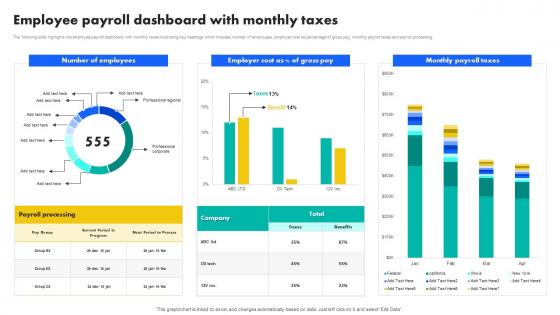
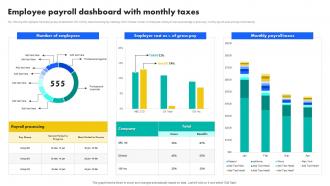
The following slide highlights the employee payroll dashboard with monthly taxes illustrating key headings which includes number of employees, employer cost as percentage of gross pay, monthly payroll taxes and payroll processing
People who downloaded this PowerPoint presentation also viewed the following :
Employee Payroll Dashboard With Monthly Taxes with all 7 slides:
Use our Employee Payroll Dashboard With Monthly Taxes to effectively help you save your valuable time. They are readymade to fit into any presentation structure.





FAQs for Employee Payroll Dashboard
An employee payroll dashboard improves transparency by providing real-time access to pay calculations, deductions, overtime tracking, and benefits allocations, while enabling employees to view historical data and upcoming payment schedules. This visibility streamlines HR inquiries, reduces payroll disputes, and enhances trust between employees and management, with many organizations finding that transparent processes ultimately deliver improved employee satisfaction and operational efficiency.
Employee payroll dashboards should display total payroll costs, overtime expenses, benefit allocations, tax withholdings, departmental breakdowns, and compliance status metrics. These comprehensive views enable HR leaders and finance teams to monitor budget adherence, identify cost optimization opportunities, and ensure regulatory compliance, with many organizations finding that real-time payroll visibility streamlines decision-making and enhances operational efficiency.
Real-time data integration enhances payroll dashboards by providing instant access to current employee information, automated tax calculations, and seamless connectivity with HR systems, time tracking, and benefits platforms. This enables payroll teams to process accurate payments faster, reduce manual errors, and deliver timely insights to management, while employees receive immediate visibility into their compensation and deductions.
User experience plays a crucial role in payroll dashboard design by ensuring intuitive navigation, clear data visualization, and streamlined access to critical information like pay stubs, tax documents, and benefit details. Effective UX design enhances employee satisfaction and reduces HR support requests, with many organizations finding that user-friendly dashboards significantly improve payroll processing efficiency and employee self-service adoption.
An employee payroll dashboard enhances compliance by automatically tracking wage regulations, tax withholdings, overtime calculations, and mandatory deductions while generating real-time audit trails. These systems streamline regulatory reporting, minimize human errors in tax filings, and ensure adherence to evolving labor standards, with many organizations finding that automated compliance features significantly reduce penalties and administrative overhead.
Features that help HR professionals identify payroll discrepancies include automated variance detection, comparative analytics across pay periods, exception reporting for unusual patterns, real-time audit trails, and integrated compliance checks. These capabilities streamline discrepancy identification by flagging anomalies, tracking historical changes, and cross-referencing multiple data sources, ultimately enabling faster resolution and enhanced payroll accuracy.
Payroll dashboards can be customized through configurable KPIs, role-based access controls, industry-specific compliance modules, flexible reporting formats, and scalable data visualization options. These customization features enable organizations across sectors like healthcare, manufacturing, and financial services to streamline payroll processes, enhance regulatory compliance, and deliver tailored insights that support strategic workforce management decisions.
Mobile accessibility transforms payroll dashboard usability by enabling anytime, anywhere access to pay information, streamlined navigation through touch-optimized interfaces, and real-time notifications for payroll updates. Through responsive design and mobile-first features, employees can quickly view pay stubs, update direct deposit information, and manage tax withholdings seamlessly, ultimately delivering enhanced user satisfaction and reducing HR administrative burden across organizations.
Visual analytics within payroll dashboards reveal compensation patterns, overtime trends, departmental spending variations, seasonal fluctuations, and cost-per-employee metrics through interactive charts, graphs, and heat maps. These visualizations enable HR teams and finance managers to identify budget anomalies, forecast labor costs, and optimize workforce allocation, ultimately delivering strategic insights that enhance operational efficiency and support data-driven compensation decisions across organizations.
Essential security measures include multi-factor authentication, role-based access controls, data encryption both in transit and at rest, regular security audits, and secure backup protocols. These protections work together by limiting dashboard access to authorized personnel, safeguarding sensitive salary information through advanced encryption, and ensuring compliance with privacy regulations, ultimately delivering enhanced data security and employee trust.
Employee feedback can be incorporated through user surveys, focus groups, usability testing sessions, and direct interviews to identify pain points and desired features. This collaborative approach enables organizations to create intuitive interfaces, prioritize relevant metrics, and streamline navigation workflows, ultimately delivering dashboards that enhance user satisfaction and reduce payroll-related inquiries.
Best practices for maintaining data accuracy in payroll dashboards include automated data validation, real-time integration with HR systems, regular audit trails, standardized input protocols, and multi-level approval workflows. These approaches streamline payroll processing by minimizing manual errors, ensuring compliance with tax regulations, and providing transparent tracking, with many organizations finding that automated validation reduces discrepancies by up to 90% while enhancing employee trust.
Integration with other HR systems enhances payroll dashboard effectiveness by centralizing employee data, automating workflows, and eliminating manual data entry across platforms. This strategic combination enables real-time synchronization between attendance, benefits, and compensation systems, streamlines payroll processing, and delivers comprehensive workforce analytics, with many organizations finding that integrated dashboards reduce processing time significantly while improving accuracy and compliance.
Organizations face challenges including data migration complexities, employee resistance to new interfaces, integration difficulties with existing HR systems, training requirements, and ensuring compliance across different jurisdictions. However, these implementation hurdles are typically outweighed by long-term benefits, with many companies finding that strategic planning, phased rollouts, and comprehensive training programs streamline adoption while ultimately delivering enhanced accuracy, reduced processing time, and improved employee satisfaction.
Training ensures effective payroll dashboard adoption through comprehensive system walkthroughs, hands-on practice sessions, role-based tutorials, and ongoing support resources. Through structured learning programs, HR teams master data interpretation, reporting functions, and troubleshooting procedures, while regular refresher sessions enhance proficiency, ultimately delivering streamlined payroll operations and enhanced organizational efficiency.
-
Excellent work done on template design and graphics.
-
Editable templates with innovative design and color combination.