


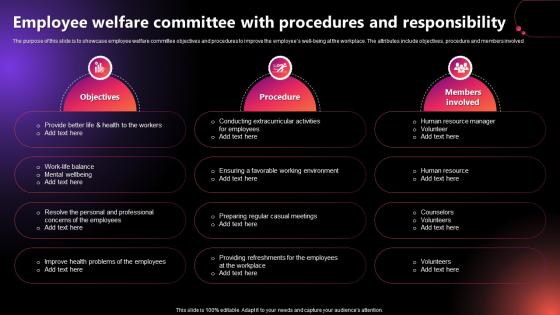
Employee Welfare Committee With Procedures And Responsibility




Try Before you Buy Download Free Sample Product
 Impress Your
 Audience
 100%
100% Editable
 Save Hours
 of Time


The purpose of this slide is to showcase employee welfare committee objectives and procedures to improve the employees well being at the workplace. The attributes include objectives, procedure and members involved
People who downloaded this PowerPoint presentation also viewed the following :
Employee Welfare Committee With Procedures And Responsibility with all 6 slides:
Use our Employee Welfare Committee With Procedures And Responsibility to effectively help you save your valuable time. They are readymade to fit into any presentation structure.





FAQs for Employee Welfare Committee With
Oh that committee? They're like the middleman between regular employees and the big bosses. Handle workplace complaints, review company policies, make sure safety stuff is up to standard. Also coordinate those awkward office parties lol. If your benefits are confusing or working conditions suck, they're who you'd complain to. Honestly, they actually do listen to feedback - way better than going straight to HR sometimes. They can push for policy changes too. Worth figuring out who's on yours, especially if you've got workplace drama brewing.
Honestly, it's pretty simple - when your team feels heard, morale goes way up. The committee gives people actual input on workplace stuff instead of just being told what to do. They can plan events, tackle benefit issues, or fix things that are bugging everyone. I know it sounds kinda corporate, but it genuinely works if you do it right. Just don't make it one of those useless committees that collects complaints and does nothing - that'll backfire hard. Give them real power to change things. Oh, and definitely survey your people first to see what they actually want fixed.
Look, communication makes or breaks the whole thing - it's that simple. Set up ways for people to actually speak up about problems and ideas. Regular updates help too, otherwise everyone thinks you're just having pointless meetings. Listen to what people tell you and be upfront about what you're doing with their feedback. Trust me, without real back-and-forth conversation, nobody will bother participating and leadership stays clueless about what's really going on. Start small - suggestion boxes work, or maybe monthly surveys. Just get people talking somehow.
Monthly meetings work best from what I've seen. Weekly burns everyone out super fast - learned that the hard way at my last job. Quarterly though? Way too long, and by then half the issues are forgotten or people just stop caring. With monthly you get enough time between meetings to actually fix stuff, but it's frequent enough that welfare stays on people's radar. Just stick to the same schedule - like first Tuesday every month or whatever works. Oh and definitely follow up on whatever you decide, otherwise it's just another useless meeting nobody wants to attend.
Honestly, the hardest part is getting people to actually show up - everyone wants to complain about workplace issues but nobody wants to be on the committee fixing them lol. Budget's always tight too. You'll also have a nightmare trying to prove your programs actually work (like did that meditation app really reduce stress?). Oh and good luck balancing what the sales team wants versus what IT needs - totally different worlds. Most committee members are squeezing this in between their real work anyway. Leadership might give you lip service but not real support. Start with something small and easy to measure first, build some wins early.
Honestly, focus on the stuff that actually matters - participation rates, engagement scores, retention data. That's where you'll see if things are working. Don't get caught up counting heads at every meeting like some committees do. Quality beats quantity every time. Track specific outcomes too - stress levels, work-life balance scores, burnout-related sick days. Exit interviews are gold for this stuff. Pulse surveys help catch problems before they explode. Just ask people directly what's helping them most though. Start with maybe 2-3 metrics so you don't get overwhelmed with spreadsheets.
Definitely hit the basics first - health insurance, retirement, PTO, flexible schedules. Those are your bread and butter. Mental health stuff is massively important now, so EAP programs and wellness perks are clutch. Survey your team though, because honestly their answers might shock you. Some people care way more about childcare help or transit benefits than you'd think. Oh, and don't sleep on professional development opportunities - that impacts whether people stick around long-term. I'd probably start with whatever your team says they want most, then work from there.
Get input from people across different departments and backgrounds - not just the usual volunteers who always sign up for everything. Your committee shouldn't be five people from accounting, you know? Anonymous surveys work great because people will actually tell you what they need versus what they think you want to hear. Think about different cultural holidays, family setups, financial situations when you're planning stuff. I always ask myself "who are we accidentally leaving out?" before rolling anything out. Then actually change things based on what people tell you - otherwise why bother asking?
Honestly, just make it stupid easy for people to join in. Send regular updates about what's happening - emails, posters, whatever works. Ask your team what they actually want though, don't just assume (I've seen so many companies mess this up). Get leadership involved visibly, and make sure events have flexible timing. People have lives, you know? Short wins get celebrated publicly - that recognition thing really works. Oh, and meet people where they're at instead of forcing it. Simple stuff tends to stick better anyway.
Honestly, getting the right mix of people is huge - I've watched committees crash and burn because they were all upper management types who had zero clue what was actually happening on the ground floor. You want maybe 5-7 people tops (any more and you'll never agree on anything). Grab some senior people who know how budgets work, but also bring in newer folks who aren't scared to call out the real problems. Don't forget different departments and demographics or you'll miss obvious stuff. Oh, and include HR but don't let them take over every discussion.
Honestly, training is huge for this - most people assume they can just figure it out as they go, but that's a mistake. Start with confidentiality stuff and basic HR policies. Conflict resolution is key too. They need to know what they can actually promise employees vs what's way above their pay grade. Active listening skills help a ton, plus you'll want clear escalation procedures for when things get messy. Oh, and definitely loop in legal contacts early - better safe than sorry. A half-day workshop should cover the essentials, then maybe create some kind of cheat sheet they can reference later.
Look, first figure out what leadership actually cares about - retention, growth, whatever. So many committees just wing it here which is nuts. Then build your welfare programs around those specific goals. Want less turnover? Focus on work-life balance stuff and job satisfaction. Here's the thing though - you've gotta track real numbers. Engagement scores, retention rates, that kind of data. Otherwise you're just throwing feel-good activities at people with no clue if they're actually helping the company hit its targets.
Definitely survey people first - you'd be shocked how many companies assume everyone wants meditation apps when they really just want better health insurance. Make sure whatever you do works for all shifts, not just the day crew. Physical stuff, mental health support, work-life balance - hit all three. Keep it voluntary though, nobody likes mandatory fun. Local gym partnerships are solid for discounts. Oh, and your managers need to actually participate, not just send emails about it. I've watched so many wellness programs crash because leadership clearly didn't care. Track what people actually use so you're not throwing money at unused yoga classes.
So your Employee Welfare Committee is basically like having workplace mediators who actually get it. They create this safe space where you can bring up issues without worrying about your boss getting revenge later. What's cool is they understand both sides - they know company rules but also what it's like being an employee. Honestly, they're way better at finding middle ground than most managers are. The key thing? Don't wait until you're ready to quit - hit them up early when problems first start. They can't fix what they don't know about, right?
Honestly, Employee Welfare Committees work really well for retention - you're looking at like 15-25% better rates. People just want to feel heard, you know? When they see you actually care about their workplace issues and benefits, they stick around way longer. The trick is giving your committee real power to make changes, not just letting them collect complaints all day (which I've seen happen, it's painful). Oh, and definitely survey your team first to figure out what they actually want. Don't assume you know - I learned that one the hard way.
-
The information is visually stunning and easy to understand, making it perfect for any business person. So I would highly recommend you purchase this PPT design now!
-
This PowerPoint layout is very helpful from a business point of view, and it's visually stunning too! I'm so happy with this product because it has helped me understand and deliver great presentations.