

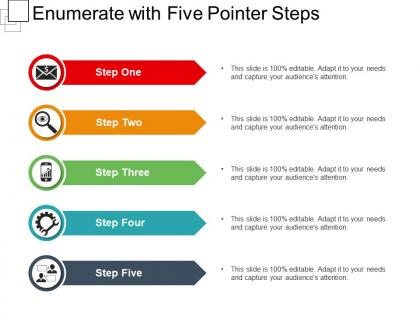
Enumerate with five pointer steps




Try Before you Buy Download Free Sample Product
 Impress Your
 Audience
 100%
100% Editable
 Save Hours
 of Time


Go further and further with our Enumerate With Five Pointer Steps. They are geared to cover any distance.
People who downloaded this PowerPoint presentation also viewed the following :
Enumerate with five pointer steps with all 5 slides:
Focus on gaining the advantage with our Enumerate With Five Pointer Steps. They help channelize the grey cells.

FAQs for Enumerate with
Honestly, enums are a game changer for three reasons. First off, your code becomes way more readable - no more random numbers floating around that nobody understands. Type safety is huge too since your compiler catches dumb mistakes before they hit production. And maintenance? So much easier. When you add new values, the compiler literally tells you every spot that needs updating. I used to think they were overkill for simple stuff, but now I use them for any group of related constants. Trust me, you'll love having self-documenting code when you're debugging at 2am six months from now.
Honestly, numbering stuff makes such a huge difference. People can actually follow what you're saying instead of getting lost in a jumble of random facts. Your brain loves having that structure - it's like breadcrumbs leading through your argument. I see this all the time in terrible work presentations where someone just dumps info everywhere. Try bullet points for priorities or breaking down processes step-by-step. Even complex data becomes way more digestible. Seriously, just number your main points next time and you'll see people actually paying attention instead of checking their phones.
So enums are basically fixed sets of named constants - think `Color.RED` or `Status.PENDING`. You can't change them once they're defined. Lists are totally different though. You can add stuff, remove things, reorder everything whenever you want. Honestly, I use enums all the time for things like user roles or status codes because they make your code way more readable. But if you need something dynamic that changes during runtime, lists are your friend. It's like... enums are a restaurant menu (fixed options) while lists are more like a shopping cart you're constantly updating. Does that make sense?
So enumeration is basically just counting and organizing your data properly before you do anything else with it. Pretty mundane stuff, but you literally can't skip it or your analysis will be garbage. Think of it like sorting your laundry first - boring but necessary. You'll use it to figure out sample sizes and set up frequency distributions. Once that's done, then you can jump into the actually interesting parts like finding correlations. I always tell people to enumerate their variables right at the start, even though it feels tedious.
So basically enumeration just means giving people actual options instead of letting them type whatever random stuff they want. You know how frustrating it is when forms ask for your state and you're not sure if they want "California" or "CA"? Dropdowns and radio buttons fix that mess completely. Users finish forms way faster, you get cleaner data, and nobody has to play the guessing game anymore. Honestly, it's one of those things that seems obvious once you do it. Look at your current forms - any text fields where you could swap in a dropdown instead? Start there and you'll see the difference immediately.
Honestly, just start numbering everything and watch how much clearer your projects get. Priority lists, deliverables, phases - give them all numbers instead of random bullet points. I learned this the hard way after too many confusing meetings where nobody could reference anything properly. Also number your risks by how bad they could mess things up, and list team responsibilities by role. Milestones should obviously go chronologically. It sounds boring but when you're in sprint planning or handing stuff off to teammates, you'll actually know what you're talking about. Works way better than I expected.
Biggest issues? Your enums get locked in once they're live. Adding new values later will totally break stuff or force annoying migrations. Users always come up with weird edge cases that don't fit your neat little categories - happens every single time. Also, you'll probably end up with those awkward "other" buckets for random stuff. Performance takes a hit too when you're doing enum lookups instead of just comparing integers. Keep them small and simple. Oh, and definitely think through how you'll add values later without everything exploding.
Dude, just break your info into bullet points or numbered lists - trust me on this. Nobody wants to read paragraph soup on a slide (seriously, those presentations are torture). Pick your main points first, then either number them if there's an order or just bullet them out. Way easier for people to scan and actually remember stuff. I always go chronological if it's steps, otherwise just put the most important thing first. Your brain processes lists so much better than dense text blocks anyway.
Honestly, you'll mostly run into simple value enums - stuff like status codes or user roles. String enums are great too since they're way more readable than random numbers. Flag enums let you do bitwise operations when you need multiple values at once (though I don't use those super often). Auto-incrementing numeric ones are everywhere - error codes, priority levels, that kind of thing. Rust and Swift have these cool associated value enums where each variant carries different data. I'd start with basic value enums for tracking states. They're perfect for APIs and state machines.
Dude, enums are so much better for validation. No more dealing with "red" vs "Red" vs "RED" - that string matching headache is the worst. With enums you've got this locked-down set of valid values, so bad inputs get caught right away. Error messages get way cleaner too since you can just list the exact options that work. Most languages will even validate enum stuff at compile time, which is honestly amazing because you'll spot issues while coding instead of some user breaking things later by typing "purple" when you only accept primary colors.
Honestly, skip the code at first - just use stuff like days of the week or traffic light colors. Once they get the basic idea, then show syntax. The dropdown menu comparison works SO well, I swear it's like watching lightbulbs go off. After that, demonstrate how enums save you from typos and make everything way cleaner than random strings everywhere. IntelliSense becomes your best friend too. Oh, and let them create enums for things they actually care about - video game characters, whatever. Makes it stick better than boring examples.
Okay so enumeration is basically when you break stuff down into smaller pieces you can actually count and work through. Instead of staring at this massive overwhelming thing, you just list everything out systematically. Honestly it's like the difference between having a grocery list vs wandering around Target for 2 hours buying random crap. Once you've got everything numbered out, you can see what needs to happen first and you won't forget the important bits. Next time you're stuck on something complicated, try literally writing down each part or scenario with numbers. Game changer.
For presentations, numbered lists are the obvious choice, but there's way more you can do. Flowcharts work great for processes. Timeline graphics are solid too. I love using icons instead of plain numbers - makes everything look less boring. Interactive slides where you reveal items one by one keep people awake (trust me on this). Mind maps are perfect when you've got subcategories and complex stuff to break down. Honestly, just start with whatever your presentation software has built-in, then get creative once you're comfortable with the basics.
Match your style to the crowd, honestly. Executives want numbered points about ROI and outcomes - they don't have time for details. Tech people? Give them bullet points with all the specs and processes they crave. Mixed groups are trickier, but simple numbered lists work best. Nobody wants that awkward silence when half the room looks lost. Visual people love numbered slides, while analytical types prefer hierarchical outlines. I always start with one approach then switch if I see glazed eyes or phone-checking. Oh, and read the room early - it'll save you from bombing your presentation.
So this stuff actually goes way back - like ancient counting systems, then Fibonacci doing combinatorial work in the 1200s. Euler pushed it forward with graph theory, and Cayley plus Sylvester really formalized everything in the 1800s. But honestly? Pólya's enumeration theorem from 1937 is where it gets wild - that thing is just beautifully elegant. Computer science totally ran with it in the 60s and 70s for algorithms and complexity. Now it's in everything from databases to ML. Oh, and definitely learn generating functions first - they make the whole field click way better.
-
Very unique and reliable designs.
-
Awesome presentation, really professional and easy to edit.