


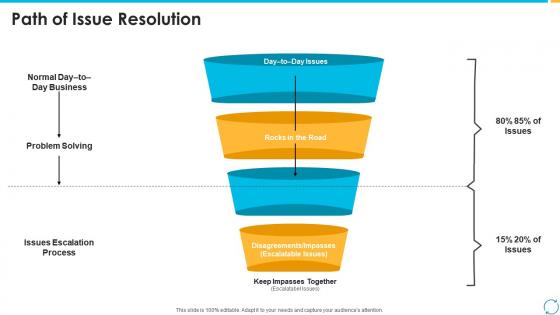
Escalation process for projects path of issue resolution




Try Before you Buy Download Free Sample Product
 Impress Your
 Audience
 100%
100% Editable
 Save Hours
 of Time


Our Escalation Process For Projects Path Of Issue Resolution are topically designed to provide an attractive backdrop to any subject. Use them to look like a presentation pro.
People who downloaded this PowerPoint presentation also viewed the following :
Escalation process for projects path of issue resolution with all 9 slides:
Use our Escalation Process For Projects Path Of Issue Resolution to effectively help you save your valuable time. They are readymade to fit into any presentation structure.








FAQs for Escalation process for projects path
Key components include clear escalation triggers, defined authority levels, established timelines for response, documented communication channels, and predetermined resolution pathways. These frameworks streamline project recovery by ensuring faster decision-making, minimizing delays, and maintaining stakeholder alignment, with many organizations finding that structured escalation processes ultimately deliver improved project outcomes and enhanced team accountability.
Organizations ensure timely communication during escalation by establishing clear notification protocols, automated alert systems, defined response timeframes, and multi-channel communication methods. Through structured escalation matrices, companies streamline decision-making workflows, minimize delays, and maintain transparency across all stakeholders, ultimately delivering faster issue resolution and enhanced operational efficiency.
**INPUT**: What tools and templates are most useful for documenting the escalation process? **OUTPUT**: Essential tools include flowcharts, escalation matrices, RACI charts, incident tracking systems, and standard operating procedure templates. These resources streamline communication by defining clear roles, establishing timelines, and automating notifications, with many organizations finding that combining visual workflows with digital tracking platforms ultimately delivers faster resolution times and improved accountability.
Cultural differences significantly impact escalation processes through varying communication styles, hierarchy respect levels, conflict resolution approaches, and decision-making preferences across multinational teams. Organizations like global consulting firms and multinational banks increasingly find that implementing culturally-adaptive escalation frameworks, cross-cultural training programs, and standardized communication protocols enables more effective issue resolution while maintaining team cohesion and operational efficiency.
Common escalation process pitfalls include unclear trigger criteria, excessive approval layers, poor communication channels, inadequate timeline definitions, and insufficient staff training. These issues create bottlenecks, delayed resolutions, and customer frustration, with many organizations finding that streamlined escalation paths, clear accountability measures, and regular process reviews ultimately deliver faster issue resolution and improved customer satisfaction.
Escalation processes integrate into existing workflows through automated triggers, role-based routing systems, and predefined decision trees that connect seamlessly with current approval chains and communication channels. Organizations enhance operational efficiency by embedding escalation protocols directly into project management tools, CRM systems, and help desk platforms, ultimately delivering faster resolution times and improved accountability across departments.
Key metrics include escalation frequency rates, resolution time at each tier, customer satisfaction scores, first-call resolution percentages, and cost per escalation incident. These measurements enable organizations to streamline workflows, enhance service quality, and reduce operational costs, with many customer service departments finding that tracking these indicators ultimately delivers faster resolution times and improved customer experiences.
Training and workshops enhance employees' understanding of escalation processes by providing clear procedural frameworks, role-playing scenarios, and hands-on practice with escalation triggers and protocols. Through interactive sessions, organizations streamline decision-making, reduce response times, and improve issue resolution accuracy, with many companies finding that structured training programs ultimately deliver better customer experiences and more efficient operational workflows.
Technology facilitates smoother escalation processes through automated routing systems, real-time notifications, centralized case management platforms, AI-powered priority assessment, and integrated communication tools. These solutions streamline workflows by eliminating manual handoffs, providing instant visibility into case status, and enabling seamless collaboration across departments, ultimately delivering faster resolution times and enhanced customer experiences.
Leadership drives escalation process success by establishing clear protocols, empowering decision-making authority, and ensuring swift resolution pathways across organizational levels. Effective leaders create accountability structures, provide resources for complex issue resolution, and maintain open communication channels, with many organizations finding that strong leadership involvement reduces escalation times and enhances customer satisfaction outcomes.
Feedback loops can be established through regular case reviews, stakeholder surveys, performance metrics analysis, and post-resolution debriefs with both customers and internal teams. These mechanisms enable organizations to identify bottlenecks, refine escalation criteria, and enhance response times, with many companies finding that systematic feedback collection ultimately delivers improved customer satisfaction and streamlined operational efficiency.
Escalation examples that communication can resolve include customer complaints about service delays, employee conflicts over resource allocation, vendor disputes regarding contract terms, interdepartmental disagreements on project priorities, and client concerns about deliverable quality. Through proactive dialogue, active listening, and collaborative problem-solving, organizations streamline conflict resolution, reduce operational disruptions, and maintain stronger stakeholder relationships, ultimately delivering improved customer satisfaction and enhanced team productivity.
Organizations balance escalation with empowerment by establishing clear decision-making boundaries, providing comprehensive training, and creating flexible authorization levels that enable front-line staff to resolve routine issues independently. This strategic combination streamlines operations by reducing unnecessary escalations, accelerating resolution times, and improving customer experiences, while maintaining oversight for complex matters, ultimately delivering operational efficiency and enhanced service quality across the organization.
Strategies include proactive monitoring systems, clear communication protocols, early intervention frameworks, staff training programs, and regular stakeholder feedback mechanisms. These approaches streamline issue resolution by identifying problems quickly, establishing response hierarchies, and empowering teams with decision-making authority, ultimately delivering faster resolutions and enhanced customer satisfaction while minimizing operational disruptions.
Escalation processes significantly enhance stakeholder relations and customer satisfaction by ensuring swift issue resolution, transparent communication channels, and accountability at appropriate organizational levels. Through structured escalation frameworks, organizations deliver faster problem-solving, reduced customer frustration, and improved trust, with many businesses finding that clear escalation pathways ultimately strengthen long-term relationships and competitive advantage.
-
Qualitative and comprehensive slides.
-
Designs have enough space to add content.