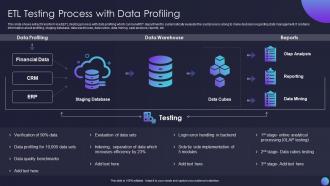
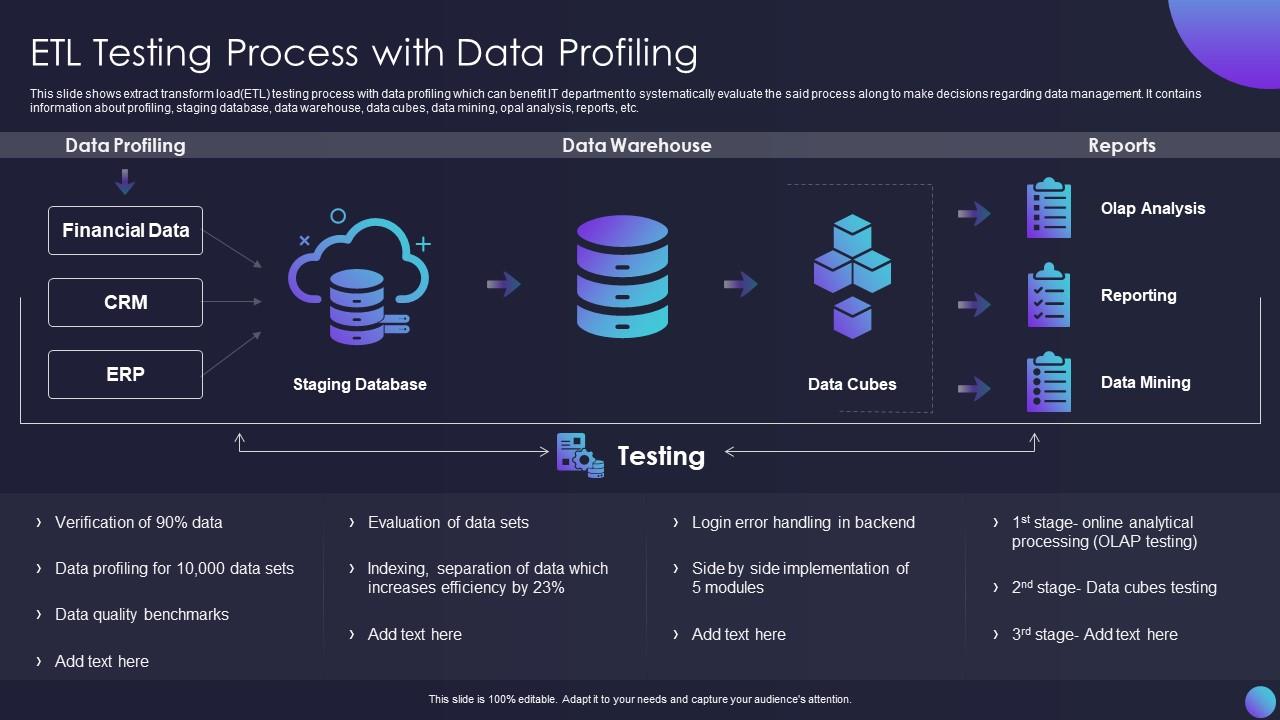
ETL Testing Process With Data Profiling
Try Before you Buy Download Free Sample Product
Audience
Editable
of Time
This slide shows extract transform load ETL testing process with data profiling which can benefit IT department to systematically evaluate the said process along to make decisions regarding data management. It contains information about profiling, staging database, data warehouse, data cubes, data mining, opal analysis, reports, etc.
People who downloaded this PowerPoint presentation also viewed the following :
ETL Testing Process With Data Profiling with all 6 slides:
Use our ETL Testing Process With Data Profiling to effectively help you save your valuable time. They are readymade to fit into any presentation structure.
FAQs for ETL Testing Process
Key objectives of ETL testing include data accuracy validation, transformation logic verification, performance optimization, data completeness assessment, and integration workflow reliability. These comprehensive testing approaches streamline data quality assurance by identifying inconsistencies, ensuring proper mapping between systems, and validating business rules, with many organizations finding that thorough ETL testing ultimately delivers faster analytics, improved decision-making capabilities, and enhanced operational efficiency.
ETL testing for structured data focuses on schema validation, data type accuracy, and referential integrity checks, while unstructured data testing emphasizes content parsing, format recognition, and transformation verification. Structured data allows predictable validation rules and automated checks, whereas unstructured data requires flexible testing frameworks that can handle varying formats like documents, images, and social media content, ultimately delivering comprehensive data quality assurance across diverse information sources.
Common ETL testing challenges include data quality inconsistencies, performance bottlenecks, complex transformation validation, incomplete test coverage, and integration issues across multiple systems. These challenges can be mitigated through automated testing frameworks, comprehensive data profiling, staged testing environments, and robust monitoring tools, with many organizations finding that strategic test planning and early validation ultimately streamline deployment timelines and enhance data reliability.
**INPUT**: Which tools are most effective for automating ETL testing and why? **OUTPUT**: Effective ETL testing automation tools include Informatica Data Validation, QuerySurge, iCEDQ, Talend Data Quality, and Apache Griffin. These platforms streamline data validation by automating source-to-target comparisons, data quality checks, and regression testing, with many organizations finding that automated ETL testing reduces validation time significantly while enhancing accuracy and reliability. [Word count: 53 words]
Data validation ensures ETL processes accurately transform and load data by verifying completeness, accuracy, consistency, and integrity at each pipeline stage. Through automated validation rules, organizations can detect anomalies, prevent corrupted datasets, and maintain data quality standards, with financial services and healthcare sectors finding that robust validation reduces processing errors and enhances regulatory compliance.
Key ETL testing metrics include data accuracy rates, processing time performance, error detection ratios, data completeness percentages, and transformation validation scores. These measurements enable organizations to assess data pipeline reliability, identify bottlenecks in financial services and healthcare systems, and ensure regulatory compliance, ultimately delivering faster reporting cycles and enhanced data-driven decision making capabilities.
ETL testing ensures data quality across multiple source systems by implementing comprehensive validation checks, data profiling techniques, source-to-target mapping verification, and automated quality rules that detect inconsistencies, duplicates, and missing values. Through systematic testing frameworks, organizations streamline data integration processes, enhance reporting accuracy, and maintain consistent data standards across disparate systems, ultimately delivering reliable analytics and improved decision-making capabilities.
**INPUT**: What best practices can be implemented for ETL test case design? **OUTPUT**: ETL test case design best practices include comprehensive data validation, source-to-target mapping verification, performance benchmarking, error handling scenarios, and incremental load testing. These approaches streamline quality assurance by ensuring data accuracy, maintaining transformation integrity, and validating business rules, with many organizations finding that systematic test case frameworks ultimately deliver faster deployment cycles and enhanced data reliability. *[Word count: 58]*
Compliance during ETL testing involves implementing data masking protocols, maintaining audit trails, establishing role-based access controls, and conducting regular validation checks against regulatory standards. These measures ensure sensitive data protection throughout testing phases, with financial services and healthcare organizations finding that automated compliance monitoring and documentation streamlines regulatory audits while maintaining data integrity.
Performance testing in ETL processes is crucial for ensuring data pipelines handle large volumes efficiently, meet processing deadlines, and maintain system stability under peak loads. It identifies bottlenecks, memory leaks, and scalability limits before production deployment, with many organizations finding that proactive performance validation prevents costly downtime and enables reliable data-driven decision making at enterprise scale.
A comprehensive ETL testing strategy involves data validation, transformation verification, performance testing, error handling assessment, and end-to-end workflow validation across all pipeline stages. Organizations typically implement automated testing frameworks, establish data quality benchmarks, and create rollback procedures, with many financial services and retail companies finding that systematic validation at each ETL phase significantly reduces data inconsistencies and accelerates deployment cycles.
Documentation serves as the foundation for ETL testing by establishing data mapping specifications, test case requirements, validation rules, and expected outcomes throughout the development lifecycle. Comprehensive documentation enables testing teams to maintain consistency across complex data transformations, streamline defect resolution, and ensure regulatory compliance, with many organizations finding that thorough documentation reduces testing cycles and enhances data quality assurance.
Data lineage tracking enhances ETL testing by providing complete visibility into data flow paths, enabling testers to identify transformation points, validate source-to-target mappings, and quickly isolate issues during failure scenarios. Through comprehensive lineage documentation, organizations streamline root cause analysis, accelerate debugging processes, and ensure data quality compliance, with many financial services and healthcare institutions finding that enhanced traceability ultimately delivers faster testing cycles and improved regulatory reporting accuracy.
Incremental load testing involves validating data synchronization between source and target systems, checking timestamp accuracy, verifying delta identification logic, and ensuring no duplicate or missing records during updates. Through automated comparison scripts, testers validate that only modified records are processed, data integrity is maintained across incremental cycles, and transformation rules handle change data capture correctly, ultimately delivering reliable data pipelines and optimized processing performance.
Functional testing validates that ETL processes correctly extract, transform, and load data according to business requirements, while regression testing ensures existing ETL workflows remain unaffected after system changes or updates. In banking and retail environments, functional testing verifies data accuracy and transformation logic, whereas regression testing confirms that new features don't disrupt established data pipelines, ultimately maintaining system reliability.
-
Great experience, I would definitely use your services further.
-
You can rely on SlideTeam whenever you run out of designs for your presentation. Thank you so much SlideTeam!