

evolución de la inteligencia artificial presentación de powerpoint profesional ejemplos




Try Before you Buy Download Free Sample Product
 Impress Your
Audience
 100%
Editable
 Save Hours
of Time


Explica con calma los errores en sus suposiciones.
Línea de tiempo, Negocio, Planificación, Gestión, Proceso.
Presentación de PowerPoint completamente editable, disponible para descarga inmediata.
People who downloaded this PowerPoint presentation also viewed the following :
Contenido de esta presentación de Powerpoint
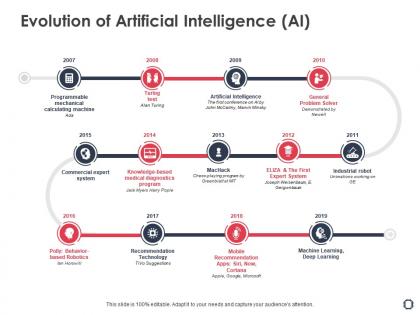
"El uso de las palabras se habrá alterado de modo que uno podrá hablar sobre el pensamiento de las máquinas sin ser cuestionado". Esta cita de Alan Turing muestra cuán importante sabía que la Inteligencia Artificial (IA) llegaría a ser y cómo no reemplazaría sino que amplificaría el conocimiento humano. La IA comenzó en la década de 1950 cuando Alan Turing propuso la prueba de Turing, que evaluaba si una máquina podía exhibir un comportamiento inteligente a la par con un humano. Esto llevó a la creación de la primera máquina calculadora mecánica programable, Ada.
En la década de 1960 se realizaron conferencias sobre IA, y se creó ELIZA para mantener conversaciones con psicoterapeutas. Desde entonces, la IA ha continuado creciendo, con robots industriales utilizados en la fabricación, el primer programa de computadora para jugar al ajedrez, diagnósticos médicos basados en el conocimiento, sistemas automatizados de software y, finalmente, el aprendizaje automático y el aprendizaje profundo.
Esta evolución moldeó la trayectoria de este medio muy poderoso y útil. En lugar de cuestionar la importancia de la IA, es útil estudiar su historia, aprender más sobre ella y ver qué campos impactará próximamente y cómo puede ayudar a su negocio.
Plantillas de Evolución de la Inteligencia Artificial
Para dar sentido a esta evolución y rastrearla de una manera creativa y fácil de entender, en SlideTeam hemos diseñado plantillas de evolución de la IA. Estas plantillas muestran una línea de tiempo de eventos que representan los hitos de cada año. Utilice esta útil herramienta para ayudarlo a usted y a su organización a comprender la importancia de la IA y por qué podría ser útil para su crecimiento.
Evolución de la inteligencia artificial Slide 1: Introducción a la inteligencia artificial Slide 2: Avances en el aprendizaje automático Slide 3: Aplicaciones de la IA en diversos sectores Slide 4: Desafíos y consideraciones éticas Slide 5: Perspectivas futuras de la IA
Su ascenso está garantizado que sea impresionante debido a nuestra Evolución de la Inteligencia Artificial Ai Ppt Powerpoint Presentación Ejemplos Profesionales. Usted se graduará en los más altos escalones.


FAQs for Evolution of artificial intelligence ai ppt powerpoint
So early AI was mostly rule-based systems and symbolic reasoning from the 50s-60s. ELIZA was this chatbot therapist thing, plus basic chess programs that just followed if-then logic. Super primitive but kinda revolutionary back then, you know? Those old systems actually shaped how we still build AI today - the logical frameworks and knowledge stuff carries over. Neural networks even pull ideas from those symbolic approaches. Oh and if you're doing any AI work, it's worth knowing this history since it's still baked into how we approach problems and architecture.
So neural networks basically let AI learn patterns from data instead of following rigid rules. Before, you'd have to code every single scenario manually - total nightmare for anything complex. Now you just dump tons of examples into the system and it figures out the patterns itself. That's how we got image recognition, language processing, all that stuff. Honestly, it's pretty wild how different modern AI is from those old rule-based systems. If you're diving into any AI projects, understanding this shift will make everything click way better.
Dude, computational power is literally what made AI possible. Back in the day researchers had amazing ideas but computers were way too slow and expensive to actually do anything with them. Moore's Law changed everything though - suddenly you could train neural networks with millions of parameters instead of like, dozens. GPUs around 2010 were the real breakthrough that made deep learning actually work. And honestly? Cloud computing might be the biggest deal because now anyone can mess around with AI models without buying their own supercomputer. It's wild how accessible it's become.
So ML started as this academic thing back in the 50s-80s where people just hardcoded rules everywhere. Pretty clunky stuff. Neural networks picked up steam in the 90s but computers were still too slow honestly. The 2010s changed everything though - deep learning plus huge datasets meant algorithms could finally learn patterns instead of needing someone to program every little thing. Wild how fast it shifted from curiosity to running basically all AI now. Oh and if you're doing ML stuff, worry about your data quality way more than which algorithm you pick. That's where people mess up.
So basically, narrow AI is what exists right now - super specialized stuff like facial recognition or chess programs. Can't do anything beyond what it was trained for though. AGI would be completely different - like having an actual digital brain that learns whatever you teach it. You know that one person at work who's weirdly good at everything? That's the AGI dream. But honestly, we're nowhere near that yet. Current AI is more like having a really smart calculator that only works for one type of problem. The flexibility just isn't there - it can't suddenly decide to learn cooking or fix your car.
So those AI winters were brutal - funding got slashed and researchers fled to other fields. Two big crashes happened in the mid-70s and late 80s when reality hit all the hype. It's crazy how this stuff repeats itself, honestly. But the silver lining? Those lean years made people focus on actual foundational work instead of wild moonshots. Researchers learned not to overpromise (well, mostly). That's probably why today's AI crowd is... okay maybe not *that* much more measured, but at least they pretend to be. Worth remembering when you see the next big AI announcement.
Honestly, the scariest stuff right now is how AI can screw people over without anyone noticing. Job losses are obvious, but algorithmic bias is worse - like getting rejected for loans or jobs because some algorithm has hidden prejudices. Privacy's toast too with all the data hoarding. What really gets me is the "black box" issue where nobody can explain why the AI decided something. That's nuts when it affects real lives. Oh, and don't wait until you've got problems to think about ethics - bake it into your process from the start or you'll regret it later.
Oh man, it's crazy how much better computers have gotten at understanding us. You don't have to talk like a robot anymore - just speak normally and voice assistants actually get what you mean. Siri picks up on context now, and those customer service chatbots can handle way more complex stuff than before. Honestly, the whole thing just feels more like texting a friend than using software. Instead of us learning computer-speak, they finally learned human. Definitely try ChatGPT for work stuff - it's wild how conversational it feels compared to clunky old interfaces.
Honestly, the biggest thing I've noticed is that AI works way better when it's focused on one specific task. Chess programs crushed it. So did Netflix recommendations. But those early chatbots that tried to be know-it-alls? Total disasters. There's this clear pattern - breakthroughs happen when you stop trying to copy how humans think and just let computers do what they're actually good at: crunching tons of data fast. Oh, and overpromising will absolutely kill your funding. Focus on solving real problems instead of chasing that sci-fi fantasy.
Dude, AI has completely changed how companies work now. Most routine stuff gets automated, and businesses make decisions based on actual data instead of just guessing. Healthcare uses it for diagnoses, banks catch fraud with it, stores optimize inventory - the works. What's crazy is how fast everything processes now. Like, real-time data analysis that would've taken days before. Honestly feels like it happened overnight! If you're not using any AI tools yet, maybe start simple - automated scheduling or basic data crunching. Don't go overboard right away though.
Deep learning really took off around 2012 - that was the big turning point. Then transformers and GPT models completely changed language processing starting in 2017. ChatGPT blowing up in 2022? That's just years of neural networks getting crazy good at spotting patterns. AlphaGo crushing Go champions in 2016 was mind-blowing too, honestly didn't think we'd see that so soon. The whole field's been moving insanely fast lately. If you're trying to track what matters, I'd focus on large language models and computer vision - that's where businesses are actually finding useful stuff they can implement.
Back in the 80s and 90s, AI was just movie stuff - think Terminator or whatever. Pretty much fantasy. Around 2010 things got real with Siri and Netflix recommendations, but nobody was freaking out yet. Then ChatGPT dropped in late 2022 and everything went crazy. Suddenly my mom's texting me about robots stealing jobs (which is kinda hilarious but also terrifying?). The shift happened so fast it gave me whiplash. For your work thing, definitely focus on that 2022-2024 window. That's where all the drama is.
Honestly, the multimodal stuff is where things get interesting - AI handling text, images, and video all at once. Autonomous agents are getting crazy good at complex tasks without much hand-holding. What's really catching my attention though? Models are becoming way more efficient and tailored for specific fields like healthcare or finance. Oh, and finally we're seeing AI decisions become less of a black box, which is huge for getting buy-in from higher-ups. You should probably start thinking about how this might shake up your current automation and decision-making workflows.
Oh man, this is such a good question! China's all about surveillance tech and social credit systems, which honestly feels pretty dystopian to me. Europe's the opposite - they're obsessed with privacy rules that slow everything down but people actually trust AI more there. The US just lets companies do whatever basically, very hands-off. Japan's robot companions for elderly care are actually kind of amazing though. And developing countries? They're leapfrogging straight to AI mobile apps without building traditional infrastructure first. If you're doing anything global, definitely check what locals think about privacy and government stuff beforehand.
Dude, transformers are literally everywhere right now - ChatGPT, image generators, even protein folding stuff. Wild. Multimodal AI is the real game-changer though, mixing text, images, and audio for robotics and creative tools. RLHF makes everything actually useful instead of just fancy tech demos (though I'm still impressed by the tech side honestly). If you're looking at investments or whatever, multimodal companies are where I'd put my money. That's where the next big apps will come from. Oh and reinforcement learning from human feedback - that's what separates the good AI from the "wow cool but useless" AI.
No Reviews