


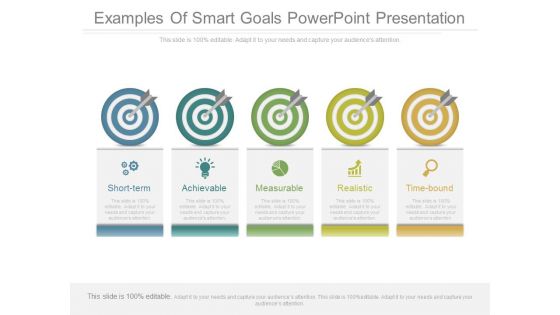
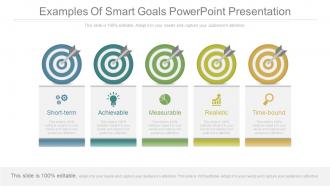
Examples of smart goals powerpoint presentation





Try Before you Buy Download Free Sample Product
 Impress Your
 Audience
 100%
100% Editable
 Save Hours
 of Time


PowerPoint presentation is the most emphatic way to present the concept as it depicts information in visuals. Taking this into account we have designed PPT template on the example of smart goals. In order to get success in business you have to be smart enough to achieve the goals. Our experts offer exclusive presentation slides for the executives looking for smart strategy of achieving objectives. Don’t wait now. Just click on smart goal PowerPoint slides and explore your knowledge.
People who downloaded this PowerPoint presentation also viewed the following :
Examples of smart goals powerpoint presentation with all 5 slides:
Force their brains to absorb your ideas. Our Examples Of Smart Goals Powerpoint Presentation help you hammer them in.
FAQs for Examples of smart
SMART goals break down to Specific, Measurable, Achievable, Relevant, and Time-bound. Sounds boring but honestly it works. Like instead of "I want better presentations," you'd say "I'll take a public speaking course and do three team presentations by March 31st." Way harder to bail when it's that specific, you know? The whole thing forces you to actually think through what you want instead of just having some vague idea floating around. I used to hate how corporate it sounded but whatever - it gets results. Pick one of your goals right now and try making it SMART. You'll probably realize you hadn't thought it through as much as you thought.
Use the SMART framework for each goal - it actually works. State exactly what you want to achieve first (Specific), then add real numbers so people know what success looks like (Measurable). Your timeline should be right upfront too. Make sure it's realistic - honestly, unrealistic goals just kill team morale. I usually go through each letter out loud: "This is specific because..." Sounds kinda mechanical, but it keeps everyone on the same page. Oh, and tie it back to why it matters for your specific project. Makes your whole presentation way more solid.
Honestly, most people mess up by being way too vague. Like writing "improve sales" instead of "increase sales by 15% in Q1" - that's useless. Unrealistic deadlines are another killer. I've watched so many teams set goals that sound impressive but totally ignore what they can actually pull off with their resources. The relevance thing trips people up too - chasing metrics that look good on paper but don't actually help your business grow. Oh, and here's something I learned the hard way: don't try to tackle like 10 goals at once. Pick 2-3 max and actually nail them.
Okay so SMART goals are honestly a game-changer because they give your whole team the same playbook. No more of those painful meetings where everyone's like "wait, what exactly are we doing again?" Everyone knows what success looks like with actual numbers and deadlines. Each person can see how their stuff fits into the big picture too. The measurable part is clutch - you're all tracking the same things instead of having those weird debates about whether something's "basically finished." I'd say try splitting your next project into maybe 2-3 SMART goals and see what happens. Your meetings will probably get way less chaotic.
Yeah, SMART goals totally work for personal stuff too! I use them for everything - fitness, reading, even relationship goals. Like instead of "get healthier" I'll set "work out 3x weekly for 30 minutes." Way more specific. I did "read 24 books this year" once and actually hit it because I could track progress. Also tried "have one real conversation with my boss monthly" which sounds weird but helped my career honestly. The trick is treating personal goals like work projects - same specificity, same tracking. Otherwise you just... don't do them. Trust me on this one.
Dude, specificity is what actually makes goals work. Your brain needs something concrete to latch onto - otherwise it's like shooting arrows blindfolded. "Get healthier" sounds nice but always crashes and burns. Compare that to "run 3 miles twice a week" and boom, suddenly you know exactly what you're doing. Specific goals show you what resources you need and make tracking progress super obvious. I honestly think this is why most New Year's resolutions die by February. Here's my test: if you handed your goal to a stranger, would they know exactly what success looks like? If not, get more specific.
Honestly, regular check-ins are a game changer for SMART goals. I'd do weekly or monthly reviews - whatever feels right for your timeline. Break those big targets into smaller pieces so you're not just crossing your fingers at the end. A basic spreadsheet works great for tracking actual vs expected progress (though I'm probably a bit obsessed with spreadsheets lol). The time-bound aspect really saves you here because it forces those regular gut checks. Falling behind? Adjust your approach or push the deadline before things get messy. Set those calendar reminders now or you'll totally forget.
So for SMART marketing goals, you want to get super specific with your numbers and timelines. Like "boost email open rates from 22% to 28% by Q3 using A/B tests on subject lines." Lead gen works too - "get 150 qualified LinkedIn leads monthly within a $5K budget by targeting SaaS managers." Instagram's always fun to track: "grow from 4K to 5K followers in six months with daily posts plus three influencer collabs per month." Honestly, the more detailed you get about tactics, the better. Just pick whatever area's driving you crazy right now and write it out using this format - you'll be surprised how much clearer your strategy becomes.
Honestly, SMART goals are a game changer because they force you to get specific about what you're actually trying to do. No more "I'll work on that project" - now it's "I'll finish the first three chapters by Friday." The deadlines part is what really gets me motivated though. Without them, I'll procrastinate forever (guilty as charged). Plus when everything's measurable, you can't fool yourself about progress. Like, you either wrote those pages or you didn't, you know? Try picking one thing you've been putting off and make it SMART this week. Trust me on this one.
Honestly, just pick whatever system you'll actually stick with - that's way more important than finding the "perfect" tool. I love Trello and Asana for breaking goals into smaller tasks, but a simple spreadsheet works too if you're not feeling fancy. Weekly check-ins are clutch. Set a recurring reminder and review your progress. Progress bars are weirdly motivating, even though they're super basic. Oh, and don't go overboard with complicated tracking - I've definitely fallen into that trap before. Keep it simple enough that you won't dread doing it.
Honestly, I've learned to check in with myself every month or so - though you could totally do it quarterly if that's more your speed. Just ask yourself: do these goals still make sense for where I'm at right now? Life moves crazy fast, and something that felt super important six months ago might be totally irrelevant now. Here's the thing though - ditching goals that don't serve you anymore isn't failing, it's actually pretty smart. You're just being realistic about your time and energy. Build some flexibility into your planning from the get-go so you're not stuck chasing stuff that doesn't matter.
So SMART goals are basically how you stop your company's mission from being just fancy words on a poster. You take something vague like "be the industry leader" and turn it into actual targets - like boosting customer satisfaction 15% this quarter. People can see exactly how their work connects to the bigger picture, which honestly makes them way more invested. It's that bridge between the inspirational stuff leadership talks about and what you're actually doing every Tuesday at 2pm. When goals are specific and measurable, everyone knows what they're working toward instead of just hoping they're on the right track.
Okay so visual aids are honestly a lifesaver for SMART goals. They basically force you to fill in all the boxes - Specific, Measurable, Achievable, whatever - and you can't just wing it with vague stuff. I swear it's like goal-setting with training wheels. You'll spot problems right away, like when your timeline is too wishy-washy or you don't actually know how you'll measure success. A simple table works great for this. Also makes it way easier to show someone else and get their thoughts on it. Trust me, the visual structure just clicks better than writing paragraphs about your goals.
Ditch the boring bullet points and make your SMART goals visual! Create simple infographics showing each goal as a journey from start to finish. Dashboard-style presentations with progress bars work great too. I know this sounds weird, but "goal recipe cards" are surprisingly effective - people love that format. Timeline or roadmap layouts are perfect when your goals connect to each other. Honestly, anything beats another dry PowerPoint slide. Just match whatever vibe your audience responds to and you'll actually get people excited about the goals instead of zoning out.
Think of feedback loops as your personal GPS for goals - they show you when you're off track before you end up completely lost. Schedule regular check-ins with yourself, maybe weekly or monthly. Review how you're doing against those measurable targets you set up. The data might shock you sometimes, not gonna lie. Behind schedule? Time to pivot your strategy or adjust deadlines. Crushing it ahead of time? Push that goal a little further. Here's the thing though - treat these reviews like doctor appointments. Don't bail just because Netflix is calling.
-
Innovative and Colorful designs.
-
Designs have enough space to add content.