

Financial Inclusion To Promote Economic Development Fin CD




Try Before you Buy Download Free Sample Product
 Impress Your
 Audience
 100%
100% Editable
 Save Hours
 of Time


Check out our professionally designed Financial inclusion to promote economic development Template. This Digital Financial Services deck explores financial inclusion, offering insights into its significance, advantages, and strategic objectives within the economy. Moreover, this Access to Credit PPT begins with an introductory overview, delving into the key concepts and insights surrounding financial inclusion. Also, the Financial Empowerment presentation emphasizes the advantages of promoting financial inclusion and highlights its role in empowering individuals and driving economic growth. Additionally, the module compares financial inclusion and exclusions, elucidates the three pillars of financial inclusion, and presents global statistics associated with access to financial services. Furthermore, the PPT examines the components of financial inclusion and explores the diverse roles of financial inclusion in empowering the economy. In Addition, the Mobile Banking Solutions module discusses government initiatives, popular strategies to encourage financial inclusion and technologys role in advancing financial inclusion efforts. Further, this PPT addresses challenges, provides solutions, and explores the latest trends in promoting financial inclusion. Finally, the Digital Financial Services presentation outlines KPIs and metrics for measuring the financial inclusion of a country, offering a comprehensive toolkit for policymakers, practitioners, and researchers. Get access now.
People who downloaded this PowerPoint presentation also viewed the following :
Content of this Powerpoint Presentation
Slide 1: The slide introduces Financial Inclusion to Promote Economic Development. State Your Company Name.
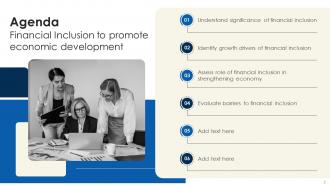
Slide 2: This is an Agenda slide. State your agendas here.
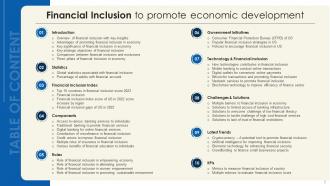
Slide 3: The slide displays TABLE OF CONTENT for the presentation.
Slide 4: The slide continues TABLE OF CONTENT further.
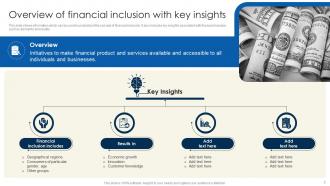
Slide 5: This slide shows information which can be used to understand the concept of financial inclusion.
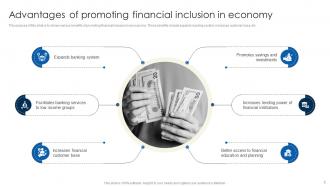
Slide 6: This purpose of this slide is to shows various benefits of promoting financial inclusion in an economy.
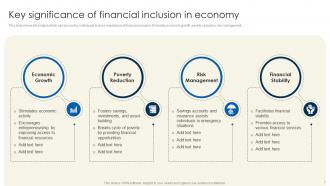
Slide 7: This slide shows information which can be used by individuals to know importance of financial inclusion.
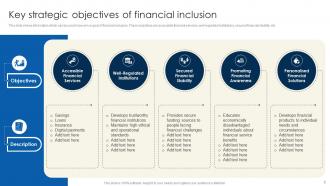
Slide 8: This slide highlights information which can be used know aim or goal of financial inclusion.
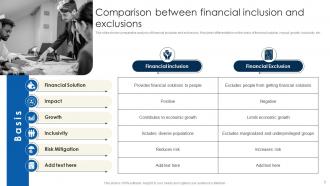
Slide 9: This slide renders comparative analysis of financial inclusion and exclusions.
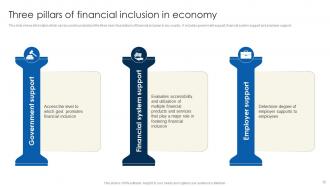
Slide 10: This slide covers information which can be used to understand the three basic foundations of financial inclusion in any country.
Slide 11: The slide displays Title OF CONTENT further.
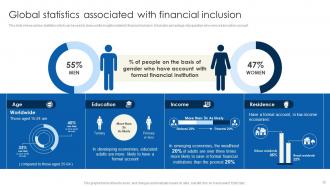
Slide 12: This slide shows various statistics which can be used to draw useful insights related to financial inclusion.
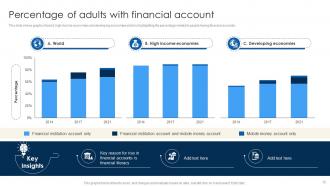
Slide 13: This slide showcases graphs of world, high income economies and developing economies.
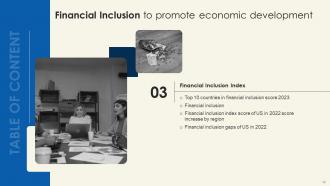
Slide 14: The slide renders Title OF CONTENT further.
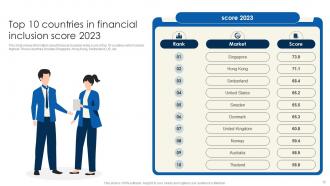
Slide 15: This slide shows information about financial inclusion index score of top 10 countries which ranked highest.
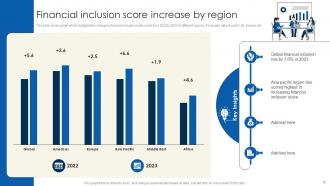
Slide 16: This slide shows graph which highlights the change in financial inclusion index score from 2022 to 2023 in different regions.
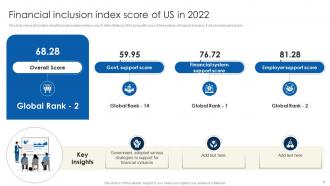
Slide 17: This slide renders information about financial inclusion index score of Unites States in 2022 along with score of three pillars of financial inclusion.
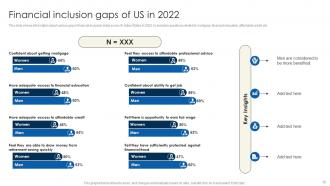
Slide 18: This slide shows information about various gap in financial inclusion index score of Unites States in 2022.
Slide 19: The slide renders Title OF CONTENT which is to be discussed further.
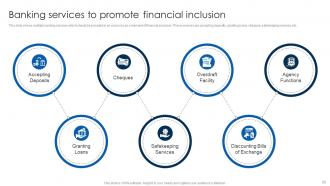
Slide 20: This slide covers multiple banking services which should be provided in an economy as a element of financial inclusion.
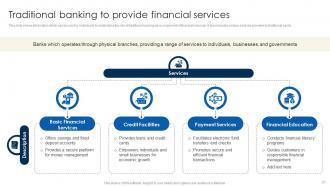
Slide 21: This slide shows information which can be used by individuals to understand the role of traditional banking as a component of financial inclusion.
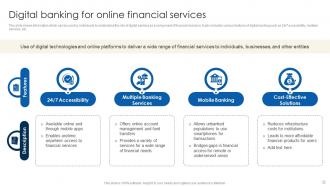
Slide 22: This slide continues information which can be used by individuals to understand the role of digital banking as a component of financial inclusion.
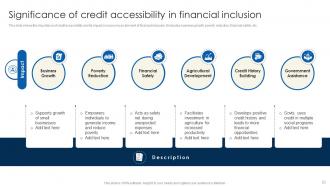
Slide 23: This slide shows the importance of credit accessibility and its impact on economy as element of financial inclusion.
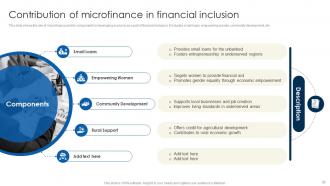
Slide 24: This slide highlights the role of micro finance and its components in developing economy as a part of financial inclusion.
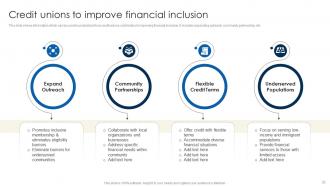
Slide 25: This slide displays information which can be used to understand how credit unions contributes in improving financial inclusion.
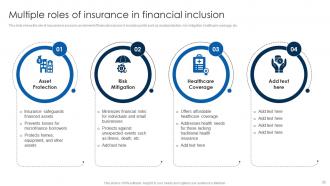
Slide 26: This slide showcases the role of insurance in economy as element of financial inclusion.
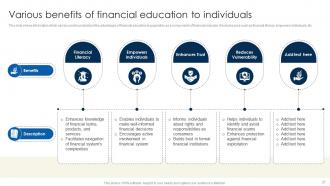
Slide 27: This slide shows information which can be used to understand the advantages of financial education to population as a components of financial inclusion.
Slide 28: The slide renders Title OF CONTENT further.
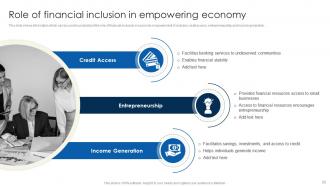
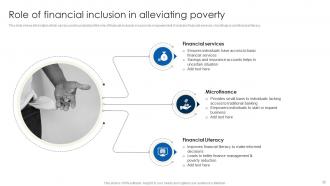
Slide 29: This slide shows information which can be used to understand the role of financial inclusion in economic empowerment.
Slide 30: This slide continues information which can be used to understand the role of financial inclusion in economic empowerment.
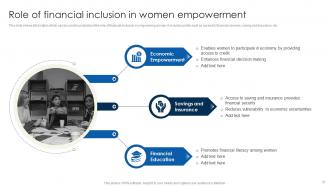
Slide 31: This slide shows information which can be used to understand the role of financial inclusion in empowering women.
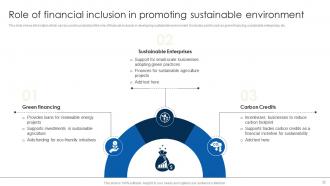
Slide 32: This slide shows information which can be used to understand the role of financial inclusion in developing sustainable environment.
Slide 33: The slide describes TABLE OF CONTENT further.
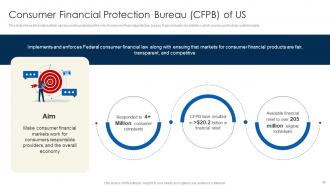
Slide 34: This slide shows information which can be used to understand the role of consumer financial protection bureau.
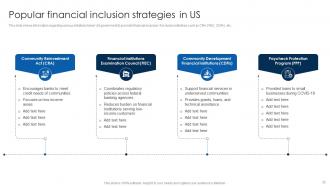
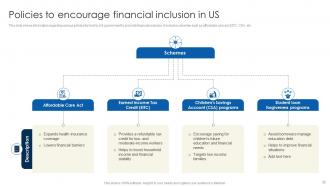
Slide 35: This slide showcases information regarding various initiatives taken US government to promote financial inclusion.
Slide 36: This slide continues information regarding various policies formed by US government to promote financial inclusion.
Slide 37: The slide displays TABLE OF CONTENT further.
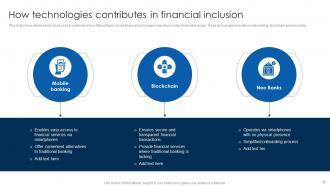
Slide 38: This slide shows details which can be used to understand how different types of new financial technologies helps to promotes financial inclusion.
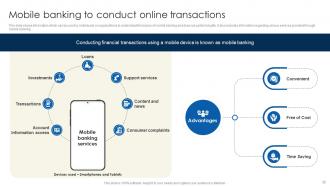
Slide 39: This slide shows information which can be used by individuals or organizations to understand the basics of mobile banking and draw out useful insights.
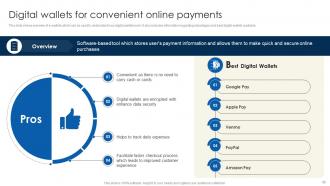
Slide 40: This slide shows overview of e-wallets which can be used to understand how digital wallets work.
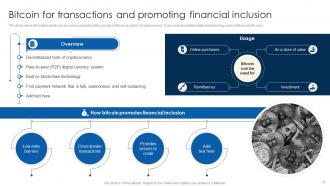
Slide 41: This slide highlights information which can be used to understand the concept of Bitcoin as a form of cryptocurrency.
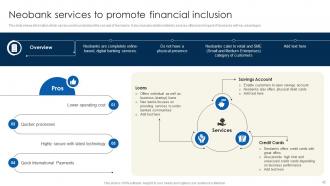
Slide 42: This slide shows information which can be used to understand the concept of Neobanks.
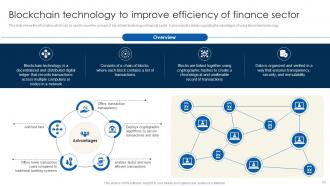
Slide 43: This slide covers the information which can be used to know the concept of blockchain technology in financial sector.
Slide 44: The slide describes Title OF CONTENT further.
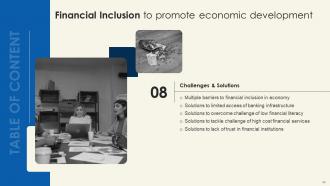
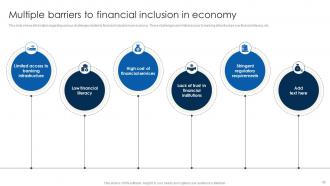
Slide 45: This slide displays information regarding various challenges related to financial inclusion in an economy.
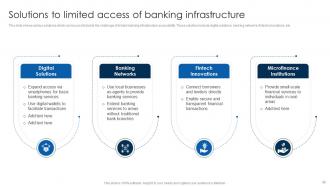
Slide 46: This slide renders various solutions which can be used to tackle the challenge of limited banking infrastructure accessibility.
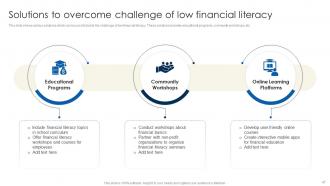
Slide 47: This slide shows various solutions which can be used to tackle the challenge of low financial literacy.
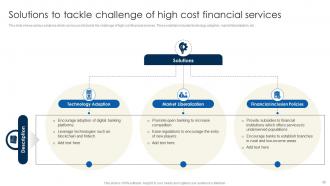
Slide 48: This slide shows various solutions which can be used to tackle the challenge of high cost financial services.
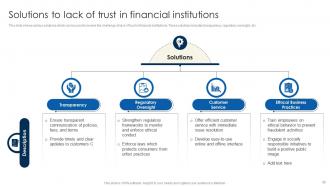
Slide 49: This slide shows various solutions which can be used to resolve the challenge of lack of trust in financial institutions.
Slide 50: The slide displays Title OF CONTENT further.
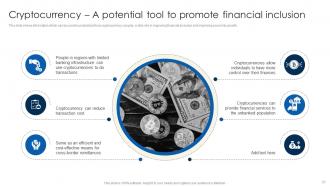
Slide 51: This slide shows information which can be used to understand how cryptocurrency can play a vital role in improving financial inclusion.
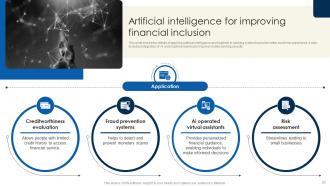
Slide 52: This slide highlights the details of applying artificial intelligence and chatbots in banking system to provide better customer experience.
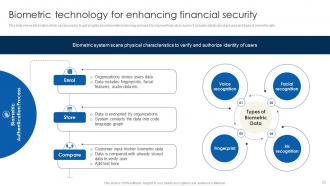
Slide 53: This slide shows information which can be used by to get insights about biometric technology and use it to improve financial inclusion.
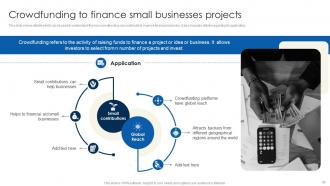
Slide 54: This slide renders details which can be used to understand the how crowdfunding can contribute to improve financial inclusion.
Slide 55: The slide displays Title OF CONTENT further.
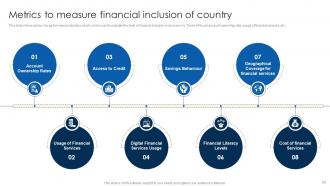
Slide 56: This slide shows various key performance indicators which can be used to evaluate the level of financial inclusion in an economy.
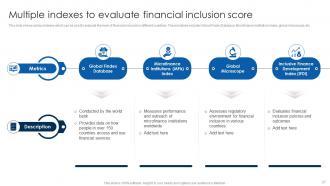
Slide 57: This slide shows various indexes which can be used to evaluate the level of financial inclusion in different countries.
Slide 58: This slide shows all the icons included in the presentation.
Slide 59: This slide is titled as Additional Slides for moving forward.
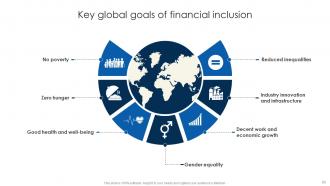
Slide 60: The slide renders Key global goals of financial inclusion.
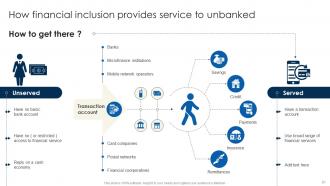
Slide 61: The slide displays How financial inclusion provides service to unbanked.
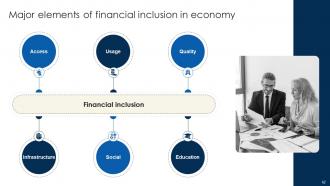
Slide 62: The slide renders Major elements of financial inclusion in economy.
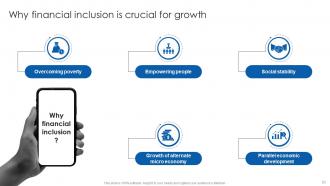
Slide 63: The slide represents Why financial inclusion is crucial for growth.
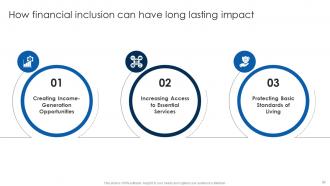
Slide 64: The slide contains How financial inclusion can have long lasting impact.
Slide 65: The slide highlights Our vision mission & goal. State your firm goals here.
Slide 66: This slide depicts Venn diagram with text boxes.
Slide 67: This slide contains Puzzle with related icons and text.
Slide 68: This slide provides 30 60 90 Days Plan with text boxes.
Slide 69: This slide shows Post It Notes. Post your important notes here.
Slide 70: This is a Thank You slide with address, contact numbers and email address.
Financial Inclusion To Promote Economic Development Fin CD with all 78 slides:
Use our Financial Inclusion To Promote Economic Development Fin CD to effectively help you save your valuable time. They are readymade to fit into any presentation structure.










FAQs for Financial Inclusion To Promote Economic
So the biggest issues? People can't get the right paperwork together - IDs, proof of address, all that stuff. Banks are often way too far away, especially in rural areas. Minimum balances are insane when you're barely scraping by. Language barriers don't help either, and honestly a lot of people just don't understand how banking works. Daily fees can literally cost more than someone makes that day, which is pretty messed up. Mobile banking sounds great until you realize not everyone has a decent phone or internet. Oh, and if you're working on this stuff - I'd start with making documentation easier and getting mobile money going first.
Honestly, tech has been a total game-changer here. Mobile banking means people can skip the whole bank branch thing - super helpful if you're in the middle of nowhere or can't afford gas to drive there. Fintech companies are getting creative with how they check if someone's good for a loan too, which I think is about time. They're not just looking at traditional credit scores anymore. Even basic stuff like SMS banking helps tons of people who don't have fancy smartphones. The trick is actually building these tools FOR these communities from the start, not just slapping on a quick fix later.
Microfinance is basically for people who can't get regular bank loans - small amounts for low-income folks or anyone without credit history. Banks usually won't bother with them. But honestly, even tiny loans can be game-changers when you're trying to start something or handle an emergency. It's all about reaching people who are completely locked out of normal banking. They offer savings accounts and insurance too, not just loans. If you're doing inclusion work, you'll probably want to team up with existing microfinance groups since they already know how to reach these communities.
Policies totally shape whether financial inclusion actually works or just stays a nice idea on paper. Mobile banking rules and digital IDs? Game changers - they've opened doors for millions. Banks being required to serve underbanked communities helps too. But then you get the stuff that backfires. Crazy KYC requirements and sky-high licensing fees basically tell people "stay out." It's honestly frustrating how some regulations meant to help end up doing the opposite. The whole thing's about balance - protect consumers without creating so much red tape that innovation dies. Oh, and definitely keep tabs on regulatory changes if you're in this field. They'll flip your strategy overnight.
Honestly, you've gotta make this stuff feel relevant to their actual lives, not like some textbook crap. Bite-sized videos work way better than long courses - people are busy! Most fintech apps are doing interactive tools now that teach budgeting while you're actually using them. Smart move, right? Nobody wants separate education modules when they're just trying to pay rent. Community partnerships help too since those orgs already have trust built up. But here's the thing - embed the learning right into transactions. People learn by doing, not by sitting through another boring presentation about compound interest or whatever.
Track account ownership and transaction frequency first - those are your basics. But honestly, the stuff that actually matters is income stability and how people handle financial emergencies. Business growth too. Don't forget to split your data by gender since women hit different roadblocks. Digital payments are huge now, can't ignore that trend. Quality-of-life changes take forever to show up though, so give yourself 12-18 months between measurements. Oh, and baseline data is everything - you're basically flying blind without it.
So this is wild - culture totally shapes who gets access to banking. Like, tons of people don't trust formal banks because of sketchy government history or past exploitation, so they'll stick with community savings circles instead. Religious stuff matters too. Islamic communities need products that follow Sharia law, and some cultures think interest is just morally wrong. Then you've got gender issues - imagine not being able to open your own bank account without your husband's permission (still happens in some places). The thing is, you can't just copy-paste Western banking everywhere and expect it to work. You've gotta actually get the local mindset first.
Yeah, digital currencies could totally change the game for people who can't get regular bank accounts. Cross-border payments become way cheaper and faster - that's massive for unbanked folks. But here's the thing: you still need internet and basic tech skills, which isn't a given everywhere. Honestly, the regulatory mess scares a lot of people off too. If you're diving into this world, start with teaching people how to use it safely first. The tech is pretty cool, but it's worthless if people don't know what they're doing with it.
Banks and NGOs make solid partners because they cover each other's weaknesses. NGOs are way better at the community stuff - they know what people actually need and already have trust built up. Banks bring the money and regulatory know-how. Usually the NGO handles outreach and education (honestly, they're just more relatable), while banks deal with the actual lending and compliance headaches. Together they can create products that actually work - like microloans with flexible terms or savings accounts that don't require huge minimums. My advice? Look for partners who fill your gaps, not duplicate what you're already good at.
Mobile money is your best bet - M-Pesa in Kenya lets people bank through basic phones, no smartphone needed. Partner with local shopkeepers who become like human ATMs for deposits and withdrawals. Biometric ID works great since rural areas often lack formal documents. Trust me, the innovation coming out of these markets is incredible. You'll want to map out existing social networks first though. Building through community leaders beats forcing traditional banking on people. It's all about working with what's already there instead of against it.
Credit access totally makes or breaks entrepreneurship for marginalized communities. Banks usually reject them over missing collateral or thin credit history - honestly such BS when you think about it. But microfinance and community lenders? Game changers. Success rates shoot up when people can actually buy equipment and inventory. My cousin went through this whole thing last year. Check out CDFIs if you know entrepreneurs stuck in traditional banking hell. Those community development financial institutions get it way more than big banks do.
So basically when you get more people using banks and formal financial stuff, it creates this snowball effect. More savers means banks can lend more money out for actually productive things instead of people just hoarding cash at home. The resource allocation gets way better too - banks are pretty good at spotting profitable investments. What's really cool is it helps reduce inequality since lower-income folks can finally access credit and savings accounts, which boosts their spending power. That creates more demand in the economy overall. Oh and if you're doing development work, start with digital payments - they're like the gateway drug to financial inclusion lol.
So basically you want to map where financial services exist vs where people actually need them. Pull your demographic data, transaction patterns, geographic stuff - gaps become super obvious fast. Mobile money data is gold for this since it shows real usage patterns. Then throw in socioeconomic data, population density, business registrations to find underserved areas. Honestly, most companies overthink this part. Just start with your customer data and overlay it with census info. Multiple data sources give you the complete picture, but you'll spot the biggest gaps right away with just those two.
Oh man, great examples to look at! M-Pesa in Kenya is the big success story - totally changed mobile money and now has 50+ million users across different countries. Then there's Bangladesh's Grameen Bank which basically invented microcredit (though honestly, results have been pretty mixed when others tried copying it). India did something massive with Jan Dhan Yojana - opened over 400 million bank accounts for people who never had banking before. Brazil's approach was smart too - they partnered with local businesses to bring banking to rural areas. What works seems to be mixing tech with local partnerships and getting government buy-in.
Okay so financial inclusion and women's empowerment are basically tied together. Give women access to banking and credit? They get way more control over household decisions. In developing countries especially, women end up managing the family money for schools and healthcare once they have their own accounts. Honestly sounds almost too simple but it actually works. Women with bank accounts start more businesses and save better for emergencies. Oh and they invest more in their kids' education too - which makes total sense when you think about it. If you're looking at gender equality stuff, financial access is probably where I'd start.
-
Innovative and creative templates with high-quality designs. Helped me with my presentation as the slides were easy to edit.
-
Huge collection of high-quality templates. Worth each penny.