


Green Finance Fostering Sustainable Development CRP CD




Try Before you Buy Download Free Sample Product
 Impress Your
 Audience
 100%
100% Editable
 Save Hours
 of Time


Grab our insightfully designed Green Finance Fostering Sustainable Development PowerPoint Presentation. Dive into the future of finance through our PPT bundle and explore sustainable finance, green bonds, and environmentally conscious investment strategies. This comprehensive deck delves into the intricacies of environmental banking and climate finance. Additionally, the Green Investment PPT templates provide insights into navigating the evolving landscape of responsible financial practices. Moreover, the Environmental Banking PPT slides display the potential of green investments and describe how to align financial goals with environmental sustainability. Whether you are a seasoned industry professional or new to green finance, this PPT equips you with the knowledge and strategies essential for success in the era of eco-conscious finance. Harness the power of responsible financial decision-making and contribute to building a sustainable and resilient future. Download our 100 percent editable and customizable PowerPoint, compatible with Google Slides, to streamline your presentation process.
People who downloaded this PowerPoint presentation also viewed the following :
Content of this Powerpoint Presentation
Slide 1: This slide introduces GREEN FINANCE - Fostering Sustainable Development. State your company name and begin.
Slide 2: This is an Agenda slide. State your agendas here.
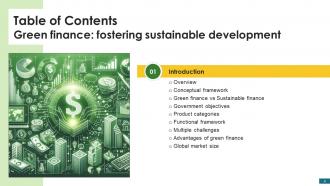
Slide 3: This slide shows Table of Content for the presentation.
Slide 4: This slide shows title for topics that are to be covered next in the template.
Slide 5: This slide offers a comprehensive overview of green finance, encompassing goals, financial products, and service categories.
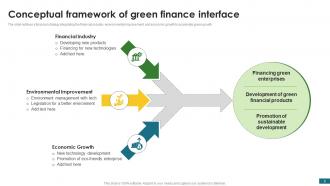
Slide 6: This slide outlines a financial strategy integrating the financial industry, environmental improvement, and economic growth to accelerate green growth
Slide 7: This slide conducts a comparative analysis of green and sustainable finance, examining key components such as scope, project types, etc.
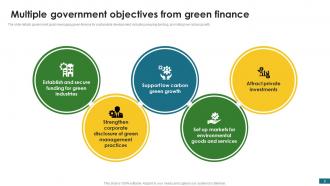
Slide 8: This slide details government goals leveraging green finance for sustainable development, including securing funding, promoting low-carbon growth etc.
Slide 9: This slide spotlights eco-friendly green finance products such as: retail finance, investment, asset management, etc.
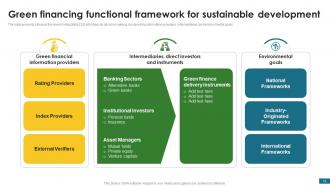
Slide 10: This slide presents a finance framework integrating ESG into financial decision-making, incorporating information providers, intermediaries, and environmental goals.
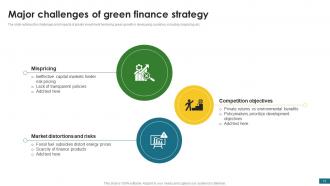
Slide 11: This slide outlines the challenges and impacts of private investment hindering green growth in developing countries, including mispricing, etc.
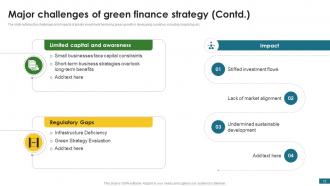
Slide 12: This slide also outlines the challenges and impacts of private investment hindering green growth in developing countries, including mispricing, etc.
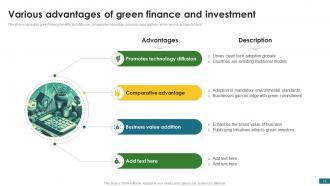
Slide 13: This slide emphasizes green finance benefits: tech diffusion, comparative advantage, business value addition, and economic prospects boost
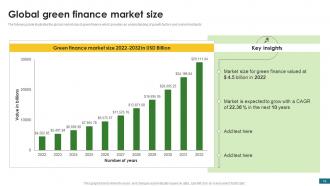
Slide 14: This slide illustrates the global market size of green finance which provides an understanding of growth factors and market restraints.
Slide 15: This slide shows title for topics that are to be covered next in the template.
Slide 16: This slide underscores financial instruments fostering environmental sustainability goals: green bonds, sustainability bonds, green loans, blue bonds, etc.
Slide 17: This slide compares financial instruments based on factors like sustainability impact, use of proceeds, and application year.
Slide 18: This slide presents an overview of carbon credits and offsets, elucidating their meaning and key differences in mitigating climate change.
Slide 19: This slide illustrates the carbon credit workflow, encompassing project developers, investors, carbon exchanges, and credit buyers to elucidate the operational system.
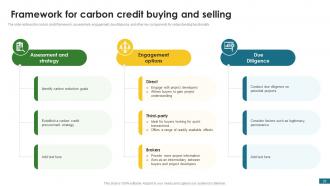
Slide 20: This slide outlines the carbon credit framework: assessment, engagement, due diligence, and other key components for understanding functionality.
Slide 21: This slide also outlines the carbon credit framework: assessment, engagement, due diligence, and other key components for understanding functionality.
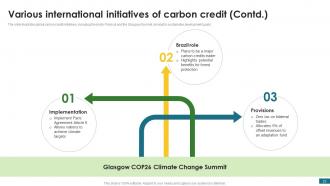
Slide 22: This slide illustrates global carbon credit initiatives, including the Kyoto Protocol and the Glasgow Summit, aiming for sustainable development goals.
Slide 23: This slide also illustrates global carbon credit initiatives, including the Kyoto Protocol and the Glasgow Summit, aiming for sustainable development goals.
Slide 24: This slide shows title for topics that are to be covered next in the template.
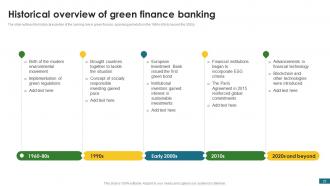
Slide 25: This slide outlines the historical evolution of the banking role in green finance, spanning periods from the 1960s-80s to beyond the 2020s.
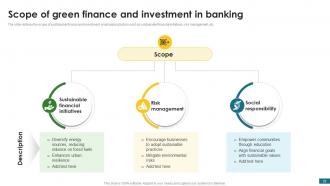
Slide 26: This slide displays the scope of sustainable finance and investment, emphasizing factors such as sustainable financial initiatives, risk management, etc.
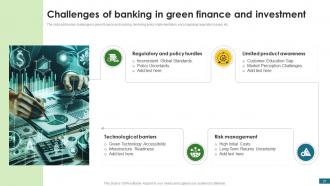
Slide 27: This slide addresses challenges in green finance and banking, hindering policy implementation, encompassing regulatory issues, etc.
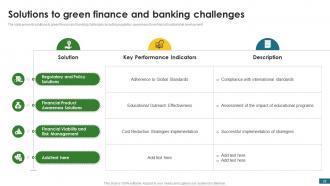
Slide 28: This slide presents solutions to green finance and banking challenges, including regulatory, awareness for enhanced sustainable development.
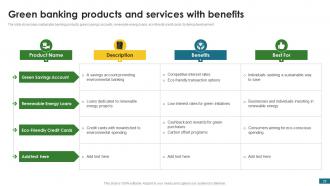
Slide 29: This slide showcases sustainable banking products: green savings accounts, renewable energy loans, eco-friendly credit cards, fostering development.
Slide 30: This slide shows title for topics that are to be covered next in the template.
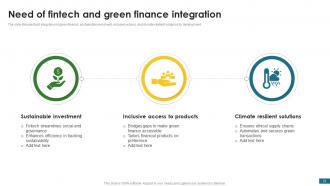
Slide 31: This slide stresses tech integration in green finance: sustainable investment, inclusive access, and climate-resilient solutions for development.
Slide 32: This slide showcases technologies for green environmental development, detailing their descriptions, workings, and implementation advantages.
Slide 33: This slide outlines risks in fintech and green finance integration such as: data privacy, and regulatory compliance challenges.
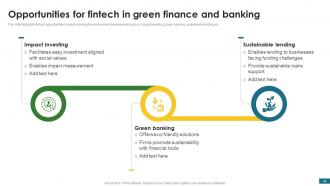
Slide 34: This slide highlights fintech opportunities in green banking for environment development such as: impact investing, green banking, sustainable lending, etc.
Slide 35: This slide presents cutting-edge technological trends in emphasizing the future potential of blockchain, AI, and IoT monitoring for sustainable development.
Slide 36: This slide introduces risk management technologies in green finance, incorporating predictive analytics, blockchain, and artificial intelligence.
Slide 37: This slide shows title for topics that are to be covered next in the template.
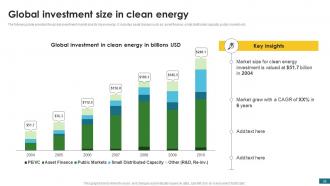
Slide 38: This slide provides the global investment market size for clean energy. It includes asset classes such as: asset finance, small distributed capacity, public markets etc.
Slide 39: This slide underscores climate financing importance: low carbon economy transition, global environment protection, and social sustainability benefits.
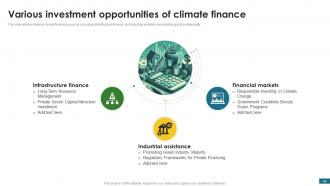
Slide 40: This slide outlines diverse climate financing sources, including infrastructure finance, and industrial assistance promoting global sustainability.
Slide 41: This slide presents challenges to climate financing and investment, including uncertain policy landscape, financial instrument gaps, and verification challenges.
Slide 42: This slide depicts policy measures addressing climate financing investment challenges, encompassing information building, environmental regulations, etc.
Slide 43: This slide shows title for topics that are to be covered next in the template.
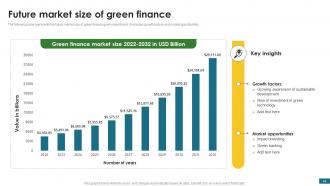
Slide 44: This slide represents the future market size of green finance green investment. It includes growth factors and market opportunities.
Slide 45: This slide outlines growth factors driving the rise in green finance and investment, including regulatory support, investments, corporate sustainability, etc.
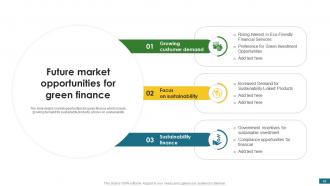
Slide 46: This slide details market opportunities for green finance which include growing demand for sustainable products, a focus on sustainability.
Slide 47: This slide shows title for topics that are to be covered next in the template.
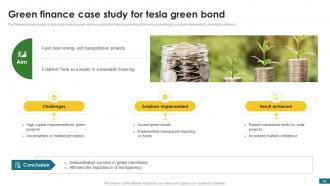
Slide 48: This slide provides a case study for tesla green bond insurance that helps to understand the various challenges, solutions implemented, and results achieved.
Slide 49: This slide presents a case study for green climate fund that helps to understand the various challenges, solutions implemented, and results achieved.
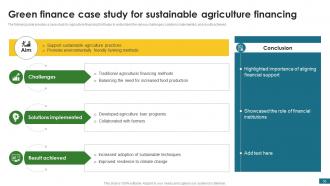
Slide 50: This slide provides a case study for agriculture financing that helps to understand the various challenges, solutions implemented, and results achieved. Solutions implemented
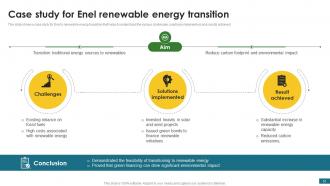
Slide 51: This slide shows a case study for Enel’s renewable energy transition that helps to understand the various challenges, solutions implemented, and results achieved.
Slide 52: This slide shows all the icons included in the presentation.
Slide 53: This slide is titled as Additional Slides for moving forward.
Slide 54: This is a financial slide. Show your finance related stuff here.
Slide 55: This slide provides 30 60 90 Days Plan with text boxes.
Slide 56: This is a Quotes slide to convey message, beliefs etc.
Slide 57: This slide contains Puzzle with related icons and text.
Slide 58: This slide shows SWOT analysis describing- Strength, Weakness, Opportunity, and Threat.
Slide 59: This is a Timeline slide. Show data related to time intervals here.
Slide 60: This is a Thank You slide with address, contact numbers and email address.
Green Finance Fostering Sustainable Development CRP CD with all 68 slides:
Use our Green Finance Fostering Sustainable Development CRP CD to effectively help you save your valuable time. They are readymade to fit into any presentation structure.
































FAQs for Green Finance Fostering Sustainable
So green finance boils down to a few things. First is additionality - you're actually funding new environmental stuff, not projects that were happening anyway. That one confuses people but it's huge. Transparency matters too - where's the money actually going? Plus you need measurable results you can track. Oh and proper governance frameworks, ideally following something like EU Taxonomy standards. My take? If you can't clearly explain the environmental impact and show real numbers, it's probably just regular finance with green marketing slapped on top.
So green finance is basically regular investing but with an environmental twist. You're still looking at returns and risk, but now you also care about climate impact. Like, you might skip a profitable coal investment because it's terrible for the planet, or go for solar projects even if they're a bit riskier. Traditional finance? Pure profit focus - which honestly makes sense from a business perspective. But green finance treats environmental impact as a real factor in decisions, not just some afterthought. ESG ratings are a good starting point if you want to check it out.
So green bonds are debt securities that fund eco-friendly stuff - renewable energy, clean transport, that kind of thing. Works like regular bonds but the money has to go toward green projects specifically. They're having a moment right now since investors can make returns while funding climate solutions. ESG investors will sometimes pay extra for that green label too, which is nice. My cousin works in municipal finance and says they're seeing way more demand lately. If you need capital and want to show you're serious about sustainability, they're worth looking at. Just don't expect them to solve everything overnight.
Honestly, start with ESG frameworks - Environmental, Social, Governance stuff. Carbon footprints, how they treat workers, board diversity, all that. MSCI and Sustainalytics will rate companies for you, though their methods are kinda inconsistent sometimes. Check if things line up with UN Sustainable Development Goals too. The real trick isn't just ticking boxes - you've got to stay consistent across your whole portfolio and actually track results over time. Oh, and the EU taxonomy is worth looking at if you're investing there.
Honestly, green finance is what makes climate stuff actually happen. It pushes tons of money toward clean energy and sustainable projects instead of fossil fuels. Without it? All those amazing climate solutions just sit there because no one can afford to build them at scale. Money talks, especially here - it creates incentives that make green investments competitive with oil and gas. My cousin works in renewables and says this all the time. If you're planning climate strategies at work, start by tracking where the funding goes. That'll show you what's really going to move forward versus what sounds good in meetings.
So basically government policies are what's driving all the green finance stuff right now. Carbon pricing and those green taxonomy rules? They're forcing companies and investors to actually care about sustainable options. Plus tax breaks and government-backed green bonds make these investments way more appealing. Without policy pressure, honestly most of this would still be super niche - which is kinda crazy when you think about it. The EU's killing it with their Green Deal thing. My advice? Always scope out what policy changes are happening in your area before jumping into green investments.
So green finance is basically funding for stuff that's actually good for the environment. Solar and wind farms are huge right now. Buildings get money for energy efficiency upgrades or LEED certifications. There's also funding for sustainable transport, water systems, waste management - oh and sometimes tree planting projects, though those seem less common. The catch? You've gotta prove your project will make a real difference. Funders want hard numbers on carbon reduction or how much water you'll save. Honestly, the measurable impact thing is non-negotiable, so nail down those metrics first.
So carbon footprint is probably your best bet - shows CO2 emissions from whatever you're invested in. Most big fund companies publish this stuff now, though honestly some of it's pretty sketchy quality-wise. ESG scores from MSCI or Sustainalytics work too. Bloomberg has this PORT thing that's decent, or check Morningstar's sustainability ratings. Oh, and track how much you've got in green stuff versus fossil fuels - that tells you a lot. I'd just start by asking your current fund managers for carbon reports. Way easier than diving into all the fancy tools right away.
Ugh, green financing is such a pain honestly. Banks get spooked by the longer payback times and higher upfront costs. Plus you have to prove your project actually helps the environment - which sounds easy but the certification stuff is a mess. There aren't tons of lenders doing this yet either, so your options are limited. Most banks don't really get environmental projects anyway. Oh and the paperwork? Way more intense than regular loans. I'd say find some specialized green finance folks early and nail down your sustainability numbers first. Makes the whole process way smoother.
Honestly, blockchain is a game-changer here - it shows exactly where your money goes, so no more sketchy "sustainable" projects that don't actually exist. Smart contracts only release funds when environmental goals are actually met, which is genius. You've got IoT sensors and satellite data tracking real impact in real-time too. AI can scan through tons of ESG data and catch greenwashing before you get burned. I mean, the tech exists to verify everything now. Just push your finance partners to use these tools - you deserve to see where your money's really going.
So the Green Taxonomy is basically a rulebook that defines what actually counts as "green" investments. No more companies slapping "sustainable" on random stuff - there's real criteria now. Honestly, it's about time someone did this because the greenwashing was getting ridiculous. You can actually verify if projects qualify as environmentally sustainable instead of just taking their word for it. Companies get clearer guidelines for green funding too. For your work? You'll finally be able to trust those green labels and use this framework when evaluating opportunities.
So those big climate deals like the Paris Accord? They're basically setting up the playbook for green finance. The EU Taxonomy is probably the best example - it actually tells you what counts as "green" so you're not guessing. These agreements push through new regulations that'll affect your funding and what you need to report. Developed countries usually promise financing too, which creates more opportunities. Honestly, keeping track of this stuff matters way more than people think. Major climate agreements will shape your green finance options down the road.
Green investments are tricky - watch out for greenwashing where companies basically lie about how eco-friendly they are. Political shifts can mess with regulations too, which sucks for your returns. The tech stuff is hit or miss, especially newer renewable energy that might flop. Honestly the whole market's all over the place right now. You'll probably pay more upfront and wait longer to see profits compared to regular stocks. Just dig into the actual numbers and environmental impact before you throw money at anything green. Some of it's legit, some isn't.
Green finance is actually pretty accessible right now - climate stuff is hot with investors. First, get your sustainability numbers sorted and craft a solid story about your environmental impact. Even if you're not pure cleantech, there's probably some carbon reduction angle you can work with. Check out green bonds, ESG-focused VCs, or those sustainability-linked loans where rates drop when you hit eco milestones. Accelerators like Techstars Sustainability are worth looking into too. Just make sure you can actually track and report your green metrics - investors will definitely ask for proof.
Honestly, PPPs are pretty clutch for scaling green finance. The government brings policy support and risk guarantees while private companies have the capital and innovation. It's like - governments can take some of the uncertainty out of risky green tech investments that would scare off private investors. Then the private side keeps everything commercially viable and well-managed. Risk-sharing is key though, and both sides need their incentives aligned or it falls apart. I'd say look for deals where that balance is actually clear upfront.
-
Awesome presentation, really professional and easy to edit.
-
Mesmerized with the fantastic collection! Super sleek, relevant infographics.