

Financial Inclusion With Blockchain Technology Training Ppt





Try Before you Buy Download Free Sample Product
 Impress Your
Audience
 100%
Editable
 Save Hours
of Time


This set of slides provides information on the significance of financial inclusion,such as economic growth,empowerment of communities,and reduction in inequality. It also covers how blockchain technology can improve financial inclusion.
People who downloaded this PowerPoint presentation also viewed the following :
Content of this Powerpoint Presentation
Slide 1
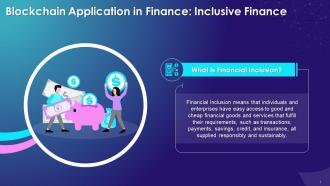
This slide gives an overview of Inclusive Finance which means that individuals and enterprises have easy access to useful financial goods and services that fulfill their requirements such as transactions, payments, etc.
Slide 2
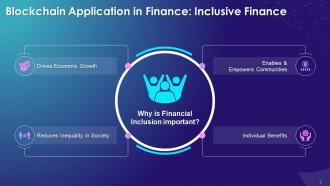
This slide highlights the importance of inclusive finance in a society by listing the advantage it provides such as economic growth, empowerment of communities, reduction in inequality, and individual benefits.
Instructor’s Notes:
- Drives Economic Growth: Financial inclusion benefits individuals, families, and entire communities and contributes to economic growth of the poor population
- Enables & Empowers Communities: It enables and empowers people by providing them with the knowledge and tools to manage and save their money along with the information they need to make sound financial decisions
- Reduces Inequality in Society: Financial services assist the poorest and most vulnerable members of society in escaping a life of penury, while also alleviating social inequality
- Individual Benefits: Participation in the financial system leads to a host of individual benefits, including the ability to establish and build a business, which allows people to improve their long-term prospects through micro-financing programs. This also enables some of those helped to pay for education of their children; overall, there is the emergence of an educated and informed citizenry
Slide 3
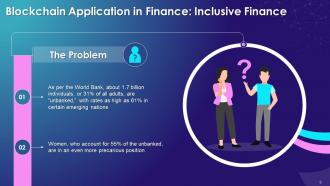
This slide highlights the problem with the current situation of financial inclusion. There are approximately 1.7 billion unbanked individuals due to their inability to prove their identity through documents like a valid passport or birth certificate.
Instructor’s Notes:
These 1.7 billion individuals who traditional banking system does not include. Many of these 1.7 billion are already economically disadvantaged — have few options for sending and receiving money, building a savings account, obtaining credit, or obtaining insurance. Without any kind of financial safety net, any kind of unexpected event related to money spells disaster for this large section of society. No one is really isolated, as we are all interconnected today.
Slide 4
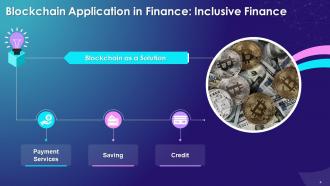
This slide discusses how blockchain technology can be used to promote financial inclusion. It can help in payment services, savings, credit, and insurance.
Instructor’s Notes:
- Payment Services: Unbanked people have a more challenging time sending and receiving money, and they typically lack the necessary documents to create an account, such as a passport or evidence of income. Blockchain applications are becoming a popular choice of technology for remittances, especially for transfer of small amounts of money, since they offer quick, inexpensive, traceable transactions that can store many currencies and be sent across numerous mobile networks, nationally and globally
- Saving: Xcapit, located in Argentina, uses blockchain's decentralized ledger to create an alternative platform that makes savings and investing more accessible for individuals without a bank account, credit, or financial literacy. The blockchain enables Xcapit to create a simple investing interface where consumers can depend on the network's security to know their funds are secure, while benefiting from a faster and affordable investment procedure
- Credit: Credit scores, which banks have historically used to assess credit eligibility, significantly impact economic growth. Grassroots Economics, a blockchain-based initiative established in Kenya and financed by UNICEF's Innovation Fund, attempts to bridge the credit gap in low-income areas
Financial Inclusion With Blockchain Technology Training Ppt with all 20 slides:
Use our Financial Inclusion With Blockchain Technology Training Ppt to effectively help you save your valuable time. They are readymade to fit into any presentation structure.












FAQs for Financial Inclusion With Blockchain
Honestly, it's mostly about documentation - so many people just don't have official IDs. Then you've got the obvious stuff like bank branches being miles away (try traveling 3 hours to make a deposit!) and those annoying minimum balance requirements that shut out anyone who's broke. Trust is another big one - people get burned by sketchy financial schemes and then won't touch anything that looks "official." Digital literacy matters too, though mobile banking has helped some. Oh, and geographic isolation is brutal in rural areas. If you're actually doing work in this space, partner with local orgs who already have street cred in the community.
Look, you can give people all the bank accounts and apps you want, but if they don't get how interest works or what those fees mean, they'll just stop using them. Or end up in some nasty debt spiral. Most people learn this the hard way, honestly. The programs that actually work? They teach you the why behind everything, not just which buttons to tap. Think about it - knowing when NOT to use credit is probably more valuable than having access to it. Without that basic knowledge, all these fancy fintech solutions are pretty much useless.
So microfinance institutions are like the financial middlemen for people who can't get regular bank loans. They offer small loans and basic savings to low-income folks that banks usually ignore. Pretty smart system actually - they often do group lending where neighbors basically vouch for each other's loans. It's like financial training wheels that help people build credit and learn money skills. Oh, and if you're doing any financial inclusion work, definitely partner with local MFIs. They've already got the community trust built up, which honestly takes forever to establish from scratch.
So mobile banking tears down those old barriers that kept people locked out. Digital wallets let you store cash and pay for stuff without dealing with traditional banks at all. Kenya's M-Pesa thing blew my mind - it happened so fast there. AI's getting pretty good at figuring out if someone's creditworthy by looking at weird data like how they use their phone instead of credit scores. Oh, and if you're building something in this space, make sure it works on crappy smartphones. Half these solutions need internet but people don't always have it.
Honestly, digital currencies could really help with financial inclusion. People can access banking without needing actual bank branches - which is huge for rural areas where banks just don't exist. The transaction costs are way lower and everything's faster too. But here's where it gets tricky - you still need internet and people have to know how to use this stuff. So we might end up excluding the same folks we're trying to help, which is kind of ironic. I think the real solution is rolling out digital currencies alongside better internet infrastructure and teaching people how to actually use them. Otherwise it's just another barrier.
So basically governments can dangle tax breaks for banks that open branches in poor neighborhoods. There's also the regulatory route - like the Community Reinvestment Act that basically forces banks to serve these areas or face consequences. Government loan guarantees help too since they reduce the risk for banks. Some places throw subsidies at mobile banking infrastructure, which honestly makes sense in rural areas. You can also do financial literacy partnerships. But the real trick is mixing several of these together instead of just picking one. I'd figure out why banks are avoiding those areas first, then target your incentives to fix those specific problems.
Honestly, just look at what's actually working out there - M-Pesa in Kenya and India's Jan Dhan thing crushed it by keeping everything stupid simple. Mobile-first is non-negotiable at this point. You'll want local agents people trust, not some fancy app they don't get. Regulatory sandboxes are clutch too (governments basically let you test stuff without red tape). Start with one thing - payments or basic savings - then build from there. I know it's tempting to launch with everything, but people need time to warm up. Oh, and simplified products win every time over feature-heavy ones.
So gender creates massive gaps in banking access, especially in poorer countries. Like, 1.7 billion women worldwide can't even get basic bank accounts - that's wild. Sub-Saharan Africa and South Asia are the worst offenders, usually because of cultural barriers or needing a man's permission (ugh). Latin America's actually ahead of the game here. The gap gets smaller in richer countries but it's still there. Quick tip though - if you're ever working on financial projects, break down your data by gender. You'll catch problems that would totally fly under the radar otherwise.
Honestly, regulators need to get their act together and actually understand the tech they're supposed to be watching. Make fintech companies follow the same consumer protection rules as regular banks - transparent pricing, clear data policies, all that. Some of these apps are deliberately confusing about fees, which is super sketchy. We also need way better digital literacy programs so people can spot the bad ones. Oh, and better complaint systems when stuff inevitably goes wrong. It's about finding that sweet spot where you don't kill innovation but also don't let consumers get screwed over as test subjects.
So basically, public-private partnerships mix the best of both worlds. Governments have the regulatory power and can reach people in remote areas that companies wouldn't bother with (not profitable enough). Meanwhile, private firms bring the innovation and efficiency that frankly, government agencies often lack. Perfect example? Banks teaming up with postal services - I mean, post offices are literally everywhere. The government provides this massive existing network, banks bring their financial know-how. Works best when both sides actually split the risks and rewards fairly. Otherwise you just get another pilot program that never goes anywhere.
So financial inclusion is basically about giving people the actual tools they need to build wealth, you know? Having access to banks, credit, insurance - that stuff lets you start a business or invest in education. Plus you're protected when life hits you with unexpected costs. People with bank accounts just save more and take smarter risks. The whole community gets more economically active as a result, which is pretty cool. Oh and if you're doing development work, mobile banking is where it's at - it's reaching people traditional banks totally ignored.
Okay so you'll want to track two main things - access and actual usage. Access is the easy stuff like how many people have accounts and where services are available. Usage is trickier but way more important honestly. Look at transaction frequency, loan uptake, savings patterns - that kind of thing. Having an account means nothing if it just sits there collecting dust! The really interesting part though is measuring actual impact on people's lives. Track income changes, business growth, how families handle financial emergencies. My advice? Start simple with whatever data you can grab easily, then get fancier over time.
Dude, credit access is literally make-or-break for starting businesses in low-income areas. No loan = no inventory, no equipment, stuck with just ideas. It's wild how much talent just sits there unused. But when people can get microloans or find alternative lenders? Small businesses everywhere - food trucks, repair shops, you name it. Creates jobs, keeps money local instead of bleeding out to big chains. Honestly the traditional banks are pretty useless here since they don't get these communities. Your best bet is connecting folks with lenders who actually understand their situation and won't demand perfect credit scores.
Honestly, it's a mess of interconnected problems. Poor internet and limited smartphones are the obvious ones, but trust is equally brutal - people are super skeptical of digital banking, and rightfully so. Most folks don't have the digital skills to navigate these apps anyway. Then you've got language barriers since apps rarely support local dialects, plus all the paperwork requirements that rural people often can't meet. The math sucks too - expensive to acquire customers but they transact way less. Oh, and I almost forgot the documentation thing is particularly annoying since many don't have formal IDs. Your best bet? Partner with local agents who can actually sit down and walk people through everything face-to-face.
Community-based stuff works because people already trust each other there. Local leaders and organizations get the real barriers - language issues, cultural stuff, why someone might avoid banks. Way more than some suit downtown would. Don't try to reinvent the wheel though. Find groups that already have street cred in those neighborhoods and figure out how to back what they're doing. Peer education is huge too since people listen to folks who've been in their shoes. Honestly, half the battle is just not being another outsider showing up with grand plans.
-
Huge collection of high-quality templates. Worth each penny.
-
The visual appeal of the templates is just unparalleled! I was so worried about the design of my presentation but SlideTeam made it all so easy.