Five stages process of penetration testing

Five stages process of penetration testing
Slide 1 of 5
Favourites Favourites

Try Before you Buy Download Free Sample Product

Audience Impress Your
Audience
Editable 100%
Editable
Time Save Hours
of Time
The Biggest Sale is ending soon in
0
0
:
0
0
:
0
0
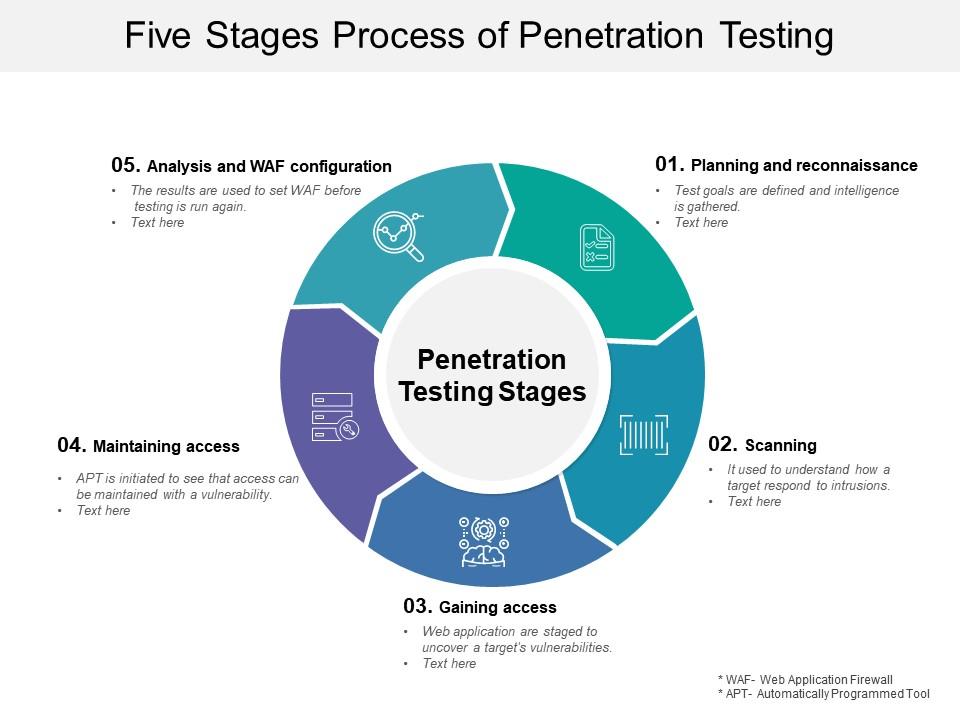
Presenting this set of slides with name Five Stages Process Of Penetration Testing. This is a five process. The stages in this process are Penetration Testing, Process, Techniques. This is a completely editable PowerPoint presentation and is available for immediate download. Download now and impress your audience.

People who downloaded this PowerPoint presentation also viewed the following :

FAQs for Five stages process

The primary purpose of penetration testing in cybersecurity is to proactively identify vulnerabilities, assess security weaknesses, and evaluate defense mechanisms before malicious attackers exploit them. Through simulated attacks, organizations across sectors like banking, healthcare, and retail can strengthen their security posture, reduce breach risks, and ensure compliance requirements, ultimately delivering enhanced protection and competitive advantage in an increasingly threat-rich environment.

Penetration tests actively exploit discovered security weaknesses to demonstrate real-world attack scenarios, while vulnerability assessments simply identify and catalog potential security flaws without attempting exploitation. Through simulated attacks, penetration testing reveals actual business impact and breach pathways, enabling organizations to prioritize critical fixes and strengthen defenses against sophisticated threats.

Common penetration testing methodologies include black box, white box, gray box, external, internal, and web application testing approaches. These methodologies enhance security by simulating real-world attacks, identifying vulnerabilities across network perimeters and applications, and enabling organizations to strengthen defenses, with many financial institutions and healthcare providers finding that comprehensive testing ultimately delivers improved compliance and reduced breach risks.

Social engineering in penetration testing involves simulating human-based attack vectors like phishing emails, pretexting calls, physical infiltration attempts, and baiting scenarios to assess organizational vulnerabilities. These techniques complement technical testing by evaluating employee security awareness and procedural weaknesses, with many organizations finding that human factors often present the greatest security risks, ultimately delivering comprehensive vulnerability assessments.

Legal considerations include obtaining written authorization from system owners, defining clear scope boundaries, ensuring proper insurance coverage, complying with data protection regulations, and establishing incident response protocols. Organizations must also verify testing doesn't violate third-party agreements, maintain confidentiality standards, and document all activities, with many enterprises finding that comprehensive legal frameworks ultimately streamline testing processes while minimizing compliance risks.

Penetration testers ensure minimal business disruption by conducting tests during off-peak hours, using controlled testing environments, implementing gradual attack simulations, and maintaining constant communication with IT teams. Through careful scoping and phased approaches, organizations like banks and healthcare providers successfully balance security assessments with operational continuity, ultimately delivering comprehensive vulnerability insights without compromising daily business functions.

Essential penetration testing tools include network scanners like Nmap, vulnerability assessment platforms such as Nessus, web application testing suites like Burp Suite, exploitation frameworks including Metasploit, and wireless security analyzers. These technologies streamline security assessments by automating reconnaissance, identifying system vulnerabilities, and simulating real-world attacks, ultimately enabling organizations to strengthen defenses and minimize breach risks.

Organizations effectively communicate penetration test findings through comprehensive executive summaries, detailed technical reports with risk prioritization, visual dashboards showing vulnerability metrics, and structured remediation roadmaps with clear timelines. These communication methods enable stakeholders to understand security gaps, allocate resources strategically, and track improvement progress, with many enterprises finding that clear, actionable reporting accelerates vulnerability resolution and strengthens overall security posture.

Penetration testing typically takes one to four weeks, depending on scope complexity, system size, and testing depth requirements. For smaller networks or applications, tests complete within days, while comprehensive enterprise assessments spanning multiple systems require weeks, with organizations increasingly finding that thorough testing delivers stronger security postures and regulatory compliance advantages.

Organizations should conduct penetration tests quarterly for high-risk environments, annually for standard operations, and immediately after major system changes or security incidents. Many financial institutions and healthcare organizations perform continuous testing alongside scheduled assessments, while retail and manufacturing companies typically find annual comprehensive tests sufficient, ultimately delivering proactive threat detection and regulatory compliance.

Penetration testers should possess technical skills including network security, vulnerability assessment, scripting languages, system administration, and social engineering techniques, alongside certifications like CEH, OSCP, CISSP, and GPEN. These qualifications enable cybersecurity professionals to identify security weaknesses, simulate real-world attacks, and provide strategic recommendations, with many organizations finding that certified testers deliver more comprehensive assessments and actionable insights.

Penetration test scope is determined by identifying target systems, defining testing boundaries, establishing business objectives, and considering regulatory requirements and budget constraints. Organizations typically collaborate with security teams to specify critical assets, acceptable testing windows, and risk tolerance levels, while ensuring comprehensive coverage of high-value systems, ultimately delivering focused security assessments that enhance organizational defenses.

Threat modeling provides the strategic foundation for penetration testing by identifying potential attack vectors, prioritizing high-risk vulnerabilities, and mapping realistic threat scenarios before testing begins. This systematic approach enables security teams to focus their penetration testing efforts on the most critical assets and likely attack paths, ultimately delivering more targeted assessments and actionable security improvements for organizations.

Remediation actions should be prioritized based on risk severity, exploitability, and business impact, focusing first on critical vulnerabilities that provide system access or data exposure. Organizations typically address high-risk findings affecting core systems first, then medium-risk issues in customer-facing applications, ultimately delivering enhanced security posture and regulatory compliance while reducing overall organizational risk.

Penetration testing challenges include scope limitations, time constraints, false positives, client system disruptions, and evolving threat landscapes. These obstacles can impact assessment accuracy and thoroughness, with many organizations finding that insufficient documentation, limited access permissions, and coordination across multiple departments often complicate engagements, ultimately requiring strategic planning to deliver comprehensive security insights.

Ratings and Reviews

0% of 100
Write a review
Most Relevant Reviews

No Reviews