


Five steps strategic planning goals and objectives powerpoint design




Try Before you Buy Download Free Sample Product
 Impress Your
 Audience
 100%
100% Editable
 Save Hours
 of Time


Our Five Steps Strategic Planning Goals And Objectives Powerpoint Design ease the burden of journalists. It facilitates collation of information.
People who downloaded this PowerPoint presentation also viewed the following :
Content of this Powerpoint Presentation
Description:
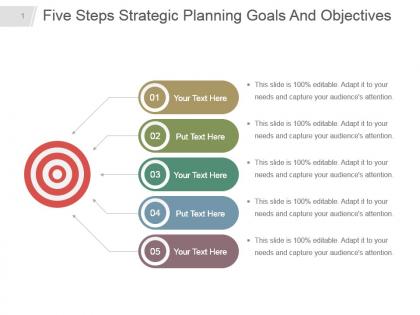
The image is a PowerPoint slide titled "Five Steps Strategic Planning Goals And Objectives," designed to guide viewers through a five-step process in strategic planning. The visual centerpiece is a sequence of circular elements numbered from 01 to 05, each connected by a line that suggests progression through the steps. These circles are color-coded, with a target icon at the beginning, symbolizing the goal or objective-setting phase of strategic planning.
Beside each number is a text box with "Put Text Here," indicating where detailed descriptions for each step should be inserted. The repeated statement "This slide is 100% editable. Adapt it to your needs and capture your audience's attention." emphasizes the customizable nature of the template, allowing the presenter to tailor the content to specific strategic goals and objectives.
Use Cases:
This strategic planning slide is versatile and can be adapted for use in various industries, such as:
1. Business Consulting:
Use: Crafting tailored strategies for business growth and development.
Presenter: Strategy Consultant.
Audience: Business Owners and Executives.
2. Education:
Use: Setting institution-wide strategic educational goals.
Presenter: Academic Director.
Audience: Faculty and Institutional Stakeholders.
3. Healthcare:
Use: Developing long-term patient care and health service objectives.
Presenter: Healthcare Administrator.
Audience: Medical Professionals and Hospital Board Members.
4. Non-Profit Organizations:
Use: Planning for mission-driven objectives and community impact.
Presenter: Program Manager.
Audience: Donors, Volunteers, and Community Leaders.
5. Technology Firms:
Use: Steering product development and market entry strategies.
Presenter: Chief Technology Officer.
Audience: Product Teams and Investors.
6. Financial Services:
Use: Defining investment strategies and client wealth management plans.
Presenter: Financial Planner.
Audience: Clients and Financial Advisors.
7. Government Agencies:
Use: Structuring policy objectives and public service improvement plans.
Presenter: Policy Analyst.
Audience: Public Officials and Civic Representatives.
Five steps strategic planning goals and objectives powerpoint design with all 5 slides:
Cut across borders with our Five Steps Strategic Planning Goals And Objectives Powerpoint Design.They ensure geographical borders blur.
FAQs for Five steps strategic planning goals and
You'll want to start with environmental scanning - basically checking out your competition and market. Then nail down your vision/mission statements and do a SWOT analysis. Most people totally skip that first step though, which is dumb because you're flying blind otherwise. Set 3-5 strategic priorities max (seriously, don't go overboard), create action plans with deadlines, and assign who's doing what. Oh, and build in quarterly reviews. Things change fast and you need to pivot when they do. I've seen way too many teams make these massive, complicated plans that just collect dust.
Stop treating your mission and vision like fancy posters nobody reads. Break them into actual measurable stuff your team can work toward. When you're planning strategy, ask yourself - does this goal actually help us live our mission or get closer to our vision? If not, why are we doing it? I swear, most companies act like these are totally separate things when they should be connected. Try making a simple chart that shows how each big priority ties back to your mission/vision statements. Super basic but it works.
Oh, SWOT analysis? It's like doing a reality check before making any big moves. You list out what you're good at, what sucks, plus what opportunities are out there and what could screw you over. Honestly, most people skip the "threats" part because it's depressing, but that's where the gold is. Once you've got all that mapped out, your strategy basically writes itself - you'll know exactly what to focus on instead of just guessing. The trick is being real with yourself about the weaknesses. No point lying to yourself, right?
Quarterly reviews work best honestly - things change way too fast now to wait a whole year. I mean, look how much shifted just in the past six months in most industries. Do a deep dive annually for sure, but those lighter quarterly check-ins? They'll save you from getting blindsided. Don't be rigid about timing though. If something major hits - new competitor, market shake-up, whatever - just review it then. Put those quarterly dates in your calendar right now or you'll totally forget. Trust me on that one.
Honestly, surveys and interviews are your starting point for getting early input. Workshops work amazing too - I swear those chaotic whiteboard sessions where everyone's interrupting each other always produce the best ideas. Maybe set up a stakeholder committee that meets regularly? Online tools help if people are remote, and town halls are solid for bigger groups. Here's the thing though - executives want different approaches than your frontline people. Map out who you need involved first, then pick like 2-3 methods that actually fit your timeline. Don't overthink it.
Honestly, you need both hard numbers and gut-check stuff. Set up KPIs that actually connect to your goals - revenue, customer satisfaction, whatever matters most to your business. Some wins won't show up for years though, which sucks when everyone wants instant results. Don't forget the softer things like how engaged your team feels or if you're actually doing what you said you'd do. Quarterly reviews work well - look at the data but also ask "how's this really going?" A simple dashboard helps you catch problems early. Oh, and make sure stakeholders are still on board - that can make or break everything.
So for SWOT analysis, Creately and Lucidchart are solid for visual stuff. Balanced scorecard software? ClearPoint Strategy is pretty decent. But honestly, don't sleep on a well-organized spreadsheet - I've seen those work better than fancy tools sometimes. Tableau's great for catching data trends your team probably missed. Once you've got your strategy figured out, Monday.com or Asana will keep those initiatives from falling apart. My advice? Pick one tool that fixes your biggest headache first. Trust me, trying to roll out everything at once is a nightmare.
Honestly, most companies mess this up by stopping at the big town hall announcement. You've gotta follow through with department meetings that actually show people how this affects their day-to-day work. That's where the real understanding happens. Send email summaries, put stuff on the intranet, whatever - just keep the message consistent everywhere. Make some simple visuals they can look at later (trust me, they will). But here's the thing that really matters: train your managers to bring this up in regular one-on-ones. Otherwise it just becomes another PowerPoint gathering dust.
Oh man, the worst thing you can do is plan like 5 years out with zero wiggle room. I've watched entire teams waste months building these super detailed strategies that sound impressive but tell nobody what they're supposed to actually do tomorrow. Don't forget to talk to your customers first - sounds obvious but you'd be shocked how many people skip this step. Same with checking what competitors are up to. Keep timelines realistic (learned this the hard way) and get input from whoever's actually doing the work. Make it specific enough to track but loose enough to change course when things inevitably go sideways.
Ditch those massive 5-year plans - they're basically useless now. Go for quarterly check-ins instead and keep some budget unallocated so you can actually move fast when things change. Set up alerts for market shifts and have a few "what if" scenarios ready to go. The companies that didn't completely crash in 2020? They were already doing this flexibility thing. Oh, and let your people make decisions without waiting for fifty approvals - that's huge. Honestly, start every planning meeting by asking what could totally wreck your plan. Sounds paranoid but it works.
Think of data analytics like having a really good map when you're driving somewhere new. You can see patterns in what's actually happening instead of just guessing and hoping for the best. Honestly, I used to make way too many decisions based on hunches - terrible idea. Now I track customer behavior and market changes with real numbers. The tricky part is figuring out which metrics actually matter for your goals. Don't get caught up measuring stuff that just looks impressive in meetings but doesn't help you make better choices.
Honestly, the best approach is working backwards from where you want to be in 3-5 years. Take those big goals and chop them into smaller chunks you can actually tackle each quarter. It's basically like using GPS - you need all those little turns to get where you're going. The trick is making sure what you're doing today actually moves you forward instead of just dealing with whatever crisis pops up. So many teams get stuck just reacting to stuff! Start with your long-term vision, then figure out what absolutely has to happen this year to stay on track. Those become your stepping stones.
Honestly, just be super upfront about what's changing and why it matters to them personally. Nobody wants stuff happening TO them without understanding it, you know? Get your key people bought in first - they'll do half the work for you. Don't ignore the complainers either, actually listen to their concerns. Let people help shape how things roll out instead of just dictating everything from above. Quick early wins are clutch for momentum. Oh, and patience is everything here. I've seen good changes fail just because leadership gave up too soon when people didn't adapt immediately.
Do that impact vs effort thing first - tackle high impact, low effort wins obviously. Most leaders try juggling everything at once (total disaster, trust me). Pick maybe 3-5 initiatives you can actually do well instead of half-assing a dozen. Quick wins are clutch for building momentum while you're working on bigger stuff. Factor in your resources, timelines, what actually moves the needle on your main goals. Oh and create some simple scoring system so your leadership team isn't arguing about random criteria later. Way easier when everyone's aligned upfront.
Honestly, the biggest thing is making sure it actually sounds like your company, not some generic corporate fluff. Get your team involved in writing it - you'll need their buy-in anyway. Skip the buzzwords that make everyone cringe. Keep it broad enough to guide decisions but specific enough that it couldn't describe any random business down the street. I'd definitely test it with employees first before rolling it out. Make sure it captures what you really do and care about, not just what looks impressive on the website. Short and clear beats long and confusing every time.
-
Visually stunning presentation, love the content.
-
Out of the box and creative design.