


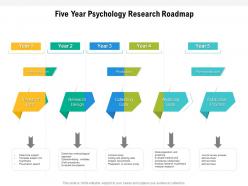
Five year psychology research roadmap





Try Before you Buy Download Free Sample Product
 Impress Your
 Audience
 100%
100% Editable
 Save Hours
 of Time


A cohesive work plan is essential for achieving the desired target. Communicate your vision and lay a firm ground in front of your audience with our PowerPoint layout. Align your project milestones, budgets, deliverables, deadlines, and all the requisite information for a dynamic presentation by employing this amazingly designed Five Year Psychology Research Roadmap. Maximize team efficiency and streamline a work plan efficiently by introducing our ready made roadmap PowerPoint theme. You can quickly establish coordination between different activities across the organization and present an insight to your colleagues by utilizing this useful business tool. Color code specific tasks, prioritize, and keep a close eye on the deadlines with the help of our eye catchy PowerPoint template. Download our Five Year Psychology Research Roadmap for excelling at productive management.
People who downloaded this PowerPoint presentation also viewed the following :
Five year psychology research roadmap with all 2 slides:
Use our Five Year Psychology Research Roadmap to effectively help you save your valuable time. They are readymade to fit into any presentation structure.
FAQs for Five year
Okay so basically you've got four big things to nail down: informed consent, confidentiality, minimizing harm, and making sure participation is actually voluntary. Your participants need to genuinely get what they're agreeing to - and they can bail anytime without consequences. Data protection is massive, especially now that we can track so much digitally (honestly it's wild how much info we can gather). You'll also need to justify any psychological discomfort against the research benefits. Oh, and definitely loop in your IRB early and keep them updated. When you're unsure, just protect the participants first.
Your methodology is literally everything - it decides what you'll actually discover. Want to say "X causes Y in 78% of cases"? Go quantitative for that statistical power. But qualitative gets into the messy human stuff numbers can't touch. Why do people act weird? What does their experience feel like? I've seen researchers study the exact same thing and get totally different results. Surveys show low anxiety while interviews reveal people are secretly falling apart but won't admit it on paper. Pick whatever gives you the right depth or breadth for your question.
So replication is basically how we figure out if psychology findings are legit or just random noise. You need multiple studies showing the same results before you can trust a theory. Psychology actually went through this whole crisis recently - tons of famous studies couldn't be replicated (social priming was a mess). But honestly? That made the field way more rigorous. One study proves nothing on its own. Different labs, different people, same results - that's when you know you've got something solid. Always double-check if findings have been replicated before you base your research on them.
Dude, the change in psych data collection is wild - like, completely different from 10 years ago. Smartphone apps let you track real-time behavior now. Online experiments? You can get huge sample sizes without leaving your office. Wearables track physiological stuff while people go about their normal day, which is honestly so much better than having them sit in some sterile lab. Yeah, you lose control over variables, but the authentic data makes up for it. Oh, and if you haven't tried online surveys yet, seriously start there - recruiting participants used to be such a pain.
So basically, culture affects everything in psych research - what questions get asked, how people respond to tests, even how researchers interpret the data. Your background shapes whether you value independence or community, if you're cool with certain testing setups, all that stuff. Most "universal" psychology is actually just based on WEIRD populations (Western, Educated, Industrialized, Rich, Democratic) which is... pretty narrow when you think about it. Researchers bring their own biases too. Always worth asking: who's actually represented in this study and who got left out?
Ugh, bias is everywhere in research and it's super annoying. You'll unconsciously pick certain participants or interpret data to fit what you already think - classic confirmation bias. Then your participants lie to look good (social desirability bias) or give answers they think you want. I swear, sometimes I wonder how any study gets reliable results! Double-blind setups help a ton. Also get someone else to check your methods beforehand - you're probably too close to spot your own blind spots anyway.
Honestly, you'll want to mix different approaches since these things are super complex. Validated scales are your friend - Academic Motivation Scale for motivation, Big Five for personality. Those are pretty reliable. But also throw in some interviews or behavioral observations if you can. I'm probably biased but I think the combo approach works way better than just surveys alone. Oh, and physiological measures are cool too if you're feeling ambitious. Each method has its blind spots, so being upfront about limitations is smart. Really depends on what exactly you're trying to figure out though.
Ugh, participant dropout is the absolute worst - people just vanish and it totally messes up your data. Practice effects are another pain because participants get better at tasks from repetition, not real development. Historical events can screw with results too, which is annoying. Oh, and the time/money commitment? Brutal. Honestly, retention strategies need to be your priority from the start. I always tell people to expect at least 20-30% dropout when calculating sample sizes. Maybe even more if your study's really long. Trust me on this one.
So peer review is basically like having other experts double-check your work before it goes public. They'll catch stuff like bad sample sizes, wonky statistics, or when you're claiming way more than your data actually shows. Honestly, it's terrifying as a researcher - nobody likes getting their work torn apart. But that's the whole point, right? Studies with crappy methodology get filtered out. When you're looking up psychology research, you can feel pretty confident that published stuff has been picked over by people who actually know their shit. Just make sure whatever you're reading actually went through the process first.
Honestly, you can't really do good psych research in a vacuum anymore. Human behavior is way too complex for just one field to figure out. Teaming up with neuroscientists makes your cognitive studies so much stronger - like, brain imaging data completely changes how you interpret results. Economists and sociologists bring totally different angles too. Plus there's the practical stuff - more funding options, better methods to cross-check your findings. I'd say just email researchers whose work overlaps with yours. Most people are surprisingly down to collaborate, especially if you're specific about what you bring to the table. Way better than trying to tackle everything solo.
So basically, therapy uses stuff that actually works in studies. Cognitive-behavioral therapy comes from research on how our thoughts mess with our behavior. Attachment theory helps therapists figure out relationship problems. The research moves pretty slowly though, which is annoying. Meta-analyses show which treatments actually help people get better. Then therapists tweak these methods for each person - you know, cultural stuff matters too. I'd look for therapies that mention research backing them up. That's usually your best shot at finding something effective.
Digital mental health stuff is everywhere right now - AI therapy tools, apps, all that. Climate psychology is blowing up too since everyone's stressed about the environment (can't blame them honestly). There's massive funding for cultural psychology research, especially how different communities handle mental health treatment. Cross-cultural validation studies are getting tons of money. Oh, and neurodiversity research is huge. If you're thinking about switching focus, definitely look at tech mixed with traditional therapy approaches. That's where all the grant dollars are going. Pretty wild how much the field's changing.
Honestly, psychology research has way more impact on policy than most people realize. Researchers figure out what actually works in schools, mental health programs, criminal justice - then policymakers take those findings and scale them up. Like childhood development initiatives or addiction treatment programs. What's interesting is how it works backwards too - community programs create real data that helps researchers improve their theories. Oh, and if you're thinking about getting into this space? Find a specific policy problem where psychological insights could genuinely move the needle. That's probably your best starting point.
Neuroimaging completely changed brain research - we can actually watch thoughts happen instead of just guessing from behavior. It's wild seeing brain areas light up during decision-making or when memories form. fMRI and PET scans show us which regions do what and how they talk to each other. This gives way more precise ideas about how cognition works. Plus it helps prove or bust existing theories, which is honestly satisfying when some old idea gets demolished. If you're planning studies, neuroimaging data can really back up your behavioral results. The tech isn't perfect but it's pretty incredible.
Honestly, you gotta go where people already hang out instead of waiting for them to find you. Hit up community centers, churches, cultural groups - that kind of thing. Prolific's way better than campus flyers for diversity, though yeah it costs more (ugh). Remote sessions help too since not everyone can make it to campus during normal hours. Oh and definitely check that your materials aren't accidentally excluding people - maybe translate key stuff if you can. Campus recruiting is just too narrow these days.
No Reviews