


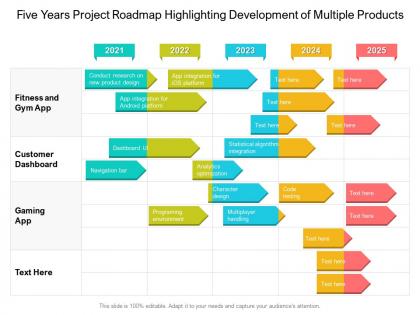
Five years project roadmap highlighting development of multiple products




Try Before you Buy Download Free Sample Product
 Impress Your
 Audience
 100%
100% Editable
 Save Hours
 of Time


A cohesive work plan is essential for achieving the desired target. Communicate your vision and lay a firm ground in front of your audience with our PowerPoint layout. Align your project milestones, budgets, deliverables, deadlines, and all the requisite information for a dynamic presentation by employing this amazingly designed Five Years Project Roadmap Highlighting Development Of Multiple Products. Maximize team efficiency and streamline a work plan efficiently by introducing our ready made roadmap PowerPoint theme. You can quickly establish coordination between different activities across the organization and present an insight to your colleagues by utilizing this useful business tool. Color code specific tasks, prioritize, and keep a close eye on the deadlines with the help of our eye catchy PowerPoint template. Download our Five Years Project Roadmap Highlighting Development Of Multiple Products for excelling at productive management.
People who downloaded this PowerPoint presentation also viewed the following :
Five years project roadmap highlighting development of multiple products with all 2 slides:
Give your audience a fulfilling experience. They will find our Five Years Project Roadmap Highlighting Development Of Multiple Products elevating.
FAQs for Five years project roadmap highlighting development
You'll need five main things: clear goals, realistic milestones with deadlines, key deliverables, task dependencies, and resource planning. I swear, half the roadmaps I see are just fancy charts that look impressive but tell you nothing useful. Figure out your critical path and risks early on. Anyone looking at it should instantly get what's happening, when, and who owns what. Oh, and build in regular review dates - things always change. Start simple with a basic template first. You can add complexity later, but don't go overboard initially or you'll confuse everyone.
Okay so first thing - actually figure out what the business wants to hit this quarter and year. Sounds basic but so many PMs just... don't do this? Take every big roadmap thing and connect it to a real business goal - revenue, keeping customers happy, whatever. I always make some kind of visual chart because execs eat that stuff up, they love seeing how features actually impact the business. Oh and check in with stakeholders regularly since priorities change constantly. Honestly, if you can't explain how something moves the needle, just cut it.
For roadmap stuff, I'd check out Roadmunk or ProductPlan first - they're built specifically for this and look super professional when you're presenting to stakeholders. Miro's really flexible too if you want more control over design. Quick confession: I've made some solid roadmaps just using Notion with decent formatting. Even Google Sheets works if you get creative with it. The biggest thing though? Pick whatever tool your team's already using daily. There's no point choosing something fancy that'll just sit there collecting digital dust because nobody wants to log into yet another platform.
Honestly? Monthly works for most projects I've seen. Weekly if things are moving super fast or you're constantly putting out fires. The main thing is actually sticking to whatever schedule you pick - I can't tell you how many teams say they'll review monthly then only do it when stuff hits the fan. Just throw a recurring meeting on everyone's calendar with stakeholders, otherwise it won't happen. Catches scope creep and priority shifts before they mess everything up. Way easier to tweak timelines early than scramble later when deadlines are breathing down your neck.
Ugh, the worst mistake is going crazy with details right away - you'll be updating that thing constantly and it becomes totally pointless. Don't lock everything down either since priorities shift all the time. Team dependencies will bite you (trust me, we once had engineering twiddling their thumbs for weeks waiting on design). Build in buffer time or stakeholders will lose their minds when you inevitably hit delays. Oh, and don't try cramming every random feature request into your timeline just because someone asked nicely. Focus on big milestones first. Add the nitty-gritty details later when you're actually close to working on that stuff.
Start with stakeholder interviews early on, then throw some workshops or surveys at them once you've got rough drafts. I always do this "roadmap review" thing where people can actually see the timeline visually - honestly way better than just talking through priorities in the abstract. Here's the key part though: show them how their feedback changed your decisions. People need to know you actually listened. Oh, and set up quarterly check-ins so you're not building something that becomes totally irrelevant six months later. Business needs shift constantly.
Think of milestones as your project's major checkpoints - the big stuff you absolutely can't miss. They show when key deliverables or phases wrap up without boring stakeholders with every little task. Honestly, they're lifesavers for catching problems early. Focus on outcomes, not activities - so "user testing done" beats "conduct user tests." The small tasks will shift around anyway (they always do), but milestones keep you anchored. They're basically your early warning system for when things start going sideways.
Honestly, ditch hard deadlines from the start - use timeboxes instead. Review monthly or you'll definitely forget (trust me on this one). My team's "Q2 launch" turned into a total Q4 disaster because we never looked back at our priorities. Quarters work better than specific dates for planning features. Always keep some buffer time for random stuff that pops up. Your roadmap isn't set in stone, so treat it like it can change. When you do shift things around, just explain the business reasons behind it. Stakeholders hate surprises but they're cool with changes if they get the why.
There are a few good ways to tackle this. MoSCoW method is pretty simple - just bucket everything into Must have, Should have, Could have, Won't have. Great for getting everyone on the same page. I'm personally a fan of value vs. effort matrices since they help you spot the obvious wins and avoid rabbit holes. RICE scoring works well if your team loves data (Reach, Impact, Confidence, Effort). But honestly? Sometimes the best filter is just "what breaks if we skip this?" - cuts through so much BS. Find what clicks with your team and don't overthink it.
So the trick is giving each group what they actually want to hear. Executives? Hit them with big milestones, budget stuff, and business impact - skip the sprint details. Your dev team needs all the technical mess, dependencies, timelines that won't make them laugh at you. Honestly, I end up making like 3 different versions of the same roadmap and yeah, it's annoying but beats answering a million questions later. Stakeholders just want to know when their stuff gets done. Match your visuals to what they're used to seeing. Always start with why you're doing something before you get into the timeline weeds.
Pick metrics that actually matter for each milestone - completion rates, quality scores, staying on budget, hitting deadlines. User adoption rates are huge for feature launches. Budget milestones? Track cost variance religiously. I've watched so many teams get obsessed with flashy metrics that tell you nothing useful. What matters is setting clear success thresholds upfront so you know what you're aiming for. Build a simple weekly dashboard everyone can understand. Make sure your whole team knows what "winning" looks like for each metric before you even start tracking.
So here's the thing with remote teams - you can't just tap someone on the shoulder to explain your roadmap anymore. Cloud tools are your best friend here. Miro's pretty solid, or even just a Google Doc that everyone can jump into. Make sure timelines and who owns what are super obvious at first glance. I always over-communicate stuff that would be no-brainer conversations in the office. Set up regular video calls where the whole team reviews progress together - way better than endless Slack threads. Oh, and don't let it become one of those dusty documents nobody touches. Keep updating it or it's useless.
So basically, waterfall means you plan everything upfront - like mapping your whole project timeline with fixed phases before you even start. Agile's totally different. You work in short 2-4 week chunks and can change direction based on what you learn. Think of waterfall as a detailed blueprint vs agile being more flexible and responsive. Honestly, agile makes way more sense unless your requirements are super clear from day one (which... let's be real, when does that actually happen?). Waterfall's fine for predictable stuff, but agile lets you adapt when things inevitably shift.
You need both, trust me. Quick wins keep everyone motivated - there's nothing like crossing stuff off your list to feel productive. But you can't just chase the immediate stuff or you'll end up nowhere meaningful. Long-term goals give you direction so you're not just busy being busy, you know? Plus when things get crazy (and they will), short-term goals help you pivot without losing sight of where you're headed. Stakeholders eat this up too - they see progress now AND the bigger vision. I'd start with your long-term thing first, then chunk it down into quarterly pieces.
Honestly, your old project data is gold for planning roadmaps. Pull up your last 3-6 similar projects and compare what you planned vs what actually happened - the patterns jump out fast. I always look at why stuff got delayed because those same issues keep coming back to bite you. Past sprints show you realistic velocity and where bottlenecks usually pop up. Buffer time is your friend here, even if stakeholders hate hearing longer estimates. Trust me, being upfront about timelines based on real data beats scrambling to explain delays later. The "crystal ball" thing sounds cheesy but it really works.
No Reviews