


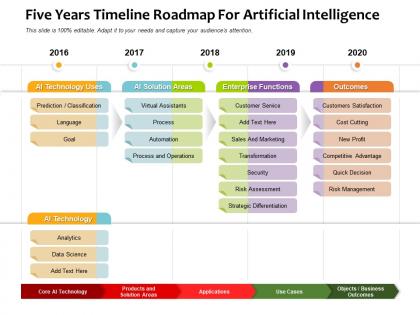
Five years timeline roadmap for artificial intelligence




Try Before you Buy Download Free Sample Product
 Impress Your
 Audience
 100%
100% Editable
 Save Hours
 of Time


Our Five Years Timeline Roadmap For Artificial Intelligence are topically designed to provide an attractive backdrop to any subject. Use them to look like a presentation pro.
People who downloaded this PowerPoint presentation also viewed the following :
Five years timeline roadmap for artificial intelligence with all 2 slides:
Use our Five Years Timeline Roadmap For Artificial Intelligence to effectively help you save your valuable time. They are readymade to fit into any presentation structure.
FAQs for Five years timeline roadmap
Key milestones in AI evolution include the Turing Test (1950), expert systems development (1970s), machine learning breakthroughs (1980s), deep learning emergence (2000s), and modern generative AI capabilities. These advancements have progressively enhanced automation, decision-making, and predictive analytics across industries, with organizations increasingly leveraging AI for competitive advantage, operational efficiency, and innovation-driven growth strategies.
Organizations effectively integrate AI into existing business models by conducting comprehensive audits of current processes, identifying high-impact automation opportunities, and implementing pilot programs in specific departments like customer service, finance, or operations. Through strategic phased deployment, companies can streamline workflows, enhance decision-making capabilities, and reduce operational costs, while many organizations finding that gradual integration minimizes disruption and maximizes employee adoption.
Key ethical considerations include algorithmic bias, data privacy, transparency in decision-making, accountability for AI outcomes, and ensuring human oversight in critical applications. These principles help organizations build responsible AI systems by establishing clear governance frameworks, implementing fairness testing, and maintaining user trust, with many companies finding that ethical AI practices ultimately deliver stronger customer relationships and reduced regulatory risks.
AI transforms job roles across industries by automating routine tasks, augmenting human capabilities, and creating new specialized positions requiring AI collaboration skills. While manufacturing and finance see significant automation in assembly and data processing, healthcare and education experience enhanced diagnostic capabilities and personalized learning, with many organizations finding that strategic AI integration ultimately delivers improved efficiency and competitive advantage.
Common misconceptions about artificial intelligence include AI replacing all human jobs, requiring massive datasets to function, being inherently biased, and operating as a "black box" without explainability. These misconceptions often stem from limited understanding, with many organizations finding that strategic AI implementation actually enhances human capabilities, streamlines operations through targeted automation, and delivers measurable competitive advantages across sectors.
Small businesses can leverage AI through chatbots for customer service, automated inventory management, predictive analytics for demand forecasting, and streamlined accounting processes. These technologies enable smaller organizations to compete with larger competitors by reducing operational costs, improving customer experiences, and making data-driven decisions, with many finding significant efficiency gains and faster growth.
Machine learning serves as the foundational engine driving AI advancement, enabling systems to learn from data, recognize patterns, make predictions, and improve performance without explicit programming. Through neural networks and deep learning algorithms, organizations across healthcare, finance, and retail can automate complex decision-making, enhance predictive analytics, and deliver personalized customer experiences, ultimately accelerating AI's practical business applications.
AI deployment in critical sectors presents risks including algorithmic bias, system failures, cybersecurity vulnerabilities, regulatory compliance challenges, and workforce displacement concerns. While these challenges require careful management, many organizations in healthcare, finance, and transportation are finding that strategic risk mitigation frameworks, comprehensive testing protocols, and phased implementation approaches ultimately deliver enhanced operational security and competitive advantage.
AI enhances retail customer experiences through personalized product recommendations, chatbots for instant support, predictive inventory management, dynamic pricing optimization, and visual search capabilities. These technologies streamline shopping journeys by delivering tailored interactions, reducing wait times, and ensuring product availability, with many retailers finding that AI-driven personalization increases customer satisfaction and sales conversion rates.
Best practices for training AI algorithms on diverse datasets include comprehensive data collection across demographics, rigorous bias testing, balanced representation sampling, continuous validation processes, and iterative refinement cycles. These approaches enhance model accuracy by minimizing algorithmic bias, improving generalization capabilities, and ensuring equitable outcomes across different user groups, with many organizations finding that diverse training data ultimately delivers more reliable AI systems and broader market applicability.
Organizations can measure AI initiative success through key performance indicators like accuracy rates, processing speed improvements, cost reduction percentages, customer satisfaction scores, and return on investment metrics. These measurements enable businesses to track operational efficiency gains, revenue impact, and competitive advantages, with many companies finding that combining quantitative metrics with qualitative feedback delivers the most comprehensive assessment of AI transformation outcomes.
Businesses should anticipate trends including generative AI integration, autonomous decision-making systems, edge computing deployment, explainable AI frameworks, and industry-specific AI solutions. These developments enable organizations to streamline operations, enhance customer experiences, and reduce costs, with sectors like healthcare, finance, and manufacturing finding that strategic AI adoption delivers competitive advantage in increasingly automated markets.
Regulatory frameworks significantly influence AI innovation by establishing compliance standards, data protection requirements, ethical guidelines, and transparency mandates that shape development priorities. While these regulations can slow initial deployment timelines, they ultimately enhance consumer trust and market stability, with many financial services and healthcare organizations finding that proactive regulatory alignment accelerates long-term adoption and competitive positioning.
AI contributes to sustainability through smart grid optimization, predictive maintenance reducing waste, precision agriculture minimizing resource usage, carbon footprint tracking, and automated energy management systems. These technologies streamline environmental monitoring by enhancing efficiency, accelerating renewable energy adoption, and delivering data-driven insights, with many organizations finding that AI-powered sustainability initiatives ultimately reduce costs while improving environmental outcomes.
Collaboration between academia and industry accelerates AI research by combining theoretical expertise with practical application needs, shared resources, and real-world data access. Through joint research projects, universities provide foundational knowledge while companies offer commercial validation, with sectors like healthcare and finance finding that these partnerships streamline innovation cycles, reduce development costs, and ultimately deliver market-ready solutions faster.
-
Nice and innovative design.
-
Unique research projects to present in meeting.
-
Great quality slides in rapid time.
-
The content is very helpful from business point of view.
-
Innovative and Colorful designs.