

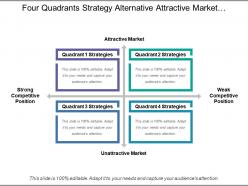
Four quadrants strategy alternative attractive market competition position





Try Before you Buy Download Free Sample Product
 Impress Your
 Audience
 100%
100% Editable
 Save Hours
 of Time


People don?t come to presentations to read or to listen to music that?s why you have to be careful when preparing presentations. To help you our Four Quadrants Strategy Alternative Attractive Market Competition Position have been pre-prepared and all you have to do is to fill in the needed information.
People who downloaded this PowerPoint presentation also viewed the following :
Four quadrants strategy alternative attractive market competition position with all 5 slides:
Pamper yourself with our Four Quadrants Strategy Alternative Attractive Market Competition Position. They will rejuvenate your thoughts.


FAQs for Four quadrants strategy alternative attractive
The Four Quadrants strategy is a strategic framework that categorizes business elements into four distinct sections based on two intersecting criteria, enabling systematic analysis and decision-making across multiple dimensions. This approach streamlines resource allocation, risk assessment, and portfolio management by organizing products, markets, or opportunities into clear segments, with many organizations finding that it enhances strategic clarity and competitive positioning across diverse industries.
The Four Quadrants strategy assists in prioritizing projects by categorizing initiatives based on impact and effort, enabling organizations to identify quick wins, major projects, fill-ins, and thankless tasks. This strategic framework streamlines resource allocation by directing teams toward high-impact, low-effort opportunities first, while systematically planning for complex initiatives, ultimately delivering enhanced operational efficiency and competitive advantage across departments.
Technology companies like Apple have successfully implemented Four Quadrants strategy by balancing core products, adjacent markets, transformational innovations, and new ventures. Financial services firms, healthcare organizations, and retail giants leverage this framework to allocate resources strategically across different growth horizons, with many finding that this approach delivers sustainable competitive advantage while minimizing innovation risks.
The Four Quadrants framework divides analysis into market penetration, market development, product development, and diversification quadrants, each requiring distinct strategic approaches, resource allocation, and risk management considerations. These quadrants interrelate by creating a strategic progression pathway, with many organizations finding that success in lower-risk quadrants like market penetration provides the foundation and resources necessary for higher-risk diversification initiatives.
Teams can measure quadrant effectiveness through specific metrics: urgency rates and resolution times for Quadrant 1, milestone completion and strategic KPIs for Quadrant 2, interruption frequency and delegation success for Quadrant 3, and time allocation audits for Quadrant 4. Through regular assessment cycles, organizations track productivity improvements, stress reduction, and strategic goal achievement, with many finding that consistent measurement ultimately delivers enhanced operational efficiency and competitive advantage.
The Four Quadrants strategy facilitates better decision-making by providing visual clarity for prioritization, resource allocation, risk assessment, and strategic positioning across competing variables. This framework enables organizations to systematically evaluate opportunities and threats, streamline complex choices into actionable categories, and maintain competitive advantage through structured analysis, with many businesses finding that quadrant-based decisions deliver faster consensus and more strategic outcomes.
Visualizing data in four quadrants transforms stakeholder perception by creating immediate visual hierarchies, enabling rapid pattern recognition, and facilitating intuitive decision-making through clear categorization. This strategic framework allows executives, managers, and team members to quickly identify priorities, assess risk-reward relationships, and allocate resources more effectively, ultimately delivering faster consensus and more confident strategic choices.
Tools for creating Four Quadrants strategy visuals include Microsoft PowerPoint, Visio, Lucidchart, Canva, and Miro, along with specialized business intelligence platforms like Tableau. These applications streamline strategic planning by enabling dynamic quadrant mapping, collaborative editing, and real-time updates, with many organizations finding that visual strategy tools enhance decision-making speed and stakeholder alignment.
Organizations tailor the Four Quadrants framework by customizing criteria, metrics, and evaluation parameters to align with their specific industry requirements, competitive landscape, and strategic priorities. Companies adapt weighting systems, timeline considerations, and resource allocation models within each quadrant, with financial services firms focusing on risk-return matrices while manufacturing organizations emphasize operational efficiency and market positioning, ultimately delivering frameworks that drive targeted decision-making and strategic advantage.
Stakeholder feedback enables organizations to validate quadrant priorities, identify overlooked opportunities, and ensure strategic alignment across departments and external partners. Through regular input sessions, surveys, and collaborative workshops, companies can refine resource allocation, adjust timelines, and enhance strategic focus, with many finding that continuous stakeholder engagement significantly improves implementation success and competitive positioning.
The Four Quadrants strategy integrates seamlessly with SWOT analysis by mapping strengths and opportunities across quadrants, while PESTLE analysis provides external context for quadrant prioritization and risk assessment. This strategic combination enables organizations to create more comprehensive frameworks, with many consulting firms and corporate strategy teams finding that integrated approaches deliver deeper insights, enhanced decision-making capabilities, and ultimately stronger competitive positioning.
Cultural differences significantly impact Four Quadrants strategy implementation through varying communication styles, decision-making processes, risk tolerance levels, and hierarchical structures across international markets. Global organizations must adapt their strategic frameworks by incorporating local cultural values, adjusting timeline expectations, and modifying stakeholder engagement approaches, with many multinational companies finding that culturally-sensitive implementation delivers stronger market penetration and sustainable competitive advantage.
Organizations face challenges including resistance to change, data integration complexities, resource allocation conflicts, and difficulty measuring cross-quadrant performance when adopting Four Quadrants strategy. These obstacles can be overcome through phased implementation, comprehensive staff training, and robust analytics systems, with many companies finding that clear communication and dedicated change management teams ultimately deliver smoother transitions and sustained competitive advantage.
Leaders can effectively communicate the Four Quadrants strategy through visual presentations, interactive workshops, and clear role-specific examples that demonstrate how each team member's responsibilities align with specific quadrants. By conducting regular check-ins, providing practical scenarios from their industry, and connecting daily tasks to strategic priorities, organizations streamline understanding and enhance execution, with many finding that consistent visual reinforcement ultimately delivers stronger team alignment and improved strategic outcomes.
The Four Quadrants strategy provides insights into customer value distribution, behavioral patterns, acquisition costs, lifetime value potential, and retention requirements across different segments. Through systematic quadrant analysis, organizations can identify high-value customer clusters, optimize resource allocation for targeted marketing campaigns, and develop tailored engagement strategies, with many retail and financial services companies finding that this segmentation approach significantly enhances conversion rates.
-
Illustrative design with editable content. Exceptional value for money. Highly pleased with the product.
-
Excellent design and quick turnaround.