


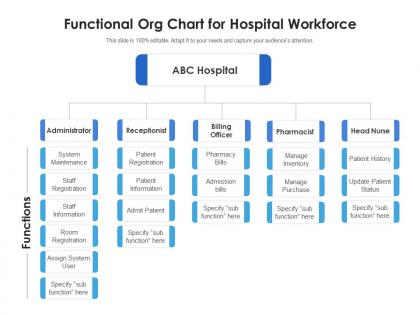
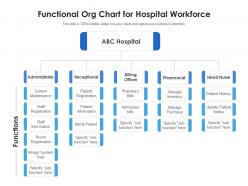
Functional org chart for hospital workforce




Try Before you Buy Download Free Sample Product
 Impress Your
 Audience
 100%
100% Editable
 Save Hours
 of Time


Our Functional Org Chart For Hospital Workforce are topically designed to provide an attractive backdrop to any subject. Use them to look like a presentation pro.
People who downloaded this PowerPoint presentation also viewed the following :
Functional org chart for hospital workforce with all 2 slides:
Use our Functional Org Chart For Hospital Workforce to effectively help you save your valuable time. They are readymade to fit into any presentation structure.
FAQs for Functional org chart
Key roles in a functional hospital organizational chart include clinical directors, department heads, nursing supervisors, physician specialists, administrative managers, and support service coordinators. These positions streamline healthcare delivery by establishing clear reporting structures, coordinating patient care across departments, and ensuring regulatory compliance, with many hospitals finding that defined hierarchies enhance operational efficiency and improve patient outcomes.
A functional org chart improves hospital communication by establishing clear reporting lines, defining departmental responsibilities, and creating structured information pathways between clinical and administrative units. Through these defined channels, departments like nursing, radiology, and pharmacy coordinate patient care more effectively, reduce response times, and minimize medical errors, ultimately delivering seamless patient experiences and operational efficiency.
Hospitals implementing functional org charts often face challenges including communication barriers between departments, slower decision-making processes, reduced cross-functional collaboration, potential patient care coordination issues, and resistance from staff accustomed to integrated care models. While these structures enhance specialized expertise and departmental efficiency, many healthcare institutions find that careful change management and clear communication protocols help minimize disruptions while maintaining quality patient outcomes.
A functional org chart enhances patient care outcomes by establishing clear reporting structures, defining specialized departmental roles, and streamlining communication pathways between clinical teams. This organizational clarity enables faster decision-making during critical situations, reduces medical errors through defined accountability chains, and ultimately delivers more coordinated care, with many hospitals finding that structured hierarchies significantly improve response times and patient satisfaction scores.
Functional org charts align with healthcare regulatory requirements by clearly defining roles and responsibilities, establishing accountability chains, documenting competency requirements, and ensuring proper oversight structures. Through defined departmental hierarchies, hospitals can demonstrate compliance with Joint Commission standards, CMS regulations, and state licensing requirements, while streamlining audit processes and maintaining transparent reporting relationships that regulatory bodies increasingly demand for patient safety and quality assurance.
Job descriptions and responsibilities align with departmental functions in hospital organizational charts, with each role clearly positioned within specialized units like nursing, radiology, pharmacy, and administration. This structure enables healthcare facilities to streamline patient care delivery, ensure regulatory compliance, and optimize resource allocation, with many hospitals finding that clearly defined functional roles ultimately enhance operational efficiency and patient outcomes.
Hospitals should assess functional org chart effectiveness through patient satisfaction scores, staff turnover rates, interdepartmental collaboration metrics, response times for critical procedures, and resource utilization efficiency. These measurements enable healthcare administrators to identify bottlenecks, streamline communication pathways, and optimize workforce allocation, with many medical institutions finding that regular organizational assessments ultimately deliver improved patient outcomes and operational cost reductions.
Technology integrates with hospital functional org charts through electronic health records, automated scheduling systems, AI-powered diagnostics, and real-time communication platforms that connect departments seamlessly. These digital solutions enhance coordination between nursing, administration, and clinical teams by reducing paperwork, accelerating patient handoffs, and enabling data-driven decisions, ultimately delivering faster patient care and improved operational efficiency.
Leadership plays a crucial role by establishing clear communication channels, defining role expectations, securing stakeholder buy-in, and ensuring adequate resource allocation for structural transitions. Effective hospital leaders facilitate cross-departmental collaboration between nursing, medical staff, and administrative units, while addressing resistance to change, ultimately delivering improved operational efficiency and enhanced patient care coordination across the organization.
A functional org chart facilitates hospital workforce planning by clearly defining departmental structures, reporting relationships, skill requirements, and resource allocation needs across clinical and administrative units. This organizational clarity enables healthcare administrators to identify staffing gaps, optimize scheduling efficiency, and strategically deploy personnel during peak demand periods, ultimately delivering improved patient care and operational cost management.
A functional org chart enhances employee morale by providing clear career progression paths, defined responsibilities, and transparent reporting structures that reduce workplace confusion and conflict. Healthcare organizations using functional structures often experience improved retention rates, as staff better understand advancement opportunities within specialized departments like nursing, radiology, and emergency medicine, ultimately delivering greater job satisfaction and professional development clarity.
Hospital operational hierarchies emphasize clinical expertise alongside administrative authority, with physicians, nurses, and specialists maintaining professional autonomy that differs from traditional corporate command structures. Unlike other industries where operational decisions flow purely through management, hospitals integrate medical professionals who make critical patient-care decisions independent of administrative oversight, ultimately balancing clinical excellence with operational efficiency.
Hospitals can maintain flexibility within functional structures through cross-departmental task forces, matrix reporting relationships, standardized communication protocols, and rotating staff assignments across specialties. These approaches enable rapid response teams for emergencies, streamlined patient care coordination, and enhanced resource allocation during peak periods, while many healthcare institutions find that strategic inter-departmental collaboration ultimately delivers improved patient outcomes and operational efficiency.
A functional org chart supports interdisciplinary collaboration by clearly defining roles, reporting structures, and communication pathways across departments like cardiology, surgery, nursing, and pharmacy. This structural clarity enables seamless care coordination, reduces duplicate efforts, and streamlines patient handoffs, with many hospitals finding that defined hierarchies ultimately enhance treatment outcomes and operational efficiency.
Best practices for updating functional org charts include conducting regular workforce assessments, gathering stakeholder feedback, analyzing patient flow patterns, reviewing regulatory requirements, and implementing phased transitions. Healthcare organizations enhance operational efficiency by establishing quarterly review cycles, creating cross-functional committees, and utilizing digital org chart tools that enable real-time updates, ultimately delivering improved patient care coordination and strategic workforce alignment.
-
Amazing product with appealing content and design.
-
Very unique and reliable designs.