

Funding slides powerpoint presentation slides




Try Before you Buy Download Free Sample Product
 Impress Your
 Audience
 100%
100% Editable
 Save Hours
 of Time


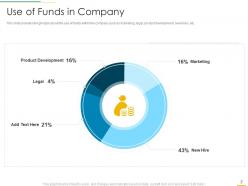
Raising funds is vital for businesses as it helps speed up the work by provisioning for working capital in the day to day working. Amount of funding and resources committed to an area directly affect the development, quality, and services related to the site. The terrace offers the yearly fundraising calendar with activities involved for all the quarters. Check out our professionally designed pitch deck on funding slides to contribute to business growth and enhance the level of a startup in the corporate world. One can exhibit fundraiser event details with fundraiser sources based on event goals, income, and more. The proposal demonstrates distinct phases of investment funds like the first close, second close, etc. You get to acknowledge the development stages of funding rounds with pre seed funding processes. The deck will showcase the companys investment funding details used for client acquisition, infrastructure, etc. Businesses can visualize the scene of startup funding based on ideas or a public offer. Pitching investors for fundraising is made easy with our Funding Slides for startups Pitch Deck. The template presents the pie chart for the use of funds within the company like legal, product development, new hires, etc. Get access and download the template now.
People who downloaded this PowerPoint presentation also viewed the following :
Content of this Powerpoint Presentation
Slide 1: This slide displays the title i.e. 'Funding Slides' and your Company Name.
Slide 2: This slide provides the glimpse about the use of funds within the company such as marketing, legal, product development, new hires, etc.
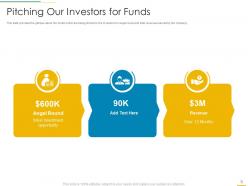
Slide 3: This slide provides the glimpse about the funds which are being pitched to the investors for angel round and total revenues earned by the company.
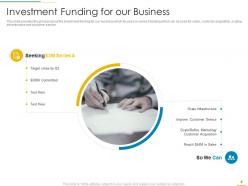
Slide 4: This slide explains the investment funding for our business which focuses on series A funding which can be used for sales, customer acquisition, etc.
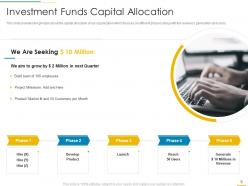
Slide 5: This slide provides the glimpse about the capital allocation of our organization which focuses on different phases along with the revenue's generation and users.
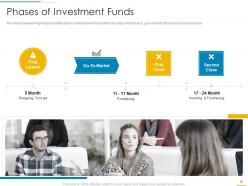
Slide 6: This slide provides the glimpse about the phases of investment funds which focuses on first launch, go-to-market, first close and second close.
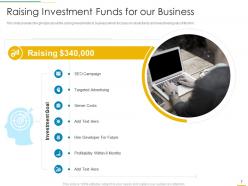
Slide 7: This slide provides the glimpse about the raising investments in business which focuses on raised funds and investment goals of the firm.
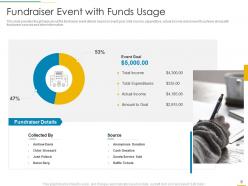
Slide 8: This slide showcases the fundraiser event details based on event goal, total income, expenditure, actual income and amount to achieve along with fundraiser sources and other information.
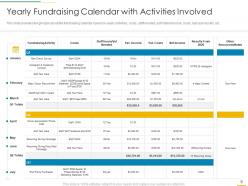
Slide 9: This slide provides the glimpse about the fundraising calendar based on yearly activities, costs, staff needed, estimated income, costs, last year results, etc.
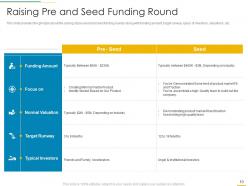
Slide 10: This slide provides the glimpse about the raising of pre seed and seed funding rounds along with funding amount, target runway, types of investors, valuations, etc.
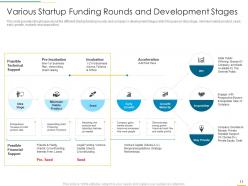
Slide 11: This slide displays different startup funding rounds and company’s development stages which focuses on idea stage, minimum viable product, seed, early growth, etc.
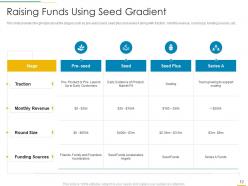
Slide 12: This slide provides the glimpse about the stages such as pre-seed, seed, seed plus and series A along with traction, monthly revenue, round size, funding sources, etc.
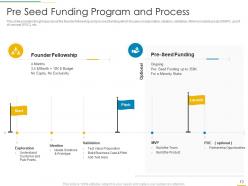
Slide 13: This slide exhibits the founder fellowship and pre seed funding which focuses on exploration, Minimum viable product (MVP), proof of concept (POC), etc.
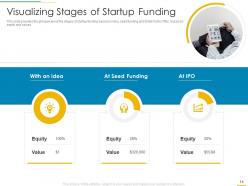
Slide 14: This slide provides the glimpse about the stages of startup funding based on idea, seed funding and Initial Public Offer, based on equity and values.
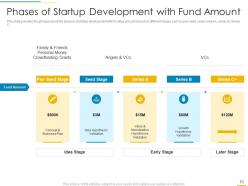
Slide 15: This slide displays phases of startup development with funding amount based on different stages such as pre-seed, seed, series A, series B, Series C.
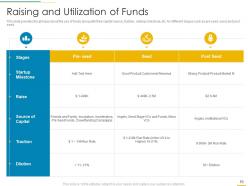
Slide 16: This slide presents use of funds along with their capital source, traction, startup milestone, etc. for different stages such as pre seed, seed, and post seed.
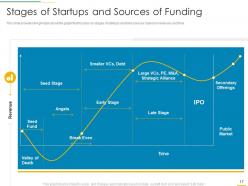
Slide 17: This slide provides the glimpse about the graph that focuses on stages of startups and fund sources based on revenues and time.
Slide 18: This is the icons slide for the project.
Slide 19: This slide presents the title for additional slides.
Slide 20: This slide showcases about the company, target audience and its client's values.
Slide 21: This slide displays the vision, mission and goals of the company.
Slide 22: This slide exhibits the 30-60-90 days plan of the project.
Slide 23: This slide displays the venn of the company.
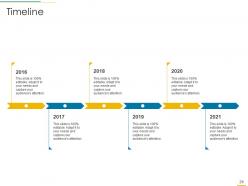
Slide 24: This slide presents the yearly timeline of the company.
Slide 25: This slide presents the puzzle of the project.
Slide 26: This slide displays the important notes of the company.
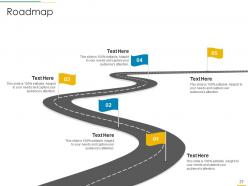
Slide 27: This slide presents the roadmap of the project.
Slide 28: This slide presents the ideas generated for the project.
Slide 29: This is the thank you slide and contains contact details of the company like address, phone no., etc. "
Funding slides powerpoint presentation slides with all 29 slides:
Use our Funding Slides Powerpoint Presentation Slides to effectively help you save your valuable time. They are readymade to fit into any presentation structure.


FAQs for Funding slides
So there's basically four main routes - bootstrapping, friends/family money, angels, then VCs. That's usually how it goes as you scale up too. Most people I know started by funding themselves or asking their circle for some initial cash. Angels jump in around $25K-$500K, VCs handle the bigger stuff after that. Don't let Silicon Valley fool you though - bootstrapping is actually super common. Loads of solid companies never touch outside money. My advice? Start scrappy and only raise what you need to hit your next big milestone. Way less headache that way.
Honestly, three things will make or break your pitch. Start with a story about the actual problem you're solving - what keeps your customers awake at 3am? Then hit them with real numbers. Even if it's just "we've got 50 users and they're obsessed," that beats vague promises. Know your market inside out too. Investors hear pitches all day, so yours better stand out fast. Practice until it feels like you're just talking, not presenting some rehearsed thing. Oh, and always end with exactly what you need and what happens next. Don't leave them guessing.
Honestly, crowdfunding is pretty smart if you think about it. You're basically testing if people actually want your thing while raising money at the same time. Kickstarter's solid for physical products, Patreon works better for ongoing stuff like podcasts or art. The cool part? You're not just getting cash - you're building up this group of people who are already rooting for you to succeed. Oh, and make sure your campaign actually tells a story people care about. I've seen so many boring ones just... die. Your backers need to feel like they're getting real value, not just throwing money at a random idea.
Track your revenue growth monthly - that's non-negotiable. Customer acquisition cost vs lifetime value is crucial too. Burn rate will come up in every investor meeting, trust me. For SaaS, monthly recurring revenue is everything (seriously, I've seen deals die over weak MRR). Retention rates and NPS show if people actually want your product. Gross margins matter more than founders think - investors need to see you get unit economics. Yeah, the numbers might suck right now but start tracking consistently anyway. Better to have ugly data than no data when you're fundraising.
Dude, good financial forecasts are basically proof you're not just winging it. Investors want to see you actually get your numbers and can defend them when they start grilling you. I've watched people with solid ideas crash and burn because their projections looked totally random. Build conservative forecasts you can back up with real research. Different scenarios matter too - shows you've thought beyond the best case. Honestly, it's one of those things that separates serious founders from dreamers. When your numbers make sense, investors can actually picture the returns and trust you won't just blow their money.
So basically, equity means you're giving up pieces of your company for cash - investors become co-owners and will probably want input on big decisions. Debt is just a regular loan you pay back with interest, but nobody gets to boss you around. Equity seems like "free money" at first, but honestly? It gets really expensive when you exit. Debt has those predictable monthly payments though. Go with equity if you actually want the mentorship and connections that come with it. Pick debt if you're dead set on keeping control and can swing the regular payments without stressing about it.
Dude, start collecting your financial records, legal docs, and business metrics way before you need them. Set up a virtual data room with 3+ years of financials, cap table, contracts, IP stuff, and your key performance numbers. It's honestly like the most intense open-book test ever, except your company's on the line. Everything needs to tell the same story about where you're headed. Begin this whole mess months before fundraising starts – I can't stress this enough. Investors have crazy good radar for desperation and chaos. Scrambling at the last second? That'll torpedo your credibility faster than anything.
Dude, government funding is honestly pretty sweet if you can get it. No debt hanging over your head, no giving up ownership stakes. Applications are brutal though - like, plan to spend weeks on paperwork. Worth it if you qualify since most businesses end up expanding way faster and can actually hire people. Plus you're not constantly stressed about cash flow anymore. The compliance stuff afterward can be annoying but whatever. I'd definitely go for it if there's programs that fit your business, just don't expect it to be quick or easy.
Honestly, grants are a pain to apply for but worth it since you don't pay them back. First figure out what category your business fits - then hunt for government, foundation, or corporate grants that match your industry or location. SBA.gov is a good starting point, plus check your state's economic development site. Industry associations sometimes have their own too. Fair warning though - the applications are super detailed and you'll need a solid business plan with financial projections. I spent like three weeks on my last one. It's competitive as hell but free money is free money, right?
Yeah, impact investing is totally mainstream now. Traditional asset managers are launching these funds left and right, and even pension funds are throwing real money at it. ESG stuff is basically expected at this point - wild how fast that happened. Climate solutions and affordable housing are getting tons of capital flow. Honestly, the whole industry got way more serious about tracking actual outcomes instead of just talking about doing good. If you're pitching investors, you better have solid impact metrics and your ESG story down pat. They want returns AND proof you're actually making a difference. Oh, and standardized reporting is becoming the norm too.
So bootstrapping basically means you keep 100% of your company but growth is gonna be slower since you're stuck with whatever cash you have. VC money lets you scale way faster, but you're handing over equity and dealing with investors breathing down your neck about hitting targets. Honestly? I think bootstrapping is way less of a headache if you can afford to wait it out. Though I guess it depends on your market - some industries you kinda have to move fast or die. Either way, figure out your actual runway first. Like how much do you really need to prove this thing works? Then you'll know if self-funding is even realistic.
Honestly, it's brutal out there. Angels want proof you're already succeeding before they'll even meet with you - but how do you get traction without their money? Classic problem. There's also just so much competition for their attention. These people get pitched nonstop, so good luck standing out in that mess. What makes it worse is they don't just look at numbers - they go with their gut too, which makes everything super unpredictable. Skip the cold emails though. Warm introductions through people you know work way better. And try to have at least some users or early revenue to show them. Even small stuff helps.
Look, investors need to see you've actually thought this through and aren't just throwing ideas at the wall. Your business plan proves you get your market, know your numbers, and have a real strategy. Most won't even meet with you without one, honestly. Focus on your revenue model, who you're selling to, what makes you different, and realistic projections. The executive summary matters most - that's what they read first. I know it's a pain to write, but without it you're basically just asking for money with nothing to back it up.
Securities law is the biggest headache - SEC compliance for equity offerings is no joke. Check if you qualify for exemptions like Rule 506(b) before diving in. Don't mess around trying to figure this out yourself. IP protection matters too, plus employment law gets tricky when you're paying people in equity instead of cash (learned that one the hard way). Corporate governance stuff you'll need eventually. Bottom line: find a decent startup attorney now. I know it feels expensive upfront, but trust me - cleaning up legal disasters later costs way more.
Dude, networking beats Google searches every single time for finding funding. Build real connections with founders and investors - they'll clue you in about grants or angel groups you'd never discover otherwise. Warm intros through your network are gold compared to cold emails. I swear, half the deals I've seen happen because someone's cousin's friend worked at the right VC. Hit up founder groups and industry meetups. Actually follow up with people though - don't just collect business cards like Pokemon. Your next funding opportunity is probably hiding in someone's Rolodex.
-
Visually stunning presentation, love the content.
-
Much better than the original! Thanks for the quick turnaround.
-
Editable templates with innovative design and color combination.