

Gap analysis ppt example file






Try Before you Buy Download Free Sample Product
 Impress Your
Audience
 100%
Editable
 Save Hours
of Time


Earn more marks with our Gap Analysis Ppt Example File. Tick all the right boxes with our Gap Analysis Ppt Example File.
People who downloaded this PowerPoint presentation also viewed the following :
Content of this Powerpoint Presentation
Description:
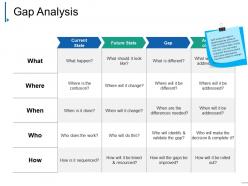
The image is a PowerPoint slide illustrating a Gap Analysis framework. This strategic tool is used to compare the current state of a business or process with the desired future state to identify areas that need improvement.
The table is segmented into four main columns:
1. Current State:
This column prompts the user to describe the present situation by asking questions like "What happen?" and "Where is the confusion?" for various aspects such as What, Where, When, Who, and How.
2. Future State:
This column is intended for detailing the optimal or desired outcomes with prompts such as "What should it look like?" and "When will it change?"
3. Gap:
Here, the differences between the current and future states are identified with questions like "What is different?" and "How will the gaps be improved?"
4. Action Plan:
The last column focuses on solutions and next steps with prompts like "What will be addressed?" and "How will it be rolled out?"
Use Cases:
Gap analysis is a critical process in strategic planning, commonly used across various industries and departments to streamline operations, enhance performance, and achieve strategic goals.
Performance and the desired goals across various industries.
1. Healthcare:
Use: Assessing and improving patient care services.
Presenter: Hospital Operations Manager
Audience: Clinical Staff, Department Managers
2. Information Technology:
Use: Upgrading systems and software to enhance performance.
Presenter: IT Project Manager
Audience: IT Staff, Stakeholders
3. Manufacturing:
Use: Optimizing production processes for efficiency.
Presenter: Process Engineer
Audience: Production Team, Quality Assurance
4. Finance:
Use: Enhancing financial operations and customer service.
Presenter: Financial Analyst
Audience: Management Team, Compliance Officers
5. Education:
Use: Developing and implementing new educational programs.
Presenter: Curriculum Developer
Audience: Educators, School Administrators
6. Retail:
Use: Streamlining inventory management and customer experience.
Presenter: Retail Strategy Manager
Audience: Store Managers, Operations Team
7. Hospitality:
Use: Improving guest services and operational workflow.
Presenter: Hotel General Manager
Audience: Service Staff, Department Heads
Gap analysis ppt example file with all 5 slides:
Display dynamism as an executive with our Gap Analysis Ppt Example File. Demonstrate that you are completely in control.

FAQs for Gap analysis
So gap analysis basically has four parts you gotta hit. Start by figuring out where you actually are right now - get real data, not just gut feelings. Then map out where you want to be with concrete goals. The fun part is identifying what's missing between point A and point B. Finally, build your action plan with deadlines and who's doing what. Honestly, most people mess up by being too optimistic about their current situation - I've done it too. Just gather solid baseline info first, then work through everything else step by step.
Honestly, gap analysis is a game changer - it shows you exactly what's broken between where you are now and where you need to be. You'll catch stuff like resource shortages, missing skills, or timeline problems before they blow up your whole project. Think of it as a reality check that actually matters. The trick is being brutally honest about what you can actually do versus what the project demands. I always forget this part, but once you see the gaps, rank them by priority. Then you can throw resources at the right problems first. Definitely try it at your next milestone.
Gap analysis is your strategic planning roadmap - shows where you are vs where you want to be. Then you figure out what's needed to bridge that gap. Super useful for prioritizing initiatives and resources since you're not just guessing anymore. Too many teams skip this and their strategy ends up all over the place. Use the findings to make smart decisions about investments, timelines, and which capabilities to build first. Oh, and map your current state honestly from the start. That's where people usually fudge numbers and screw up everything.
First thing - figure out what "good" actually means for each process you're looking at. Set some real benchmarks. Map where you are now and measure against those targets. Data helps, but honestly don't get lost in spreadsheets when the problems are staring you in the face. Chat with people doing the actual work - they'll catch stuff your metrics won't. Document what you find, rank the biggest gaps by impact and how doable they are. Then make action plans. Just be systematic about it without overthinking yourself into paralysis.
Honestly, just start with a SWOT analysis or basic skills matrix - most people already get how those work. Excel gap analysis templates are solid for deeper dives, or Lucidchart if you want something visual. I've watched teams go crazy with expensive software when a simple spreadsheet would've done the job perfectly fine. Benchmarking frameworks work great too if you're stacking up against industry stuff. The trick is matching whatever tool to your team's vibe and how complex this thing actually is. Keep it simple first, then get fancier later if you need to.
Gap analysis is perfect for this! Basically you're comparing what customers actually go through vs what they want or expect. First, grab feedback however you can - surveys, reviews, just talking to people directly. Figure out their main frustrations. Then stack that up against your ideal customer journey or what competitors are doing. The gaps you spot (slow support, weird checkout flow, missing stuff) become your fix-it list. Honestly, it's like being a detective but way less exciting. Start with the biggest problems since those move the needle most. I'd say run this every few months because people's expectations change fast these days.
Oh man, the biggest mistake? Teams jump right into fixing stuff without actually mapping where they are first. Such a waste of time. Also, don't just ask the executives - they're totally disconnected from day-to-day reality. Talk to people actually doing the work instead. And here's the thing that drives me crazy: being super vague about what you're measuring. You need specific, measurable gaps, not fluffy wishful thinking. Once you've got that figured out, resist fixing everything simultaneously. Pick your battles based on what'll actually move the needle and what's realistic to tackle.
So basically, gap analysis shows you exactly where your team's skills don't match up with what they actually need to do their jobs. Map out the key skills each role needs, then see where everyone stands right now. The gaps become super obvious once you lay it out like that. Way better than just randomly picking training topics, honestly. You can figure out which skills to tackle first based on what'll actually move the needle for your business. Plus you'll spend your training budget smarter and create focused development plans instead of those generic programs everyone hates. It's surprisingly straightforward once you get started.
Honestly, you need to check if you actually closed the gaps you found - like how many got fixed and if you hit your timeline. ROI matters too - did fixing stuff improve performance or cut costs? I'd also track if stakeholders are happy because unhappy leadership = your work gets ignored. Implementation speed is key, plus any surprise gaps that pop up during execution. Oh, and measure your baseline first so you know where you started. Set real targets for each gap. Resource efficiency compared to your plan tells you if you're being realistic or just wishful thinking.
Honestly, automation tools will save your sanity here. Survey platforms can grab data automatically instead of you chasing down every department. The AI analytics stuff is actually pretty solid now - finds patterns I'd totally miss. Monday or Asana work great for tracking everything and getting people to collaborate. Oh, and make sure whatever tools you pick actually integrate with each other. Nothing's worse than being stuck copy-pasting between ten different spreadsheets (been there, it sucks). Real-time metrics beat manual collection every time.
Honestly, gap analysis is a game-changer for change projects. It shows you exactly what's missing between where you are now and where you want to be. No more "oh shit, we forgot about that" moments halfway through implementation. You'll spot which skills, processes, or resources need work upfront. Plus stakeholders actually listen when you show them concrete gaps instead of just saying "we need to improve things" (which sounds super vague, right?). Start by mapping what you currently have first. Then prioritize which gaps matter most and budget from there.
So gap analysis is basically finding your weak spots before they screw you over. You map out where your security, processes, whatever - where they're falling short of what you actually need. Think of it like a business health check, I guess. Then you can figure out which gaps are gonna bite you first and deal with those. The trick is being brutally honest about where you really are vs where you think you are (easier said than done). Use what you find to build your risk list and spend your budget on stuff that actually matters.
So after you finish your gap analysis, start by ranking which gaps will actually move the needle vs. what's realistic to fix. Most people mess up here - they write super vague goals that don't mean anything. Be specific and measurable instead. Pick owners for each action item with real deadlines. Figure out your budget and resources before you start (trust me on this one). Set up check-ins so you can pivot if things aren't working. Honestly, just focus on 2-3 high-impact gaps first. Don't try to boil the ocean.
Honestly, gap analysis is a game changer for this stuff. You map out what skills your team actually has versus what you need for upcoming projects. The mismatches become super obvious right away. Then you can figure out who needs training, where you're short-staffed, or - plot twist - where you've got too many people doing the same thing. I always forget to check for overstaffing but it happens more than you'd think! Skip the guesswork about who should handle what. Use real data to redistribute work, hire strategically, or move people around. Just be brutally honest about current capabilities.
Look, healthcare, tech, and manufacturing are obvious ones, but really any industry dealing with compliance chaos benefits. Financial services is huge for this since regulations change every five minutes. Retail uses it too - customers are so fickle now. Even nonprofits do gap analysis to see if their programs actually match their mission (which, honestly, many don't). The trick is having something concrete to measure against. Industry standards, regulations, performance benchmarks - whatever. First figure out what "winning" looks like for your situation, then you can spot the gaps.
-
Best Representation of topics, really appreciable.
-
Helpful product design for delivering presentation.