


Generative Adversarial Network GAN Explained Practical Guide AI CD





Try Before you Buy Download Free Sample Product
 Impress Your
 Audience
 100%
100% Editable
 Save Hours
 of Time


Generative Adversarial Network GAN is a groundbreaking artificial intelligence framework built to generate new, synthetic data that mimics real-world data. GANs comprise two neural networks the generator and the discriminator. The generator constructs realistic data samples, such as images or text, while the discriminator analyses their authenticity, distinguishing between accurate and generated data. This Generative Adversarial Network GAN explained Practical guide deck elaborates on how GAN models are trained, their architecture, and popular frameworks. It offers insights into popular GAN variants such as Vanilla GAN, conditional GAN, CycleGAN, StyleGAN, etc. It highlights various alternatives of GABs, such as autoencoders and variational autoencoders. GANs are substantial for applications across multiple fields, including image generation, video synthesis, and data augmentation. Get access to this PPT now.
People who downloaded this PowerPoint presentation also viewed the following :
Content of this Powerpoint Presentation
Slide 1: This slide showcase title Generative Adversarial Network (GAN) Explained: Practical Guide. State Your Company Name
Slide 2: This slide showcase Agenda for Generative Adversarial Network (GAN) explained: Practical guide.
Slide 3: This slide exhibit Table of content.
Slide 4: This slide highlights the Title for the Topics to be covered further.
Slide 5: This slide provides information regarding generative adversarial networks (GANs) that are type of generative models to create new data samples.
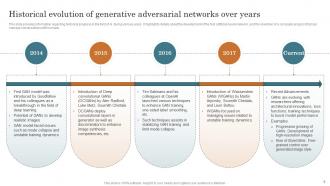
Slide 6: This slide provides information regarding historical progress in the field of AI during various years.
Slide 7: This slide provides information regarding generative adversarial networks (GANs) that are type of generative models to create new data samples.
Slide 8: This slide provides information regarding different types of GAN models to perform specific tasks along with distinct architectural characteristics.
Slide 9: This slide provides information regarding different types of GAN models to perform specific tasks along with distinct architectural characteristics.
Slide 10: This slide provides information regarding deep generative model variants designed to generate new data samples in terms of explicit likelihood models and implicit likelihood models.
Slide 11: This slide highlights the Title for the Topics to be covered further.
Slide 12: This slide provides information regarding the framework of generative adversarial networks (GANs) which comprises of generator and discriminator.
Slide 13: This slide provides information regarding major elements of generative adversarial networks (GANs) which comprises of generator and discriminator.
Slide 14: This slide provides information regarding essential steps for the deployment of GAN models in terms of data preparation and preprocessing.
Slide 15: This slide provides information regarding essential steps for the deployment of GAN models in terms of data GAN models training along with evaluation and monitoring.
Slide 16: This slide provides information regarding generative adversarial network training and prediction process.
Slide 17: This slide provides information regarding generative adversarial network training and prediction process.
Slide 18: This slide provides information regarding major issues related with generative adversarial networks.
Slide 19: This slide provides information regarding popular GAN framework as TensorFlow GANs as an open-source lightweight Python library along with key benefits associated.
Slide 20: This slide provides information regarding popular GAN framework as PyTorch enabled Torch-GAN suitable for building short and easy-to-manage codes.
Slide 21: This slide provides information regarding comparative analysis of popular GAN frameworks.
Slide 22: This slide highlights the Title for the Topics to be covered further.
Slide 23: This slide provides information regarding the overview of Vanilla GAN as a GAN variant.
Slide 24: This slide provides information regarding overview of Conditional GAN (cGAN) as a GAN variant.
Slide 25: This slide provides information regarding overview of Wasserstein GAN (WGAN) as a GAN variant.
Slide 26: This slide provides information regarding overview of CycleGAN (WGAN) as a GAN variant.
Slide 27: This slide provides information regarding notable use cases of CycleGAN as collection transfer and object transformation.
Slide 28: This slide provides information regarding notable use cases of CycleGAN as season transfer and photo enhancement.
Slide 29: This slide provides information regarding notable use cases of CycleGAN as photo development from painting.
Slide 30: This slide provides information regarding overview of StyleGAN as a GAN variant.
Slide 31: This slide provides information regarding various applications of StyleGAN in terms of object transfiguration and data augmentation.
Slide 32: This slide provides information regarding StyleGAN 2 as a GAN variant.
Slide 33: This slide provides information regarding StyleGAN inversion technique that helps in inverting assigned images to latent space to enable semantic editing with ease.
Slide 34: This slide provides information regarding various methods to deploy StyleGAN inversion in terms of optimization-based, learning-based or hybrid.
Slide 35: This slide provides information regarding overview of Super Resolution GAN (SRGAN) as a GAN variant.
Slide 36: This slide provides information regarding overview of deep convolutional GAN (DCGAN) as a GAN variant.
Slide 37: This slide provides information regarding overview of progressive GAN (ProGAN) as a GAN variant.
Slide 38: This slide provides information regarding overview of Disco GAN as a GAN variant.
Slide 39: This slide highlights the Title for the Topics to be covered further.
Slide 40: This slide provides information regarding best practices to enable the security of GAN-generated data.
Slide 41: This slide provides information regarding best practices to enable the security of GAN-generated data through monitor and auditing to track activities.
Slide 42: This slide provides information regarding best practices related to ethical use of GANs while considering transparency.
Slide 43: This slide highlights the Title for the Topics to be covered further.
Slide 44: This slide provides information regarding autoencoders which are neural networks that utilized unsupervised learning.
Slide 45: This slide provides information regarding essential components of autoencoder architecture in terms of encoder, latent space, loss function, decoder, and training of the system.
Slide 46: This slide provides information regarding advantages of autoencoders which make them relevant for specialized tasks.
Slide 47: This slide provides information regarding the disadvantages of autoencoders and highlights major challenges faced by them.
Slide 48: This slide provides information regarding variational autoencoders as a kind of generative model that builds upon conventional autoencoders.
Slide 49: This slide provides information regarding training process of variational autoencoders which are suitable in generating new samples by learning from training dataset.
Slide 50: This slide provides information regarding the advantages and disadvantages associated with variational autoencoders which are competent in generating new samples.
Slide 51: This slide highlights the Title for the Topics to be covered further.
Slide 52: This slide provides information regarding different use cases of GANs in terms of image synthesis or generation, image-to-image translation.
Slide 53: This slide provides information regarding different use cases of GANs in terms of data generation for training, data augmentation, style transfer and editing.
Slide 54: This slide provides information regarding generative adversarial network (GANs) in AI and ML in terms of data generation and privacy, realistic simulations.
Slide 55: This slide provides information regarding major use cases of AI across various categories in terms of finance, retail, transportation, security, healthcare.
Slide 56: This slide highlights the Title for the Topics to be covered further.
Slide 57: This slide provides information regarding self-attention GANs as advanced generative adversarial network variant that utilizes long-range dependency modeling for image generation tasks.
Slide 58: This slide provides information regarding few-shot GANs as advanced generative adversarial network variant that focuses on generating high-quality images.
Slide 59: This slide provides information regarding Big GANs as advanced generative adversarial network variant.
Slide 60: This slide provides information regarding improvements and innovations associated with BigGANs.
Slide 61: This slide provides information regarding role of GANs for reinforcement learning in terms of enhancing performance and efficacy.
Slide 62: This slide provides information regarding relevant use cases of GANs in reinforcement learning.
Slide 63: This slide highlights the Title for the Topics to be covered further.
Slide 64: This slide provides information regarding generative AI market insights in terms of market size along with growth rate, prominent players and geographical region.
Slide 65: This slide provides information regarding futuristic applications of generative adversarial networks (GANs) in terms of security, privacy and data manipulation.
Slide 66: This slide shows all the icons included in the presentation.
Slide 67: This slide is titled as Additional Slides for moving forward.
Slide 68: This slide provides information regarding text to image synthesis with generative adversarial networks by finding image from dataset closest to text description.
Slide 69: This slide showcase Clustered column for different products.
Slide 70: This is Our Vision, Mission & Goal slide. Post your Visions, Missions, and Goals here.
Slide 71: This slide provides 30 60 90 Days Plan with text boxes.
Slide 72: This is a Thank You slide with address, contact numbers and email address.
Generative Adversarial Network GAN Explained Practical Guide AI CD with all 80 slides:
Use our Generative Adversarial Network GAN Explained Practical Guide AI CD to effectively help you save your valuable time. They are readymade to fit into any presentation structure.












FAQs for Generative Adversarial Network GAN Explained Practical
So basically GANs have two networks fighting each other - kinda like a game. One network (the generator) makes fake data, and the other (discriminator) tries to catch it lying. Think counterfeiter vs detective, but with math lol. The generator keeps getting better at creating fakes, while the discriminator gets sharper at spotting them. This weird competition somehow works amazing well! Both networks push each other to improve until you get incredibly realistic results. Start with MNIST digits if you want to mess around with them - it's the easiest way to see this whole process.
So GANs are basically two neural networks going head-to-head - one generates fake stuff, the other tries to catch it lying. Pretty clever setup honestly. Traditional models like VAEs just work alone and tend to make everything look kinda blurry since they're averaging possibilities. But GANs? They create really sharp, convincing results because of that whole competition thing pushing both networks harder. I'd definitely go with a GAN for image work - the difference is crazy obvious once you see it. Though fair warning, they can be a pain to train sometimes.
So the discriminator is like your GAN's built-in critic - it's constantly trying to figure out what's real vs what's fake from your generator. Picture an art expert spotting forgeries, you know? It looks at real training samples AND the synthetic stuff, then spits out probabilities. That's what creates the whole adversarial thing where they're both trying to one-up each other. Oh, and here's the tricky part - you can't let your discriminator get too smart too quickly or it'll basically crush the generator's ability to learn anything useful.
So basically GANs work like this competitive game between two networks. The generator makes fake data, discriminator tries to catch it. You train the discriminator first to get better at spotting fakes, then flip and train the generator to fool that smarter discriminator. Mode collapse is probably gonna be your biggest headache - that's when the generator gets stuck making the same boring stuff over and over. Training can get super unstable too, which is annoying. Oh and balancing both networks? Good luck with that lol. You'll definitely spend way more time tweaking training than actually coding the thing.
GANs are pretty much everywhere now. Companies use them when they don't have enough real data to train models on. E-commerce sites generate product images, gaming studios create textures automatically - saves tons of time. Healthcare's getting creative with it too, making synthetic medical images so they can train diagnostic tools without worrying about patient privacy. Fashion brands are visualizing clothes without doing expensive photoshoots (smart move honestly). Oh, and deepfakes exist but let's hope people use them responsibly. If you're getting started, just focus on image generation first - that's where the tools are most polished and you'll actually see results.
So each GAN type tackles different stuff. Regular GANs just make random samples, but with CGANs you can actually control what comes out by feeding it labels or whatever. CycleGAN does that crazy image translation thing - like turning horses into zebras without needing matching photo pairs (honestly blew my mind when I first saw it). StyleGAN's all about making super realistic faces where you can tweak specific features. The training and setup gets modified for each use case. Just figure out what you're actually trying to do first - do you need control over the output, image translation, or just really good quality? That'll tell you which one to pick.
Okay so for GANs you definitely want to track FID and Inception Score. FID's become the go-to metric honestly - way more reliable than IS. It compares your generated images against real ones to see how close the distributions are. IS measures quality and diversity but can be kinda wonky sometimes. If you're doing image-to-image stuff, LPIPS is useful for perceptual similarity too. Human evaluation obviously gives you the best sense of actual quality, but who has time for that during training? Start with FID though. Super straightforward and you'll actually know if your model's getting better or just... making noise.
So basically GANs have this generator that upscales your crappy low-res images, and then there's a discriminator trying to catch it making fake details. They keep fighting each other until the generator gets really good at fooling the discriminator. SRGAN was like the breakthrough model - way better than those old interpolation methods that just made everything blurry. You actually get sharp textures and edges back instead of that mushy look. Oh, and if you're gonna try building one yourself, definitely check out ESRGAN or Real-ESRGAN first. They've fixed a lot of the weird artifacts the earlier versions had.
Honestly, deepfakes are the scary part - people making fake videos of politicians or creating explicit stuff without consent. You've seen those viral clips where celebrities "say" things they never actually said, right? It's getting harder to trust what we see online. Training data bias is another issue if you're not using diverse datasets. Also, we might be losing our ability to tell what's real anymore, which is kinda terrifying when you think about it. Detection tools help, but we really need solid ethical rules before rolling out anything involving real people's faces.
Okay so GANs are actually pretty cool for this. They create totally new synthetic data that looks real but isn't from your original dataset. Way better than just rotating images like we used to do. You can generate thousands of realistic variations - super helpful when you're working with rare stuff like medical conditions or when getting real data costs too much. Your models perform better because they've trained on way more diverse examples. Honestly, I'd just start messing around with StyleGAN or basic DCGAN. Even small synthetic datasets make a noticeable difference in performance.
Dude, GANs are perfect for this stuff. You can generate realistic textures and environments without your team spending forever on each asset. Train them to spit out infinite landscape variations or NPCs - keeps every playthrough feeling different. They're solid for real-time upscaling too, which VR really needs since those headsets are picky about resolution. Smaller file sizes but way more variety? Yeah, that's the sweet spot. Honestly feels like cheating sometimes - you get this AI cranking out art while you sleep. I'd mess around with texture generation first though. It's pretty straightforward and you'll actually see results quickly instead of getting stuck in the weeds.
So StyleGAN is still probably your best bet for faces - the results are crazy realistic. Diffusion models are everywhere now though, kinda overshadowing GANs if I'm being honest. There's also progressive growing where you build images layer by layer, which is pretty clever. BigGAN does high-res stuff really well, and CycleGAN lets you translate between image types without needing matched pairs (super useful). Oh, and self-attention made everything way more coherent. Honestly I'd just start with StyleGAN2 - the code's not too bad and it's still what most people consider the benchmark for controllable generation.
So mode collapse is when your GAN gets stuck producing basically the same output repeatedly. Your generator finds one "winning" sample that tricks the discriminator and just... stops trying anything new. Pretty frustrating honestly. Instead of diverse images, you get copies of the same boring result. It's kinda like getting stuck in a creative rut. Try unrolled GANs or minibatch discrimination to fix it. Progressive GANs work better too since they're more stable overall. The whole point is generating varied data, so this problem really defeats the purpose.
Oh man, GAN training can be such a nightmare when it goes off the rails. Try WGAN-GP first - the gradient penalty thing seriously saves you from mode collapse hell. Spectral normalization is solid for keeping your discriminator in check too. Progressive growing works but takes forever (gradually bumping up resolution during training). Feature matching helps balance things out, and honestly I've had good luck with tweaking Adam's beta values lower than default. Historical averaging is another option though I forget the exact implementation details. Learning rate scheduling can help but start with WGAN-GP and see how that goes first.
Honestly, training stability is finally getting better - thank god because GANs used to be such a pain to work with. Progressive training methods are making a huge difference, plus the new loss functions actually work. Text-to-image stuff is going crazy right now with DALL-E and Midjourney leading the charge. Video generation's picking up steam too. What's really interesting is how people are mixing GANs with transformers and diffusion models - that hybrid approach seems promising. Oh, and definitely mess around with StyleGAN3 if you get a chance. It'll give you a good sense of where everything's headed. The specialized architectures for different domains are worth watching too.
-
Wonderful ideas and visuals. I'm really pleased with the templates, which are unique and up to date.
-
Their designing team is so expert in making tailored templates. They craft the exact thing I have in my mind…..really happy.