

Generative Adversarial Networks GANs Powerpoint Presentation Slides




Try Before you Buy Download Free Sample Product
 Impress Your
 Audience
 100%
100% Editable
 Save Hours
 of Time


This Generative Adversarial Networks GANs PPT explains how Generative Adversarial Networks GANs are used to generate the desired output, such as images, sounds, videos, etc. This PowerPoint presentation demonstrates the importance, real-world examples, and benefits of Generative Adversarial Networks. In addition, this adversarial training systems PPT demonstrates the different types of Generative Adversarial Networks GANs. These are DCGAN Deep Convolutional GAN, Conditional and Unconditional GAN, Least Square GAN, Auxiliary Classifier GAN ACGAN, Dual Video Discriminator GAN, SRGAN Super Resolution GAN, etc. Furthermore, the generative-discriminative networks module highlights the training and prediction process of Generative Adversarial Networks GANs. The steps involved are problem defining, architecture selection, discriminator training on real datasets, generator training, discriminator training on fake datasets, etc. It also discusses the two primary components of Generative Adversarial Networks GANs, which are the discriminator and generator. Moreover, this adversarial neural networks deck contains sections about frameworks, training, and budget for implementing Generative Adversarial Networks GAN. This deck also outlines the applications of GAN in different domains, such as healthcare, art and content creation, privacy maintenance, and music generation. Lastly, this generative models deck comprises a roadmap, a 30-60-90 days plan, a timeline, and a checklist for Generative Adversarial Networks GAN implementation. Download our 100 percent editable and customizable template, also compatible with Google Slides.
People who downloaded this PowerPoint presentation also viewed the following :
Content of this Powerpoint Presentation
Slide 1: This slide introduces Generative Adversarial Networks (GANs). State your company name and begin.
Slide 2: This is an Agenda slide. State your agendas here.
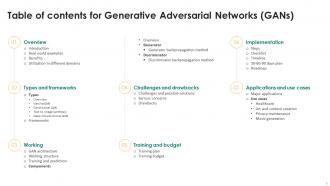
Slide 3: This slide shows Table of Content for the presentation.
Slide 4: This slide shows title for topics that are to be covered next in the template.
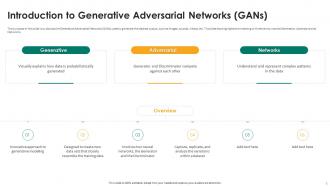
Slide 5: This slide is to discuss the Generative Adversarial Networks (GANs) used to generate the desired output, such as images, sounds, videos, etc.
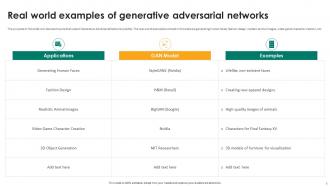
Slide 6: This slide is to discuss the practical uses of Generative Adversarial Networks (GANs). The real-world examples outlined in this slide are generating human faces, fashion design etc.
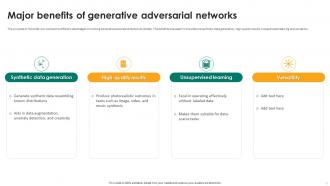
Slide 7: This slide outlines the different advantages of utilizing Generative Adversarial Networks (GANs).
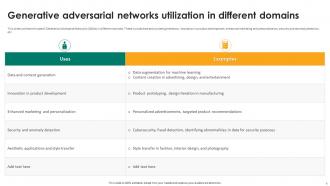
Slide 8: This slide presents the uses of Generative Adversarial Networks (GANs) in different domains. These include data and content generation, innovation in product development etc.
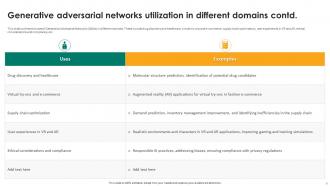
Slide 9: This slide outlines the uses of Generative Adversarial Networks (GANs) in different domains. These include drug discovery and healthcare, virtual try-ons and e-commerce etc.
Slide 10: This slide shows title for topics that are to be covered next in the template.
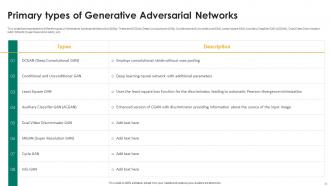
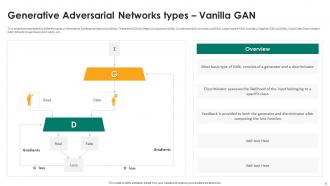
Slide 11: This slide demonstrates the different types of Generative Adversarial Networks (GANs). These are DCGAN (Deep Convolutional GAN), Conditional and Unconditional GAN etc.
Slide 12: This slide also demonstrates the different types of Generative Adversarial Networks (GANs). These are DCGAN (Deep Convolutional GAN), Conditional and Unconditional GAN etc.
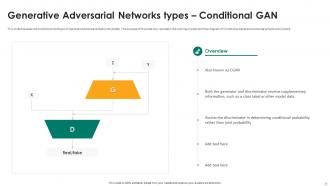
Slide 13: This slide discusses the Conditional GAN type of Generative Adversarial Networks (GANs). This slide represent the working process and flow diagram of CGAN.
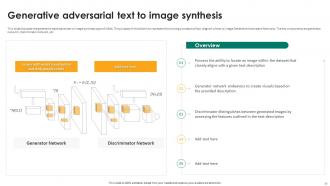
Slide 14: This slide presents the generative adversarial text to image synthesis type of GANs. This slide represent the working process and flow diagram of text to image CGAN.
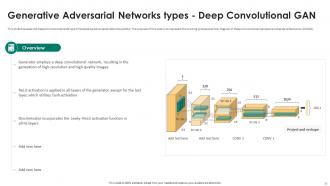
Slide 15: This slide discusses the Deep Convolutional GAN type of Generative Adversarial Networks (GANs). This slide displays the working process and flow diagram of DCGAN.
Slide 16: This slide shows title for topics that are to be covered next in the template.
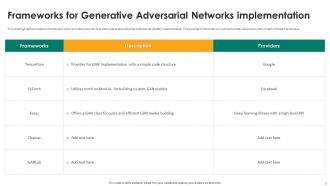
Slide 17: This slide highlights the several frameworks which provide tools and libraries for Generative Adversarial Networks (GANs) implementation.
Slide 18: This slide shows title for topics that are to be covered next in the template.
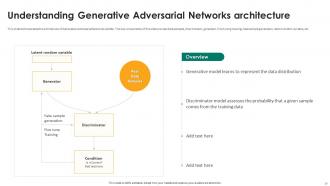
Slide 19: This slide demonstrates the architecture of Generative Adversarial Networks (GANs). The key components of this slide are real data samples, discriminator, generator etc.
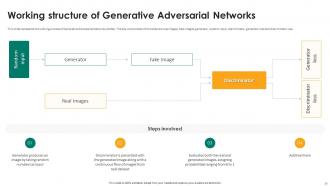
Slide 20: This slide represents the working process of Generative Adversarial Networks (GANs). The key components of this slide are real images, fake images, generator etc.
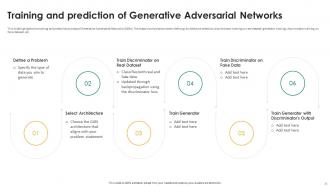
Slide 21: This slide highlights the training and prediction process of Generative Adversarial Networks (GANs). The steps involved are problem defining, architecture selection etc.
Slide 22: This slide shows title for topics that are to be covered next in the template.
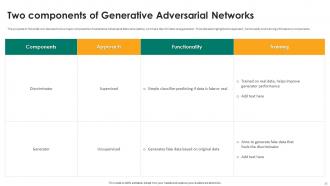
Slide 23: This slide discuss the two major components of Generative Adversarial Networks (GANs), which are discriminator and generator.
Slide 24: This slide shows title for topics that are to be covered next in the template.
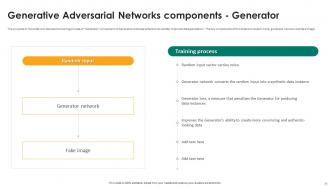
Slide 25: This slide discuss the training process of “Generator” component of Generative Adversarial Networks (GANs) improved data generation.
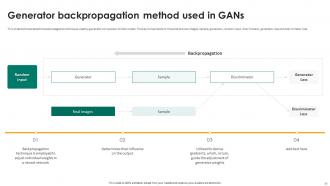
Slide 26: This slide demonstrates the backpropagation technique used by generator component of GAN model. The key components of this slide are real images, sample, generator etc.
Slide 27: This slide shows title for topics that are to be covered next in the template.
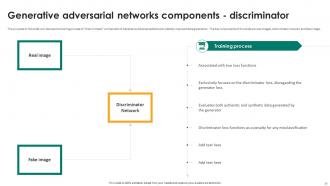
Slide 28: This slide discuss the training process of “Discriminator” component of Generative Adversarial Networks (GANs) improved data generation.
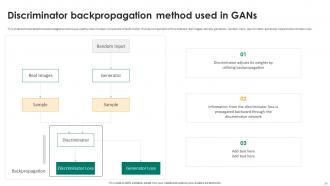
Slide 29: This slide demonstrates the backpropagation technique used by discriminator component of GAN model. The key components of this slide are real images, sample, generator etc.
Slide 30: This slide shows title for topics that are to be covered next in the template.
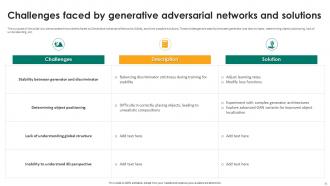
Slide 31: This slide demonstrate the problems faced by Generative Adversarial Networks (GANs), and their possible solutions.
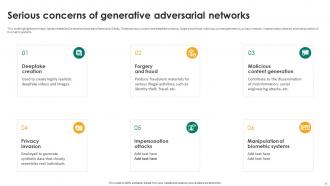
Slide 32: This slide highlights the major issues created by Generative Adversarial Networks (GANs). These serious concerns are deepfake creation, forgery and fraud and more.
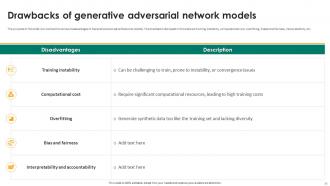
Slide 33: This slide outline the various disadvantages of Generative Adversarial Networks (GANs). The drawbacks discussed in this slide are training instability, computational cost etc.
Slide 34: This slide shows title for topics that are to be covered next in the template.
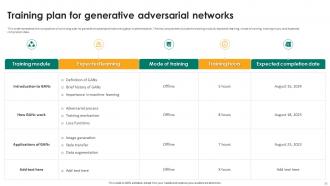
Slide 35: This slide represents the composition of a training plan for generative adversarial networks (GANS) implementation. The key components include the training module and more.
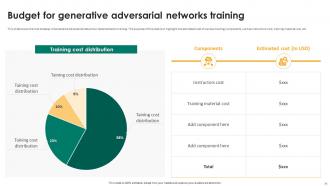
Slide 36: This slide shows the cost breakup of Generative Adversarial Networks implementation training. This slide highlight the estimated cost of various training components.
Slide 37: This slide shows title for topics that are to be covered next in the template.
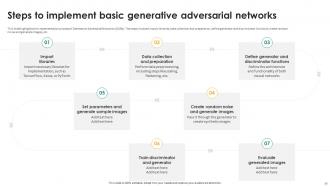
Slide 38: This slide highlights the implementation process of Generative Adversarial Networks (GANs). The steps involved import libraries, data collection and preparation etc.
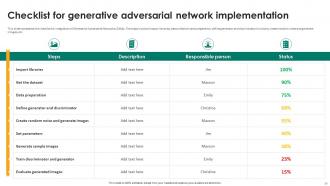
Slide 39: This slide represents the checklist for integration of Generative Adversarial Networks (GANs). The steps involved import libraries, data collection and preparation etc.
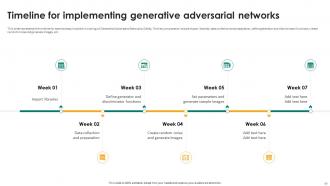
Slide 40: This slide displays the timeline for several steps involved in working of Generative Adversarial Networks (GANs). The key components include import libraries and more.
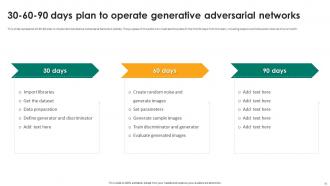
Slide 41: This slide represents 30-60-90 plan to implement Generative Adversarial Networks (GANs). This slide illustrate the plans of the first 90 days from the start, including steps to be followed at interval of one month.
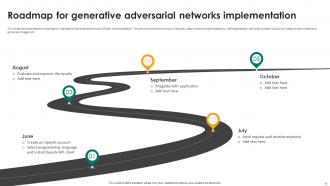
Slide 42: This slide demonstrates the roadmap for Generative Adversarial Networks (GANs) implementation. The key components are import libraries, data collection and preparation etc.
Slide 43: This slide shows title for topics that are to be covered next in the template.
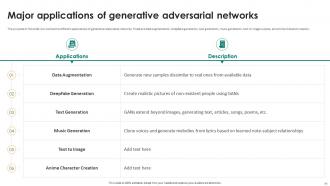
Slide 44: This slide outlines the different applications of generative adversarial networks. These are data augmentation, Deepfake generation, text generation, music generation etc.
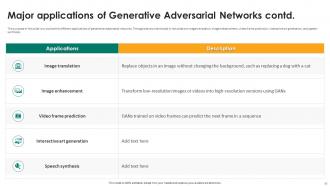
Slide 45: This slide presents the different applications of generative adversarial networks. The applications mentioned in this slide are image translation, image enhancement etc.
Slide 46: This slide shows title for topics that are to be covered next in the template.
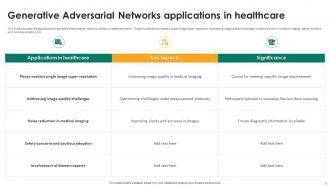
Slide 47: This slide discusses the applications of generative adversarial networks (GANs) in healthcare sector. These include photo-realistic single image super-resolution etc.
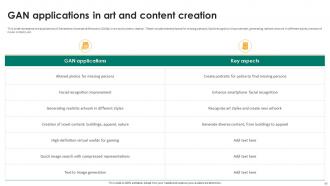
Slide 48: This slide represents the applications of Generative Adversarial Networks (GANs) in art and content creation. These include altered photos for missing persons and more.
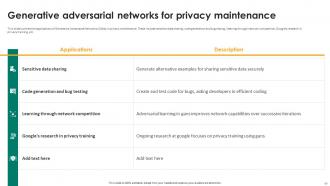
Slide 49: This slide outlines the applications of Generative Adversarial Networks (GANs) in privacy maintenance. These include sensitive data sharing, code generation etc.
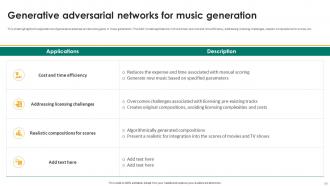
Slide 50: This slide highlights the applications of generative adversarial networks (gans) in music generation.
Slide 51: This slide shows all the icons included in the presentation.
Slide 52: This slide is titled as Additional Slides for moving forward.
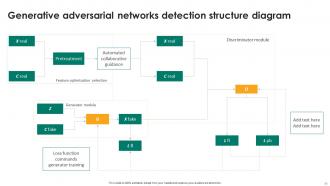
Slide 53: This slide presents Generative adversarial networks detection structure diagram with additional textboxes.
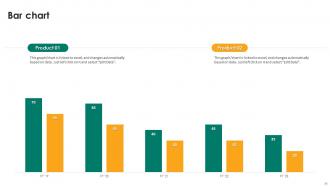
Slide 54: This slide presents Bar Graph with two products comparison.
Slide 55: This is a Timeline slide. Show data related to time intervals here.
Slide 56: This slide depicts Venn diagram with text boxes.
Slide 57: This is a financial slide. Show your finance related stuff here.
Slide 58: This slide contains Puzzle with related icons and text.
Slide 59: This is Our Goal slide. State your firm's goals here.
Slide 60: This is an Idea Generation slide to state a new idea or highlight information, specifications etc.
Slide 61: This slide provides 30 60 90 Days Plan with text boxes.
Slide 62: This slide presents Roadmap with additional textboxes. It can be used to present different series of events.
Slide 63: This slide shows Post It Notes for reminders and deadlines. Post your important notes here.
Slide 64: This is a Thank You slide with address, contact numbers and email address.
Generative Adversarial Networks GANs Powerpoint Presentation Slides with all 72 slides:
Use our Generative Adversarial Networks GANs Powerpoint Presentation Slides to effectively help you save your valuable time. They are readymade to fit into any presentation structure.









FAQs for Generative Adversarial Networks GANs
So GANs work like this - you have two networks basically fighting each other. One creates fake images, the other tries to catch the fakes. Pretty neat setup actually. The faker gets better at tricking the detector, while the detector gets sharper at spotting phonies. They keep pushing each other until boom - you're generating super realistic stuff. I mean, some of the results are honestly wild when you see them. If you're thinking about synthetic data or just want to mess around with image generation, definitely check them out. Way more fun than regular machine learning IMO.
So GANs are pretty different from regular ML models. Instead of just predicting stuff, they actually *generate* new data from scratch. There's this whole setup where two networks compete - one creates fake data, the other tries to spot the fakes. Think art forger vs art detective, which is honestly kind of brilliant. Most models just learn to classify things, but GANs learn to make entirely new samples that look legit. You're basically asking "make me something realistic" instead of "what category is this?" Really handy when you don't have enough real data to work with - though training them can be a pain sometimes.
So GANs work with two neural networks fighting each other - kinda like that counterfeiter vs detective thing. One network (the generator) makes fake images from random noise. The other one (discriminator) tries catching the fakes. They keep training against each other until the generator gets so good it can fool the discriminator most of the time. That's when you get those crazy realistic fake faces you see online. The whole adversarial setup is what makes it work - though honestly the math behind it gets pretty intense once you dig deeper. Just focus on understanding that core back-and-forth relationship first.
Oh man, GANs are everywhere now! Image generation is their biggest thing - deepfakes, AI art, those crazy realistic fake faces. Medical imaging uses them tons for synthetic training data when real patient scans are hard to get. They're also great for making blurry photos sharp again and data augmentation stuff. Fashion and gaming companies love them for virtual clothes and textures. DALL-E type tools? Yeah, that's GANs doing text-to-image magic. Honestly, if you need realistic fake data for anything, they're your go-to. Start with images though - that's where they actually work reliably instead of being temperamental.
Ugh, the biggest pain is mode collapse - your generator just gets stuck making the same boring stuff over and over. Training stability is another nightmare, plus vanishing gradients will mess with you constantly. It's like watching two AIs fight and one always wins by too much, which honestly makes you want to throw your laptop sometimes. Progressive growing helps a ton, or try spectral normalization. StyleGAN architectures are way more stable too. But seriously? Don't build from scratch first. Grab something that already works, then tweak it once you're not pulling your hair out.
Honestly, loss function choice makes or breaks your GAN training. Classic minimax is a nightmare - constant vanishing gradients and mode collapse that'll drive you insane. WGAN or LSGAN work way better for stable training. Though WGAN needs those gradient penalties which can be annoying to tune. LSGAN sometimes gives you softer images than you'd want. I'd probably start with WGAN-GP since it's pretty reliable, then mess around with others depending on what you're building. The stability difference is night and day compared to vanilla GANs.
Yeah totally! You basically tack a classifier onto your discriminator that handles the class labels for real data. The discriminator still does its normal real/fake thing too. What's cool is you're training on both your tiny labeled set AND all that unlabeled data at once. The discriminator gets way better representations from seeing all the unlabeled stuff, which makes your classifier work better than if you'd just used the labeled examples. I'd start simple - just modify the discriminator's final layer so it spits out real/fake predictions plus class probabilities.
Conditional GANs are probably your best starting point - you can actually tell them what to make instead of just hoping for the best. StyleGAN's the one behind all those creepy-realistic fake faces floating around social media. It's wild because you can tweak specific features like age or hair color independently. CycleGAN does image translation stuff (horses → zebras, that kind of thing), and Progressive GAN builds pictures layer by layer for better quality. Honestly, I'd mess around with cGANs first since they're way more intuitive to wrap your head around.
Oh man, mode collapse is the worst - your generator basically gets stuck making the same boring stuff over and over. Try Wasserstein GANs first, they've got way more stable loss functions. Spectral normalization helps too by keeping everything balanced during training. There's also unrolled GANs that let the generator peek ahead at what the discriminator's doing, which is kinda clever honestly. Still happens though, no matter what you do sometimes. Your best bet? Don't rely on just one fix - combine a few techniques. I'd go with Wasserstein + spectral norm to start.
Dude, GANs and deepfakes are a nightmare combo honestly. Non-consensual porn is probably the worst part - people can literally put anyone's face on explicit content without permission. Then there's political manipulation, identity theft, all that scary stuff. What really gets me is how it'll mess with everyone's ability to trust what they see online. Like, how do we know what's real anymore? Fraud and harassment become way easier too. Oh and misinformation spreads like wildfire with this tech. If you're building anything with GANs, definitely think through how it could go wrong first.
So GANs basically let you create fake training data that looks like your real stuff. Train it on what you've got, then the generator spits out new samples to beef up your dataset. Super helpful when you're stuck with tiny or lopsided data. The synthetic examples add variation that helps your model handle new cases better - though honestly, you gotta watch out that the GAN isn't just copying what it saw. I'd start small. Generate a batch and test if it actually boosts performance on your validation set before going crazy with it.
For GAN evaluation, I'd go with both quantitative and qualitative stuff. Inception Score and FID are your main quantitative metrics - they check diversity and how close your outputs match real data. But honestly, just looking at the samples yourself is super important too. Check for weird artifacts and mode collapse issues. One thing that works well is training models on your synthetic data, then testing on real data - the performance gap shows you quality pretty clearly. Oh and if you're working in a specific domain, definitely use those specialized metrics too. The automated scores are helpful but your eyes will catch things the algorithms totally miss.
Yeah, GANs are pricey to train for sure. You're basically running two networks at once - the generator and discriminator - so compute costs double immediately. They're also super finicky and take forever to converge compared to regular CNNs. The whole adversarial back-and-forth thing is just computationally heavy. Honestly though, they're not worse than transformers or other crazy complex architectures. I'd just plan for way longer training times. Oh, and definitely look into pre-trained models first - might save you some serious cash on compute. Trust me on that one.
Dude, you really can't do GAN research solo - the math is just too brutal. Most breakthroughs happen when teams build off each other's work and share datasets openly. Debugging these things is honestly a total nightmare, so having people to vent to about training failures saves your sanity. Twitter's surprisingly good for connecting with researchers, and definitely hit up NeurIPS or similar conferences. Oh and contribute to open-source projects when you can. The real learning happens in those informal workshop conversations, not just reading papers. Trust me on this one.
Honestly, GANs integrate pretty smoothly with what you're already doing. Fashion companies plug them right into design software - suddenly you've got AI cranking out patterns and textures that match your brand's vibe. Gaming studios use them for procedural stuff like auto-generating character variations or environments. Don't go crazy trying to rebuild everything though. Pick one small thing first, train it on your current assets, then see how it goes. The whole "AI design assistant" angle is actually pretty cool once you get it dialed in.
-
I never had to worry about creating a business presentation from scratch. SlideTeam offered me professional, ready-made, and editable presentations that would have taken ages to design.
-
Professionally designed slides with color coordinated themes and icons. Perfect for enhancing the style of the presentations.