


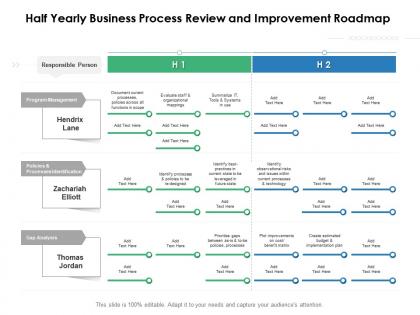
Half yearly business process review and improvement roadmap




Try Before you Buy Download Free Sample Product
 Impress Your
 Audience
 100%
100% Editable
 Save Hours
 of Time


Introducing this Half Yearly Business Process Review And Improvement Roadmap PowerPoint Presentation Slide. Managing a project can be complex, and our PPT slide will help you cover all the bases with ease and clarity. Evaluate the functioning of your business operations to develop an infallible action plan by taking the aid of this PPT template. Assess the business flow of your company to increase the organization’s productivity and profitability with the assistance of this PPT theme. Convey your expected outcomes out of the project by taking advantage of this PPT design. Select this PPT visual to create a flowchart for program management, processes identification, and gap analysis. Through this PPT presentation, you can display the roadmap for business process improvement. Build a firm foundation for the supply chain management of your company by utilizing this content-ready PPT graphic. Acquire the apt resources and redesign the process by using this PPT slide. Without waiting any further, click the download button.
People who downloaded this PowerPoint presentation also viewed the following :
Half yearly business process review and improvement roadmap with all 2 slides:
Use our Half Yearly Business Process Review And Improvement Roadmap to effectively help you save your valuable time. They are readymade to fit into any presentation structure.
FAQs for Half yearly business process review
So there's Lean for cutting waste, Six Sigma for data-heavy defect reduction, and Kaizen for those tiny ongoing tweaks. DMAIC is basically Six Sigma's playbook - Define, Measure, Analyze, Improve, Control. Value Stream Mapping rocks for seeing your whole process laid out visually. Agile's borrowed from software but works well for step-by-step improvements. Process mining's trendy now - shows what's really going down vs what you assume. Honestly, I'd go with Lean first since it's pretty straightforward, then add Six Sigma tools if you need serious number-crunching. Just match whatever fits your team's vibe.
Honestly, just start by writing down every single step in your current process - and I mean everything. Get the actual people doing the work involved because managers usually have no clue where things really break down. Sticky notes on a wall work great for this, or whatever mapping tool you prefer. Measure stuff like how long things take, error rates, costs. Look for bottlenecks and places where you're doing duplicate work. The whole point is getting a really honest picture before you mess with anything. Oh, and tackle your biggest headache processes first.
Honestly, think of data analytics like being a detective for your workflows. Track stuff like how long each step takes, where things get stuck, and who's actually doing what. Way more reliable than just going off complaints! You'll spot weird patterns - like approvals that mysteriously take forever on Fridays (probably because everyone's mentally checked out). Or realizing Sarah's somehow handling twice the workload as everyone else. Map out your process first, then pick 3-4 metrics to actually monitor. The data reveals bottlenecks you'd never catch otherwise.
Definitely get your employees involved from the start - they're doing the actual work so they know what sucks. Anonymous surveys work great, or just put up a suggestion box. Focus groups are solid too. Honestly, managers usually have no clue what's really slowing things down on the ground level. Don't just collect feedback though - you gotta actually do something with it and tell people what changed. Otherwise they'll stop caring. I'd do quarterly check-ins to keep it going. Oh and make sure it's not just the same voices every time.
Honestly, the biggest pain points are always resistance to change and getting leadership actually invested. People just love their comfort zones, you know? Start with quick wins to build momentum - that's huge. Get leadership visibly supporting it first, then explain the "why" clearly to everyone else. Don't bite off more than you can chew initially (learned that one the hard way). Make sure you've got dedicated resources, not just "fit it in when you can" nonsense. Here's the kicker though - involve your team in designing the changes. They'll actually embrace stuff they helped create instead of fighting it.
Honestly, automation tools are where I'd start if I were you. Map out what you're doing now first - then look for the stuff that's just eating up everyone's time. Workflow software, AI chatbots for customers, automated invoicing... that kind of thing. Cloud platforms are pretty solid too since your team can actually work together instead of dealing with random data scattered everywhere. I mean, even simple inventory management systems can save you hours. Focus on whatever's slowing you down the most - that's where you'll see the biggest difference right away.
Honestly, start with what actually matters to your bottom line - cycle time, error rates, customer satisfaction, cost per transaction. Get your baseline numbers first, then track the same stuff consistently. I've seen too many people get obsessed with metrics that look impressive but don't really change anything meaningful. Focus on both speed improvements AND quality gains - defects, rework, that kind of thing. Set up something simple you can check monthly. Trust me, if you create some crazy dashboard with 20 different KPIs, nobody's gonna look at it after the first week.
Oh man, culture is everything with BPI stuff. Blame-heavy places? Forget it - people will hide from changes because they don't want to look stupid. But when companies actually encourage trying new things and learning from screwups, adoption rates go through the roof. Leadership has to walk the walk too, not just talk about improvement while doing everything the old way. Honestly, I've watched so many initiatives crash and burn because of this. Figure out how open your culture really is first, then build your whole approach around that reality. Makes all the difference.
Honestly, hands-on practice sessions work way better than just lecturing people about new stuff. Let them mess around with it in a safe space first. The big thing is explaining WHY you're changing things - not just dumping new procedures on everyone (I've sat through way too many of those boring sessions). Find someone on each team who actually gets excited about this stuff to be your go-to person later. Write up simple guides they can reference when they inevitably forget half of it. Oh, and definitely do follow-up sessions after a few weeks. That's when the real questions come up.
Don't make it a one-time thing - build improvement into your regular routine. Monthly check-ins work well where teams actually review metrics and ask "what's still busted?" Make feedback super easy for frontline staff without crazy approval chains. Most leadership honestly gets distracted by the next big project (classic mistake). Tie improvement goals to performance reviews so it sticks. Oh, and start simple - pick one process owner who's actually responsible for keeping things optimized. Otherwise it just becomes nobody's job and dies.
Dude, you HAVE to get stakeholders involved - they're living in that process every single day. Skip their input and you'll totally miss what's actually broken. People hate changes they didn't help create, so get them bought in early or they'll fight you later. Management's perspective is fine, but honestly? The frontline people usually know where the real problems are. They see the daily headaches that never make it up the chain. Without them, you'll build something that looks perfect in meetings but crashes when it hits reality. It's just common sense really.
Yeah, totally! BPI is perfect for small businesses actually. Map out your main processes first and spot where things get stuck. Big companies take forever to change anything - you don't have that problem. Pick one process that affects customers directly and just fix it fast. I've watched tiny companies completely destroy their competition by being quicker to respond. Days vs months, you know? Your size is honestly your secret weapon here since you can test stuff and pivot super quick. Start with something small, see what happens, then do more of whatever works.
Here's the thing - when you fix broken processes, customers actually feel the difference. Wait times drop. Fewer screw-ups happen. Everything just flows better, you know? Your retention rates will climb because people stick with companies that don't frustrate them. They'll even start telling their friends about you, which is honestly the best marketing you can get. I'd track your key metrics before making changes though - like response times and error rates. That way you can show leadership real numbers afterward and prove it was worth the effort. Trust me, having data makes those conversations way easier.
So basically, take those five lean principles and weave them into your process improvement work. First figure out what your customers actually value - not what you think they want. Map out your current workflow and you'll probably be shocked at how much waste you find (I always am). Remove the junk - waiting around, pointless approvals, stuff getting passed between too many people. Set up pull systems where work only starts when there's real demand. Oh and do regular kaizen sessions to keep improving. My rule of thumb: if a step doesn't help the customer, ditch it.
Honestly, you gotta hit them from all angles. Yeah, send the usual emails with all the details, but also do some face-to-face stuff - town halls work great for questions. Visual aids help too, like showing the old way vs new way. Different people learn differently, so mix it up. Some folks hate meetings and just want the email summary, others need to actually talk it through. Start talking about it early and keep checking in - people always have random concerns that pop up later. Oh, and make sure you're not giving different info to different groups because that'll bite you.
No Reviews