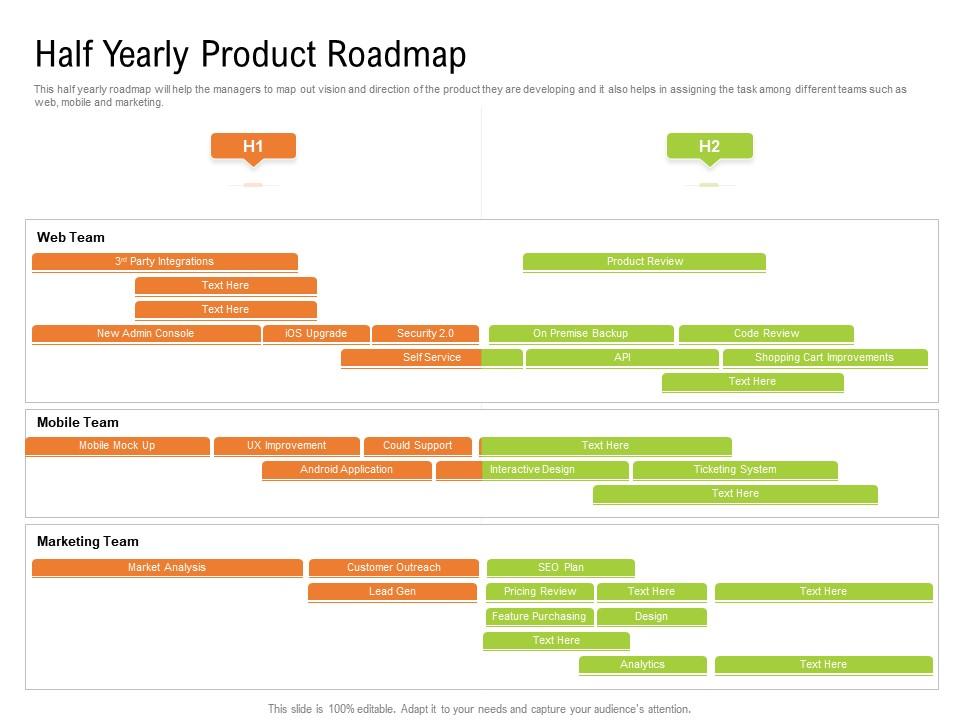
Plantilla de Powerpoint de la línea de tiempo de la hoja de ruta del producto semestral

Rating:
91%
Half yearly product roadmap timeline powerpoint template
Slide 1 of 2
Favourites Favourites

Try Before you Buy Download Free Sample Product

Audience Impress Your
Audience
Editable 100%
Editable
Time Save Hours
of Time
The Biggest Sale is ending soon in
0
0
:
0
0
:
0
0
Rating:
91%

Características de estas diapositivas de presentación de PowerPoint:

Esta es una plantilla de PowerPoint de línea de tiempo de hoja de ruta de producto semestral redactada con un conjunto diverso de gráficos, que se puede reformular y editar según sus necesidades y requisitos. Simplemente descárguelo en su sistema y utilícelo en PowerPoint o Google Slides, según sus preferencias de presentación.

FAQs for Half yearly product roadmap

Essential components of a successful product roadmap include clear strategic goals, prioritized feature sets, realistic timelines, resource allocation plans, and stakeholder alignment frameworks. These elements work together by providing transparency across development cycles, enabling cross-functional coordination, and delivering measurable business outcomes, with many organizations finding that well-structured roadmaps accelerate time-to-market while maintaining strategic focus.

Teams can prioritize features effectively through impact assessment, resource evaluation, customer feedback analysis, market research insights, and strategic alignment with business objectives. These approaches enable organizations to focus development efforts on high-value capabilities, streamline resource allocation, and deliver competitive advantages, with many successful companies finding that data-driven prioritization ultimately enhances customer satisfaction and accelerates market growth.

Customer feedback serves as a critical foundation for product roadmaps, informing feature prioritization, identifying market gaps, addressing user pain points, and validating development directions. Through systematic feedback collection and analysis, product teams can align roadmap decisions with actual customer needs, reduce development risks, and enhance market fit, with many organizations finding that customer-driven roadmaps deliver higher adoption rates and competitive advantage.

Product roadmaps should be updated quarterly or bi-annually, with major reviews aligning with business cycles, market shifts, and customer feedback patterns. This regular cadence enables organizations to respond to competitive pressures, integrate new technologies, and adjust priorities based on performance metrics, while maintaining strategic direction and stakeholder alignment across development teams.

Common pitfalls include overcommitting to fixed timelines, neglecting stakeholder input, focusing solely on features rather than outcomes, and failing to prioritize based on customer value. These missteps often result from insufficient market research, poor communication between teams, and rigid planning approaches, with many organizations finding that flexible, outcome-driven roadmaps deliver better strategic alignment and customer satisfaction.

Visual elements enhance product roadmap clarity by incorporating color coding for priorities, timeline graphics for milestones, progress bars for completion status, and iconography for feature categories. These design components streamline complex information into digestible formats, enabling stakeholders to quickly grasp project trajectories, resource allocation, and strategic priorities, while ultimately delivering more engaging presentations that facilitate better decision-making and team alignment.

Effective product roadmap tools include Aha!, ProductPlan, Roadmunk, Monday.com, and Miro, each offering visualization capabilities, stakeholder collaboration features, and integration options. These platforms streamline roadmap creation by enabling real-time updates, cross-functional alignment, and strategic communication, with many organizations finding that visual roadmapping tools enhance team coordination and accelerate product development timelines.

Industries adapt product roadmaps by prioritizing compliance requirements, customer expectations, and operational constraints specific to their sectors. Healthcare organizations focus on regulatory approval timelines and patient safety protocols, while financial services emphasize security features and risk management, with manufacturing companies prioritizing supply chain integration and scalability, ultimately delivering competitive advantage through industry-specific customization.

Effective roadmap communication strategies include stakeholder-specific presentations, visual timeline formats, regular update meetings, interactive dashboards, and milestone-based progress reports. These approaches enhance transparency by tailoring technical details for developers, focusing on business outcomes for executives, and providing customer-facing summaries for sales teams, ultimately delivering aligned expectations and stronger stakeholder buy-in across organizations.

A product roadmap facilitates cross-functional collaboration by providing shared visibility into priorities, timelines, and dependencies, enabling teams to align their efforts and coordinate resources effectively. Through centralized planning, departments like engineering, marketing, and sales can anticipate requirements, eliminate silos, and streamline communication, ultimately delivering faster product launches and enhanced customer experiences.

Product roadmap success metrics include feature adoption rates, time-to-market improvements, customer satisfaction scores, revenue impact measurements, and strategic goal alignment percentages. These metrics enable organizations to track delivery efficiency, market responsiveness, and business outcomes, with many product teams finding that combining leading indicators like development velocity with lagging indicators like customer retention ultimately delivers comprehensive performance visibility and competitive advantage.

Agile methodologies transform product roadmaps from rigid, long-term plans into flexible, iterative frameworks that adapt based on customer feedback, market changes, and development insights. Through shorter sprint cycles, continuous stakeholder collaboration, and data-driven decision making, organizations can pivot quickly, prioritize high-value features, and deliver incremental improvements, ultimately ensuring their roadmaps remain relevant and responsive to evolving business needs.

Short-term product roadmaps focus on immediate deliverables, feature releases, bug fixes, and quarterly objectives, while long-term roadmaps emphasize strategic vision, market positioning, and annual growth targets. These complementary approaches enable organizations to balance operational efficiency with strategic planning, with many companies finding that integrating both timeframes delivers enhanced product development cycles and sustainable competitive advantage.

A product roadmap supports strategic planning by aligning development priorities with business objectives, market opportunities, and customer needs, while enabling resource allocation through clear timelines and dependency mapping. This strategic combination helps organizations prioritize feature development, coordinate cross-functional teams, and allocate budget effectively, with many companies finding that well-structured roadmaps ultimately deliver faster time-to-market and competitive advantage.

Including a timeline in a product roadmap delivers enhanced stakeholder alignment, clearer resource allocation, improved sprint planning, realistic expectation management, and stronger accountability across development teams. These temporal frameworks enable organizations to coordinate cross-functional efforts more effectively, prioritize feature releases strategically, and communicate progress transparently to investors and customers, ultimately delivering predictable product launches and competitive market positioning.

Ratings and Reviews

91% of 100
Review Form
Write a review
Most Relevant Reviews
  1. 80%

    by Christian Brooks

    Unique and attractive product design.
  2. 100%

    by Eddy Guerrero

    Very unique, user-friendly presentation interface.
  3. 80%

    by Darwin Mendez

    The content is very helpful from business point of view.
  4. 100%

    by Curt Bryant

    Content of slide is easy to understand and edit.
  5. 80%

    by Dylan Richards

    Nice and innovative design.
  6. 80%

    by Curtis Herrera

    Excellent template with unique design.
  7. 100%

    by Domenic Spencer

    Professional and unique presentations.
  8. 100%

    by Reece Taylor

    Designs have enough space to add content.
  9. 100%

    by Dexter Weaver

    Appreciate the research and its presentable format.
  10. 80%

    by Derick Meyer

    Best Representation of topics, really appreciable.

Items 1 to 10 of 13 total

    Page:
  • You're currently reading page 1
  • Page 2
  • Next
per page: