


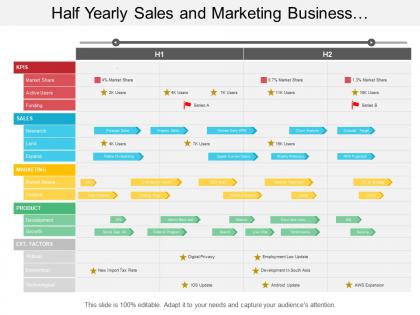
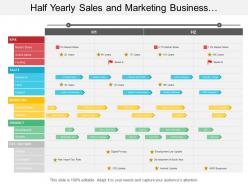
Half yearly sales and marketing business development timeline




Try Before you Buy Download Free Sample Product
 Impress Your
 Audience
 100%
100% Editable
 Save Hours
 of Time


Highlight your sales plan on a timeline with clear objectives laid out half yearly using our professionally designed half yearly sales and marketing business development timeline presentation template. PPT template crafted by our professional experts is designed especially for sales managers, marketing executives, who are planning to present their business plans to management or internal team members. This business development PPT template works effectively if you want to focus on strategic business goals and track progress towards those goals. The design template can be used to forecast and plan for your sales on half yearly basis. The design template makes use of high quality graphics to represent each aspect of company’s strategic operations in marketing and business development. This sales review presentation template is highly useful as its advantageous to forecast and make business plan in advance, so that business goals can be achieved. Download this sales and marketing presentation template and present your business development plan in most comprehensive way. Bonds germinate with our Half Yearly Sales And Marketing Business Development Timeline. Cultivate enduring connections with your customers.
People who downloaded this PowerPoint presentation also viewed the following :
Half yearly sales and marketing business development timeline with all 5 slides:
Acquire the freedom to improvise with our Half Yearly Sales And Marketing Business Development Timeline. Be able to customize to your heart's content.


FAQs for Half yearly sales and marketing
Key business development stages include market research and opportunity identification, strategic planning and goal setting, lead generation and prospect targeting, relationship building and partnership development, and deal negotiation and closure. These phases work collectively by establishing market understanding, creating actionable strategies, and building sustainable partnerships, with many organizations finding that structured timelines accelerate growth while minimizing resource waste and maximizing competitive positioning.
Market research influences business development by informing strategic decisions, identifying opportunities, validating assumptions, and mitigating risks throughout each phase. During planning stages, research guides target market selection and positioning strategies, while implementation phases benefit from customer feedback analysis and competitive intelligence, ultimately enabling organizations to make data-driven decisions that enhance market entry success and sustainable growth.
Key metrics include lead generation rates, conversion percentages, revenue growth, customer acquisition costs, and pipeline velocity throughout each timeline phase. These indicators enable businesses to track performance across sales, marketing, and partnership development activities, while identifying bottlenecks and optimization opportunities, ultimately delivering measurable ROI and strategic competitive advantage in an increasingly data-driven marketplace.
Effective milestones in business development involve setting specific revenue targets, partnership goals, market expansion deadlines, customer acquisition numbers, and product launch timelines. These benchmarks enable organizations to track progress systematically, allocate resources strategically, and adjust tactics quickly, with many companies finding that quarterly milestone reviews ultimately deliver enhanced accountability and faster strategic pivots.
Networking plays a crucial role in early business development by establishing key relationships, identifying potential partners and customers, gathering market insights, and building brand awareness within target industries. Through strategic networking events, professional associations, and industry connections, entrepreneurs can accelerate market entry, validate business concepts, and secure essential resources, ultimately creating competitive advantages that drive sustainable growth.
Technology streamlines business development timelines by automating lead qualification, accelerating proposal generation, and enabling real-time collaboration across teams. Through CRM automation and AI-powered analytics, organizations reduce manual research time, accelerate deal progression, and enhance client interactions, with many sales teams finding that integrated platforms ultimately deliver faster closure rates and improved resource allocation.
Common pitfalls include inadequate market research, unrealistic timelines, insufficient funding allocation, poor stakeholder communication, and lack of contingency planning. These challenges can be avoided by conducting thorough competitor analysis, setting milestone-based schedules with buffer periods, securing diversified funding sources, and implementing regular progress reviews, with many organizations finding that structured frameworks ultimately deliver sustainable growth and reduced operational risks.
SWOT analysis is crucial for business development timeline planning as it identifies internal strengths, weaknesses, external opportunities, and threats that directly impact project scheduling and resource allocation. This strategic assessment enables organizations to prioritize initiatives based on competitive advantages, anticipate potential roadblocks, and align development phases with market conditions, ultimately delivering more realistic timelines and higher success rates.
Cross-departmental collaboration enhances business development by aligning marketing insights with sales strategies, integrating product development with customer feedback, and coordinating finance with resource planning. This strategic integration streamlines decision-making, accelerates market entry timelines, and delivers more comprehensive client solutions, with many organizations finding that unified departmental efforts ultimately increase conversion rates and sustainable growth.
Customer feedback is significant because it validates market assumptions, identifies product-market fit gaps, and reveals priority features that accelerate or redirect development phases. Through systematic feedback collection, companies like software startups and retail brands optimize resource allocation, minimize costly pivots, and enhance user experiences, ultimately delivering market-ready solutions faster while reducing development risks and ensuring competitive positioning.
Industry trends significantly influence business development planning by dictating market timing, resource allocation, customer demand patterns, and competitive positioning strategies. Organizations increasingly align their initiatives with emerging trends like digital transformation, sustainability, and consumer behavior shifts, with many companies finding that trend-responsive planning delivers faster market entry, reduced risks, and enhanced competitive advantage.
Ethical considerations include transparency in partnerships, fair competitive practices, honest stakeholder communications, responsible data handling, and sustainable resource allocation. These principles enhance long-term business relationships by building trust with clients, partners, and communities, while many organizations finding that ethical practices ultimately deliver stronger market reputation and sustainable competitive advantage.
Storytelling can be incorporated by weaving client success narratives during initial pitches, sharing transformation case studies in proposal presentations, and presenting implementation journeys during contract negotiations. Through compelling narratives, businesses enhance emotional connection with prospects, demonstrate proven results across industries like healthcare and finance, and ultimately accelerate decision-making while building stronger client relationships throughout the entire development process.
Inbound marketing plays a crucial role in business development by attracting qualified prospects through valuable content, SEO optimization, social media engagement, and lead nurturing campaigns. This strategic approach enables organizations to build trust with potential clients, generate higher-quality leads at lower costs, and create sustainable growth pipelines, with many companies finding that inbound strategies deliver better ROI than traditional outbound methods.
Timeline adjustments should be made through quarterly strategic reviews, real-time market monitoring, and flexible milestone restructuring that allows for rapid pivoting when opportunities or challenges emerge. Successful companies implement agile planning frameworks with built-in buffer periods, enabling them to accelerate expansion into favorable markets while scaling back in declining sectors, ultimately maintaining competitive advantage through responsive adaptation.
-
Use of different colors is good. It's simple and attractive.
-
Awesomely designed templates, Easy to understand.