


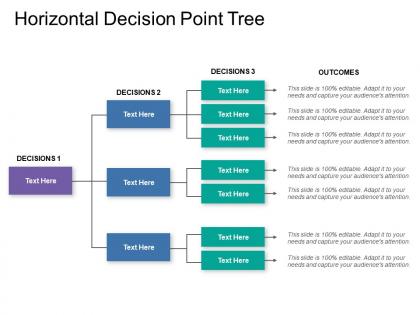
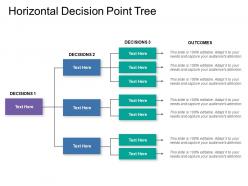
Horizontal decision point tree





Try Before you Buy Download Free Sample Product
 Impress Your
 Audience
 100%
100% Editable
 Save Hours
 of Time


Our Horizontal Decision Point Tree don't allow you to get hampered. Go forward in a free environment.
People who downloaded this PowerPoint presentation also viewed the following :
Horizontal decision point tree with all 5 slides:
Identify the cause of inequality with our Horizontal Decision Point Tree. Get folks to take corrective action.

FAQs for Horizontal
So there are basically four ways people make decisions. Quick and dirty is directive - you just go with minimal info when you're pressed for time. Analytical is the opposite - tons of research but you might overthink yourself into a corner (guilty as charged). Then there's conceptual, which is all about the big picture and creative solutions. Behavioral focuses on getting everyone's input first. Honestly, the trick is just matching your style to what's happening. Time crunch? Go directive. Complex mess? Analytical works. Need your team on board? Definitely go behavioral.
Look, your brain basically tricks you into making dumb decisions without you realizing it. Like confirmation bias - you'll hunt for info that backs up what you already think instead of challenging yourself. Then there's anchoring where the first number someone throws out totally warps your judgment on everything else. Oh and the availability thing is brutal - if something happened recently or was super dramatic, you think it's way more likely than it actually is. Honestly happens to me all the time in work meetings. Best defense? Just pause and ask yourself "wait, am I being logical here?" before you commit to anything big.
Dude, emotional intelligence is basically everything when you're making big calls. You gotta know if you're deciding from anger or fear vs actually thinking clearly - makes a huge difference. I've watched so many people crash and burn because they totally ignored how their team felt about something. Like, the data might look perfect but if everyone hates the idea? Good luck with that. The trick is letting your gut feelings inform your brain, not override it completely. Oh and next time you're stuck on a decision, just stop for a sec and ask yourself what you're actually feeling right now.
Ugh, groupthink is the worst - everyone just nods along to avoid conflict, but then you end up making garbage decisions. I've seen this happen so many times. You gotta make people comfortable with disagreeing. Don't reveal your opinion right away since that shuts everyone else up. Get someone to play devil's advocate on purpose. Maybe set up anonymous feedback so people can actually speak up without feeling awkward about it. Bringing in outsiders helps too - they'll spot problems your team's too close to see. The whole thing's about making disagreement feel normal instead of scary.
Honestly, the best thing I've learned is to argue with myself before making big decisions - sounds crazy but hear me out. Ask yourself "what am I missing here?" and actively look for people who'd disagree with your gut instinct. I used to rush into choices way too fast. Now I separate what's actually fact vs just my opinion, especially when I feel pressured to decide quickly. Playing devil's advocate with your own ideas is weirdly effective. What could go wrong with option A? Who thinks this approach sucks and why?
So instead of just winging it with gut feelings, data analytics shows you what's really going on. Like when sales tank, you can actually figure out why instead of just guessing. Honestly, it's like getting superpowers for your business decisions once you stop being intimidated by all the numbers. You'll catch problems early, spot opportunities hiding in plain sight, and finally know what's working vs what just seems like it should work. My advice? Pick one thing you actually care about measuring and start there. Don't overthink it.
Honestly, your cultural background shapes pretty much everything about how you make decisions. Like, some cultures are all about what's best for the group, while others focus on individual choices. Risk tolerance varies wildly too - I've noticed this so much at work. Quick decisions vs. endless meetings to build consensus? That's cultural. Same with how you deal with authority and whether you lean more emotional or logical when deciding stuff. Communication styles are huge too. The trick is just being aware of these differences so you don't accidentally clash with people from different backgrounds.
Okay so the big things to watch for are fairness, transparency, and who gets hurt or helped. Don't just think about immediate business stuff - that's where most people mess up honestly. You've gotta consider how employees, customers, and even your community will be affected down the road. Sometimes I catch myself only looking at the obvious outcomes. But here's what works: before you finalize anything major, literally ask yourself "who else does this impact?" It sounds simple but you'd be surprised how often we skip that step. Transparency matters too - people should understand how you made the call.
Honestly, visual aids are a game changer when you're drowning in info. Your brain just processes charts and diagrams way better than chunks of text - there's actually science behind that but whatever. Decision trees are clutch because you can literally map out all your options and see where each path leads. I'm super visual so maybe I'm biased, but sketching stuff out on paper or using something like Miro makes patterns jump out that you'd totally miss otherwise. Even for small decisions it helps. Give it a shot next time you're stuck.
OODA Loop is probably your best bet - Observe, Orient, Decide, Act. Keeps you flexible when things inevitably change. ICE framework works great too for prioritizing stuff (Impact, Confidence, Ease). Here's the thing though - any framework will work if you don't keep switching around every few months. Even basic SWOT analysis helps you figure out strengths, weaknesses, opportunities, threats. My old boss used to say pick one and stick with it, which honestly sounds boring but he was right. Just choose whatever clicks with how your team actually works and give it time to prove itself.
Ugh yeah, time pressure usually makes decisions worse. You rush through everything and don't think of all your options - plus your brain just goes with whatever shortcuts feel easiest. I swear I've made the dumbest choices when I'm stressed about deadlines. You'll skip asking people for input or miss obvious red flags. But honestly? Sometimes a little pressure stops you from overthinking forever - you know how that goes. Really depends if you actually need more info or you're just being indecisive.
Honestly depends what you're deciding about. Data stuff? Tableau or Power BI are solid for spotting patterns you'd totally miss in Excel. Decision trees help with complex choices - even sketching one out works wonders. SWOT analysis is clutch for team decisions, and you can do it in Miro or Notion. AI tools aren't bad for brainstorming either, though sometimes I think they overcomplicate things. My advice? Pick something simple that fits your situation and actually stick with it. Half the battle is just being consistent instead of jumping between tools.
Honestly, your leadership style totally changes how decisions get made on your team. Authoritative? Decisions happen lightning fast, but you'll probably miss out on good ideas from people. Go full collaborative and everyone's happy with the outcome - though you might sit in meetings forever while people debate everything to death (been there!). Democratic leaders usually nail the sweet spot between gathering input and actually moving forward. Really depends on the situation though. Crisis mode calls for speed, but complex stuff benefits from getting different perspectives. Switch it up based on what you're actually dealing with.
Honestly, both have their trade-offs. Centralized gets you faster, cleaner decisions but creates bottlenecks when leadership becomes the constraint. Decentralized means teams can actually solve problems quickly without waiting for approval - though you'll sometimes get conflicting decisions that don't make sense together. Most companies I've worked with do a hybrid thing: keep the big strategic calls and budget stuff centralized, but let teams handle day-to-day ops. Oh, and be super clear about who owns what decisions or you'll just create confusion.
So basically you create 3-4 different "what if" scenarios instead of just assuming one thing will happen. Best case, worst case, maybe a couple realistic ones in between. Then you see how your decision would play out in each situation - it's like testing your choice before you actually commit to it. Honestly, this catches so many blind spots you wouldn't think of otherwise. Figure out what big uncertainties could affect your decision first, then build your scenarios around those. The whole point is building in flexibility because let's be real, things never go exactly as planned anyway.
-
Helpful product design for delivering presentation.
-
Excellent Designs.