

Hr-Modell Powerpoint-Präsentationsfolien





Try Before you Buy Download Free Sample Product
 Impress Your
 Audience
 100%
100% Editable
 Save Hours
 of Time


Wählen Sie Hr-Modell PowerPoint-Präsentationsfolien aus, um die Funktionen von HRM zu definieren. Diese umfassende Präsentation zeigt kritische Komponenten des Personalmanagements. Das PowerPoint-Komplettpaket des HR-Frameworks enthält inhaltsfertige Folien wie Mitarbeiterlebenszyklus-Framework, Talentakquise, aktuelle Stellenangebote, Stellenbeschreibungen, Kandidatenbewertung, Mitarbeitermanagement, Anwesenheitsverfolgung, Gehaltsabrechnungsvorlage, Kompetenzmatrix, Leistungsbewertung, Mitarbeiterbewertung und -feedback, Austrittsformalitäten , Kündigungsformular für Mitarbeiter, vollständige und abschließende Erklärung usw. Präsentieren Sie die Strategien der Personalabteilung mit diesen PPT-Folien für den HR-Lebenszyklus. Diese gebrauchsfertigen PowerPoint-Vorlagen für die Mitarbeiterverwaltung werden von unserem Expertenteam nach eingehender Auseinandersetzung mit dem Thema entworfen. Alle Folien der Präsentation des Personallebenszyklus können einfach gemäß den Spezifikationen der Benutzer angepasst werden. Benutzer können Text und Grafiken kombinieren, um professionelle Präsentationen zu erstellen. Laden Sie Präsentationsfolien zum Workforce Management Framework herunter, um Ihre Botschaft zu veranschaulichen und Ihr Publikum anzusprechen. Unsere Hr Model Powerpoint Präsentationsfolien sind ein zuverlässiger Verbündeter. Sie werden Ihnen in jeder Situation zu Hilfe kommen.
People who downloaded this PowerPoint presentation also viewed the following :
Inhalt dieser Powerpoint-Präsentation
Folie 1 : Diese Folie stellt das HR-Modell vor. Geben Sie hier Ihren Firmennamen an und fahren Sie fort.
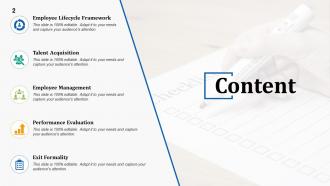
Folie 2 : Diese Folie trägt den Titel Inhalt, um Folgendes zu präsentieren: Rahmen für den Mitarbeiterlebenszyklus, Leistungsbewertung, Mitarbeitermanagement, Ausstiegsformalitäten, Talentakquise.
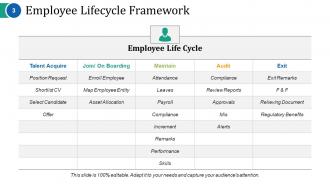
Folie 3 : Diese Folie zeigt das Employee Lifecycle Framework in tabellarischer Form.
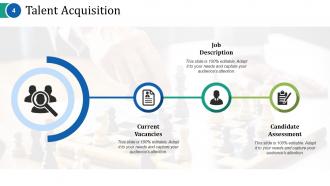
Folie 4 : Diese Folie zeigt die Talentakquise in Bezug auf - Aktuelle Stellen, Stellenbeschreibung, Kandidatenbewertung.
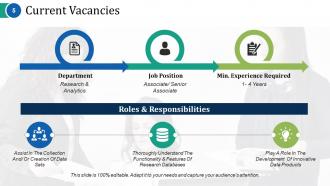
Folie 5 : Dies ist die Folie „Aktuelle Stellenangebote“ mit Symbolen und Pfeilbildern. Es zeigt- Abteilung, Job Position, min. Erforderliche Erfahrung, Es zeigt auch die Rollen und Verantwortlichkeiten.
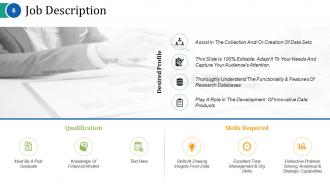
Folie 6 : Dies ist eine Stellenbeschreibungsfolie mit Qualifikation, erforderlichen Fähigkeiten, gewünschtem Profil.
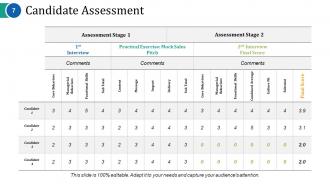
Folie 7 : Dies ist die Folie zur Kandidatenbewertung.
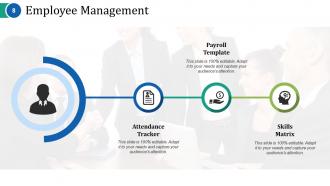
Folie 8 : Diese Folie zeigt die Mitarbeiterverwaltung mit Anwesenheitsverfolgung, Gehaltsabrechnungsvorlage, Qualifikationsmatrix.
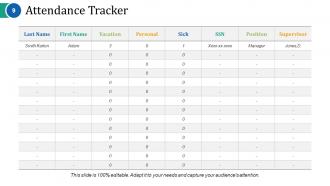
Folie 9 : Diese Folie zeigt den Anwesenheitstracker in tabellarischer Form.
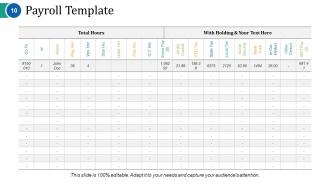
Folie 10 : Diese Folie präsentiert die Gehaltsabrechnungsvorlage.
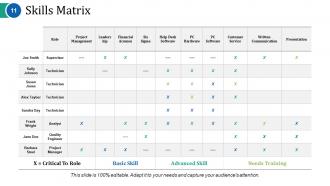
Folie 11 : Dies ist die Folie der Skills-Matrix. Präsentieren Sie hier Ihre Fähigkeiten in einer Matrixform.
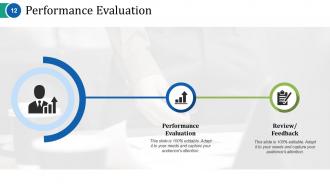
Folie 12 : Dies ist eine Leistungsbewertungsfolie mit Überprüfung/Feedback, Leistungsbewertung.
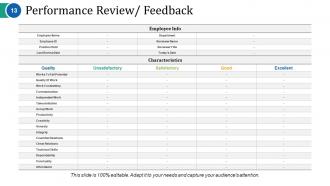
Folie 13 : Dies ist eine Folie zur Leistungsbewertung/Feedback. Hier können Sie Mitarbeiterinformationen und -merkmale angeben.
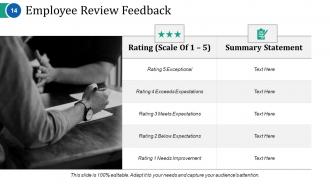
Folie 14 : Diese Folie zeigt das Feedback zur Mitarbeiterbewertung.
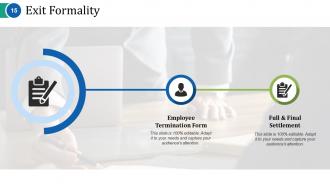
Folie 15 : Diese Folie zeigt die Austrittsformalitäten mit dem Arbeitnehmer-Kündigungsformular, die vollständige und endgültige Abrechnung.
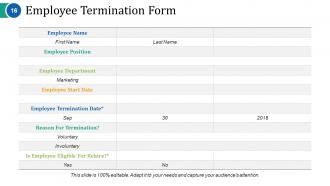
Folie 16 : Diese Folie zeigt das Kündigungsformular für Mitarbeiter mit Details.
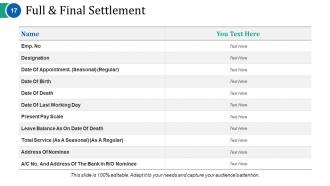
Folie 17 : Diese Folie zeigt die vollständige und endgültige Abrechnung in tabellarischer Form.
Folie 18 : Dies ist die Folie zu HR-Modellsymbolen. Verwenden/ändern Sie die Symbole gemäß Ihren Geschäftsanforderungen.
Folie 19 : Diese Folie trägt den Titel Zusätzliche Folien, um vorwärts zu gehen. Sie können den Folieninhalt nach Bedarf ändern.
Folie 20 : Diese Folie ist ein Kaffeepause-Bild für eine Pause. Sie können das Bild auf der Grundlage Ihrer Anforderungen ändern / ändern.
Folie 21 : Dies ist eine Vision & Mission-Folie. Staatsauftrag, Vision etc. hier.
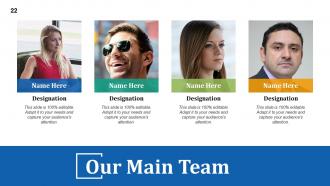
Folie 22 : Diese Folie zeigt unser Hauptteam mit Namen und Bezeichnung.
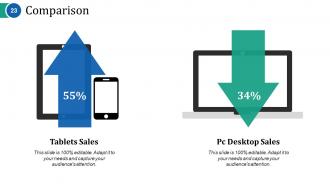
Folie 23 : Dies ist eine Vergleichsfolie, um zwei Produkte/Entitäten usw. zu vergleichen.
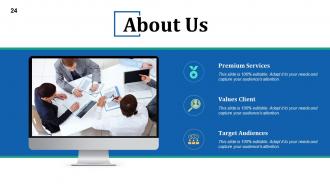
Folie 24 : Dies ist eine Über uns-Folie, die unser Unternehmen, unsere Value Client- und Premium-Dienste als Beispiele zeigt.
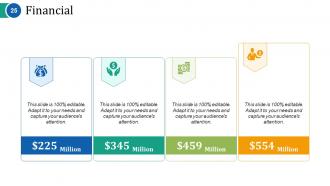
Folie 25 : Dies ist eine Folie zur Finanzbewertung, die hier die finanziellen Aspekte zeigt.
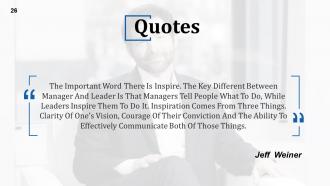
Folie 26 : Dies ist eine Zitate-Folie, um Botschaften, Überzeugungen usw.
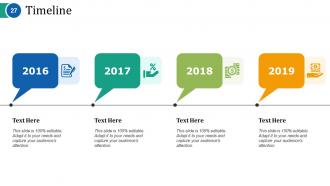
Folie 27 : Diese Folie stellt eine Zeitleiste dar, um Wachstum, Meilensteine usw.
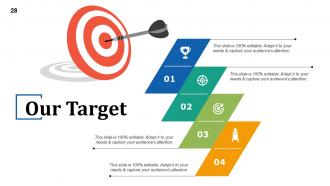
Folie 28 : Dies ist unsere Zielfolie mit Bildern. Geben Sie hier Ihre Ziele, Ziele etc. an.
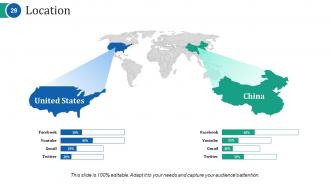
Folie 29 : Dies ist eine Standortfolie auf einem Weltkartenbild, um die globale Präsenz, das Wachstum usw.
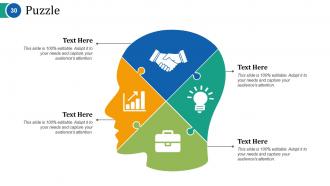
Folie 30 : Dies ist eine Puzzle-Folie mit kreativen Bildern, um Informationen, Spezifikationen usw.
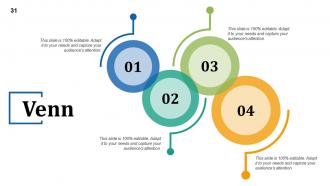
Folie 31 : Dies ist eine Venn-Diagramm-Folie zum Anzeigen von Informationen usw.
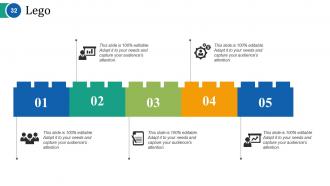
Folie 32 : Dies ist eine LEGO-Folie mit Textfeldern, um Informationen, Spezifikationen usw. anzuzeigen.
Folie 33 : Dies ist eine Silhoutte-Folie, um personenbezogene Informationen usw. anzugeben.
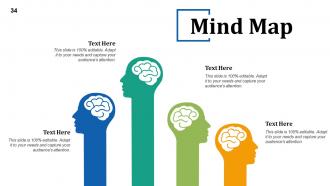
Folie 34 : Dies ist eine Mindmap-Bildfolie zur Anzeige von Informationen, Spezifikationen usw.
Folie 35 : Dies ist eine Ideen- oder Bulb-Bildfolie, um Informationen, innovative Aspekte usw. zu zeigen.
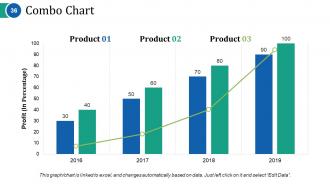
Folie 36 : Dies ist ein Kombinationsdiagramm zum Darstellen von Produkt-/Einheitsvergleichen, Spezifikationen usw.
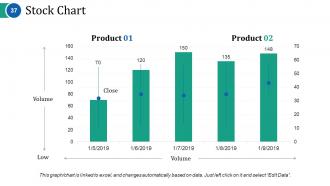
Folie 37 : Diese Folie zeigt ein Aktiendiagramm, um einen Produkt-/Unternehmensvergleich, Spezifikationen usw. zu präsentieren.
Folie 38 : Dies ist eine Dankesfolie mit Adresse# Hausnummer, Stadt, Bundesland, Kontaktnummern, E-Mail-Adresse.
Hr Model Powerpoint Präsentationsfolien mit allen 38 Folien:
Heben Sie den Beitrag wichtiger Elemente mit unseren Hr Model Powerpoint-Präsentationsfolien hervor. Identifizieren Sie die wesentlichen Elemente.



FAQs for Hr Model
Honestly, you need the basics first - talent acquisition, performance management, learning stuff, and keeping people engaged. Cover the whole employee journey, you know? HR analytics are huge too because numbers don't lie like our hunches do. Obviously compensation and benefits matter, plus culture and diversity work. But here's what I've noticed - the companies killing it focus on what employees actually want instead of just following some rigid process playbook. I'd start by figuring out what you're already doing right versus what you're just doing to say you did it.
Okay so here's the thing - your HR stuff has to actually match what the business wants to do. Growth mode? Go hard on recruiting and keeping people around. Cutting costs? Focus on making things more efficient. Most HR teams honestly just do their own thing and then get confused when executives don't care about their initiatives. It's kinda obvious when you think about it. Talk to your business leaders first. Figure out their top priorities - like maybe 3 to 5 things they're really focused on. Then rebuild your whole HR plan around those goals instead.
Dude, HR tech has completely exploded lately. AI tools now screen resumes automatically, and there's software that can actually predict which employees might quit. Most companies use HRIS platforms for payroll and benefits stuff, plus chatbots handle basic questions around the clock. Learning management systems are huge for training too. Oh, and those employee engagement apps that constantly survey people about their feelings? Those are everywhere now - though honestly some feel a bit much. The trick isn't grabbing every new shiny tool. Focus on what'll actually fix your real problems first.
Your company culture is basically the blueprint for everything HR does. Hierarchical places? They'll have tons of approval layers and rigid policies. Startups usually go the opposite way - loose and fast, though honestly that sometimes comes back to haunt them later. Team-focused cultures do group performance reviews and let people bounce between departments. Competitive environments are all about individual numbers and rankings. The trick is matching your HR stuff to what your culture actually rewards. Otherwise you're just fighting yourself, which is exhausting for everyone.
So you'll need both people stuff and business impact numbers to really see what's working. Employee retention, how long it takes to fill roles, satisfaction surveys - that kind of thing. Then track revenue per employee and productivity too. Honestly though, it totally depends what you're actually trying to fix. Scaling issues? Retention problems? Pick like 3-4 metrics that match your biggest headaches and stick with those. I'd probably start with retention since that's usually where the money bleeds out first, but you know your situation better than I do.
Honestly, just weave D&I straight into your existing HR processes instead of treating it as some separate thing. Build diverse sourcing and bias training right into hiring. Do the same for performance reviews and promotions - make it automatic. Way better than crossing your fingers that managers will remember to be inclusive (spoiler: they won't). Track metrics at every step so you can spot problems early. The whole point is making it systematic rather than relying on good vibes. It actually works when it's built into the foundation instead of slapped on top.
Honestly, getting people to actually use the new system is the hardest part. Everyone says they want change until it messes with their daily routine - then suddenly they're "too busy" to learn it. Leadership buy-in is huge too, because without it you're basically screwed from day one. Data migration always takes twice as long as planned (learned that the hard way), and training? Forget whatever timeline you had in mind. Oh, and if you don't explain the "why" really well, people will find creative ways to work around your shiny new process. Start small with a pilot group and celebrate the early wins loudly.
Look, feedback is literally your cheat sheet for fixing whatever's busted in HR. Run surveys, do exit interviews, just chat with people - you'll start seeing patterns everywhere. Like when everyone keeps griping about the same terrible performance review process or new people getting lost trying to figure out benefits (seriously, why is benefits enrollment always so confusing?). The trick isn't collecting feedback though. It's actually doing something with it. Pick one thing that comes up over and over, then rebuild that whole piece around what people told you they need. Don't just gather input to check a box.
Look, your HR setup basically controls whether people give a damn about their jobs or not. It touches everything - hiring, promotions, pay, feedback, the whole nine yards. Good HR creates clear paths forward and fair systems that actually make sense. Bad HR? People mentally check out faster than you'd think. I've watched companies with garbage HR practices scratch their heads wondering why morale sucks. The trick is figuring out what your people actually want, not just copying what sounds impressive. Take a hard look at your current stuff - is it motivating people or slowly crushing their souls?
Honestly, it depends what you're measuring efficiency against. Centralized HR rocks for stuff like payroll and compliance - way more consistent and uses fewer people. Decentralized works better locally though. Those HR folks actually know what each department needs, so they don't have to ask permission for every little thing. I always think of it like... centralized is this smooth machine, but decentralized is more like having a bunch of quick boats that can pivot fast. Company size matters a ton here. How different are your teams from each other? That'll tell you which way to go.
Honestly, three big things are changing everything: AI doing the grunt work, hybrid setups being the new normal, and companies finally caring more about skills than fancy degrees. Most places I know are already using bots for first-round interviews - saves so much time. What's wild is how employee experience is suddenly getting the same attention as customer stuff. HR departments are going crazy with feedback tools and personalized learning paths. Oh, and internal mobility is massive now. People want to grow within companies instead of job-hopping constantly. You should probably look at what you're already doing versus what you're missing.
So basically, HR models help you stop panicking every time someone good leaves. You can actually plan ahead - map out who's ready for what role, figure out skill gaps before they bite you. Instead of scrambling when your best person quits (ugh, the worst), you'll have people in the pipeline already. Start by looking at what talent you've got now and which positions absolutely can't be empty. Then build development programs around your high-potential folks. Honestly, it beats the whole "promote whoever's left standing" approach most places use. Career pathing becomes way less of a guessing game too.
Honestly, remote work flips HR on its head. Forget about those casual coffee machine chats - you're building culture through screens now. The upside? You can hire talent from anywhere. Downside? Onboarding gets weird when everyone's in different time zones. Performance reviews need a complete overhaul since you can't just pop by someone's desk. Communication strategies have to be way more intentional. Oh, and don't get me started on compliance issues when your team spans multiple states. My advice? Look at what you're doing now and figure out what actually needs people in the same room. Spoiler: it's less than you think.
Honestly, you've gotta bake flexibility into your HR setup from day one. Make job roles that can stretch and shift when business changes - and cross-train people so they're not stuck in one box. Rigid hierarchies are the worst, I've watched companies completely freeze up because they can't adapt fast enough. Remote work policies, performance reviews, pay structures - all of it needs room to evolve. Oh, and set up regular check-ins with both employees and leadership to catch changes early. Start by looking at your current processes. What's creating the biggest slowdowns when you try to pivot?
Honestly, start by telling people WHY you're doing this - nobody likes surprises at work. Get your managers on board early since they'll be the ones selling it to their teams. I'd definitely test it with a small group first because trust me, you'll find problems you never saw coming. The training part is huge - don't skimp on support during the switch. Oh, and whatever timeline you think it'll take? Add like 30% more time lol. Set up regular feedback sessions too. Your original plan will probably need tweaks once reality hits.
No Reviews