

Human Resources Termination Report Dashboard





Try Before you Buy Download Free Sample Product
 Impress Your
Audience
 100%
Editable
 Save Hours
of Time


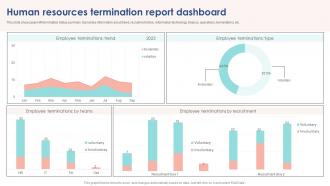
This slide showcases HR termination status summary. It provides information about trend, recruitment drive, information technology, finance, operations, terminations, etc.
People who downloaded this PowerPoint presentation also viewed the following :
Human Resources Termination Report Dashboard with all 7 slides:
Use our Human Resources Termination Report Dashboard to effectively help you save your valuable time. They are readymade to fit into any presentation structure.






FAQs for Human Resources
Human resources encompasses talent acquisition, employee development, performance management, compensation and benefits administration, and workplace culture development. These functions work together to enhance organizational effectiveness by attracting top talent, fostering employee engagement, and ensuring regulatory compliance, with many organizations finding that strategic HR practices ultimately deliver improved productivity and competitive advantage.
HR metrics improve decision-making and strategic planning by providing data-driven insights into workforce performance, employee engagement, turnover rates, recruitment effectiveness, and talent development outcomes. These analytics enable organizations to identify productivity patterns, optimize resource allocation, and predict future staffing needs, with many companies finding that strategic HR metrics ultimately deliver enhanced operational efficiency and competitive advantage.
Technology revolutionizes HR processes by automating recruitment, streamlining payroll management, enhancing employee engagement platforms, and enabling data-driven performance analytics. Through AI-powered applicant tracking systems and cloud-based HRIS platforms, organizations significantly reduce administrative burdens, accelerate hiring cycles, and improve employee experiences, ultimately delivering operational efficiency and strategic competitive advantage.
Organizations foster diversity and inclusion through comprehensive recruitment strategies, inclusive hiring practices, bias-free performance evaluations, diverse leadership development programs, and equitable compensation structures. These HR initiatives enhance workplace culture by creating psychological safety, expanding talent pools, and improving decision-making processes, with many companies finding that inclusive practices ultimately deliver better employee retention, innovation, and competitive advantage.
Best practices for effective talent acquisition include leveraging data-driven recruitment analytics, building strong employer branding, utilizing multiple sourcing channels, implementing structured interview processes, and creating compelling candidate experiences. These strategies enable organizations to attract top talent by streamlining hiring workflows, reducing time-to-fill metrics, and enhancing candidate engagement, with many companies finding that strategic talent acquisition delivers significant competitive advantage in securing skilled professionals.
HR can support employee engagement and motivation through comprehensive recognition programs, flexible work arrangements, professional development opportunities, transparent communication channels, and meaningful feedback systems. These strategic approaches enhance workplace satisfaction by fostering career growth, improving work-life balance, and creating collaborative environments, with many organizations finding that engaged employees deliver higher productivity, reduced turnover, and stronger business performance.
HR can implement strategies including mediation training for managers, structured conflict resolution protocols, neutral third-party interventions, active listening workshops, and clear escalation procedures. These approaches streamline workplace tensions by addressing issues early, fostering open communication, and creating transparent resolution pathways, with many organizations finding that proactive conflict management ultimately enhances team productivity and employee retention.
Employee training and development significantly enhances organizational performance by improving productivity, reducing turnover, and building essential skills that drive innovation and efficiency. Through strategic learning programs, companies across industries like healthcare, manufacturing, and financial services experience higher employee engagement, faster adaptation to market changes, and ultimately stronger competitive positioning with measurable ROI.
**INPUT**: What are the ethical considerations HR must keep in mind when managing employee data? **OUTPUT**: HR ethical considerations include data minimization, consent transparency, purpose limitation, security protection, and access controls when handling employee information. These principles streamline compliance with privacy regulations while building workforce trust, with many organizations finding that robust data governance enhances employee confidence, reduces legal risks, and ultimately delivers competitive advantage through ethical transparency. **Word count: 52 words**
HR creates a positive employer brand by showcasing authentic company culture, highlighting employee development opportunities, leveraging social media testimonials, offering competitive benefits packages, and maintaining transparent communication about values and mission. These strategies enable organizations to differentiate themselves in competitive talent markets, with many companies finding that strong employer branding reduces recruitment costs while attracting higher-quality candidates who align with organizational goals.
Remote work challenges for HR include maintaining employee engagement, ensuring consistent communication, managing performance evaluations, preserving company culture, and handling compliance across different locations. These obstacles can be addressed by implementing digital collaboration platforms, establishing regular virtual check-ins, creating structured remote performance metrics, and developing comprehensive remote work policies, ultimately enabling organizations to maintain productivity and employee satisfaction while reducing overhead costs.
HR can effectively manage generational differences by implementing flexible communication channels, customized professional development programs, mentorship initiatives that pair different generations, and adaptable work arrangements that accommodate varying preferences. Through strategic cross-generational collaboration projects, organizations enhance knowledge transfer, reduce workplace friction, and leverage diverse perspectives, ultimately creating more cohesive teams while maximizing each generation's unique strengths.
Performance management systems are crucial for HR as they align individual goals with organizational objectives, track employee progress, identify development needs, and facilitate fair compensation decisions. These systems enhance workforce productivity by providing regular feedback, enabling targeted training, and supporting succession planning, ultimately delivering improved employee engagement and retention while helping organizations maintain competitive advantage through optimized talent management.
HR navigates regional labor laws through comprehensive legal research, local employment law partnerships, standardized compliance frameworks, and regular policy audits. Many multinational organizations streamline this complexity by establishing regional HR centers, implementing automated compliance tracking systems, and maintaining relationships with local legal experts, ultimately ensuring consistent workforce management while minimizing regulatory risks across diverse jurisdictions.
HR can implement flexible work arrangements, personalized career development programs, continuous feedback systems, wellness initiatives, and recognition platforms to enhance retention. These approaches streamline employee engagement by addressing individual needs, fostering growth opportunities, and creating supportive work environments, with many organizations finding that strategic combinations of these methods ultimately deliver higher satisfaction rates and competitive talent advantages.
-
Amazing product with appealing content and design.
-
Thrilled to see several customizable templates catering various verticals and industries.