


Illness wellness continuum scale presentation slide powerpoint slide




Try Before you Buy Download Free Sample Product
 Impress Your
 Audience
 100%
100% Editable
 Save Hours
 of Time


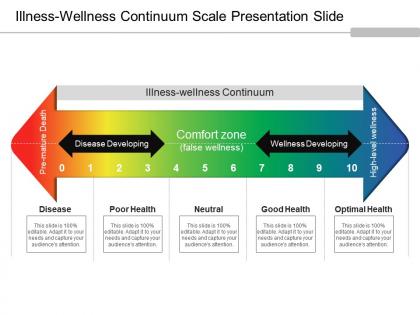
The illness wellness continuum design PowerPoint slide is a graphical illustration of concept related to wellbeing. The illness wellness continuum scale template helps a user to propose wellbeing which includes mental as well as emotional health, along with the presence or absence of illness. A presenter can use the continuum medical approach presentation template to demonstrate that the presence or absence of disease symptoms for describing wellness was insufficient and in the right side of the template it reflects degrees of wellness, whereas the left side reflects degrees of illness. The illness wellness continuum model slide for PowerPoint is useful to describe how, in physical disease absence, a person may suffer from anxiety, depression, or other mental conditions. The illness wellness continuum measure PPT slide is useful in demonstrating concept related to wellbeing such as it is a dynamic process, not a static process. The illness wellness continuum concept template is helpful in proposing that an individual can move farther to the right, or towards greater health as well as wellbeing, passing through various stages such as awareness, education, and growth. Conduct events that favor cultural exchange with our Illness Wellness Continuum Scale Presentation Slide Powerpoint Slide. Insist on interracial interaction.
People who downloaded this PowerPoint presentation also viewed the following :
Illness wellness continuum scale presentation slide powerpoint slide with all 5 slides:
Add to the joie-de-vivre with our Illness Wellness Continuum Scale Presentation Slide Powerpoint Slide. Enable folks to feel a bit carefree.

FAQs for Illness wellness continuum scale presentation
There's a bunch of stuff that affects where you sit on that wellness scale. Sleep, what you eat, how much you move - the basics matter a ton. But honestly, your mental game is just as crucial. Stress levels, whether you've got solid friendships, even how you think about things. Oh, and your environment counts too - like if you're breathing crappy air or can actually get to a doctor when needed. Sure, genetics play a part (thanks, family), but most of the time it's your daily choices that really move the needle. I'd pick one thing to work on first though. Maybe start with sleep? It's easier than overhauling everything at once.
So basically, you're not just waiting around for people to get sick anymore - you're actually trying to keep them healthy in the first place. Pretty obvious when you think about it, but somehow we got stuck in this weird reactive mode for decades. Each patient needs different stuff depending where they fall on the spectrum. Some need serious medical intervention, others just need help with lifestyle changes or wellness coaching. You catch problems way earlier this way. Plus patients actually start caring about their own health instead of expecting you to fix everything. Honestly, try plotting your current patients on it and see what jumps out.
Your daily habits are honestly what make or break your health - sleep, what you eat, moving your body, how you handle stress, all that stuff. Can't just pop vitamins and expect miracles if you're living off energy drinks and three hours of sleep, you know? But here's what works: start stupidly small. Like ridiculously small. Maybe just commit to one 10-minute walk or actually getting to bed by 11pm. Those tiny changes add up way faster than you'd think. Don't try to flip your whole life overnight - I've tried that and it never sticks.
It really depends where they're starting from, you know? Someone who's struggling with illness needs medical help and therapy first - plus basic stuff like decent sleep and eating right. People in the middle benefit from stress management and building good habits. Those already doing well can focus on fitness, mindfulness, connecting with others. Honestly, the biggest mistake is mismatching the intervention to where someone actually is. You can't throw a marathon training plan at someone who barely has energy to shower. Small steps that actually feel doable - that's what builds momentum.
So mental and physical health are basically joined at the hip - seriously, you can't have one without the other affecting it. Like when you're stressed out, you'll literally get headaches or your stomach goes crazy. And chronic pain? That'll mess with your head big time, often leading straight to depression. I've watched so many coworkers burn out and their whole body just falls apart along with their mental state. The wellness continuum thing makes total sense because both sides move together. Oh, and here's what I've learned - if you're trying to get healthier, you gotta work on both at once or you're just fighting an uphill battle.
Honestly, start small or you'll burn out trying to track everything. I've been obsessed with my sleep data lately - fitness trackers are great for that plus heart rate stuff. Mood tracking apps help you spot patterns too, which is weirdly satisfying. Don't just focus on the physical stuff though. Telehealth check-ins are pretty convenient if you can swing them. Oh, and there are nutrition apps that actually don't suck now. Pick like two things you genuinely care about first. The data's only useful if you'll actually look at it, you know?
Your support system basically determines which direction you're headed on the wellness scale. Good relationships? You'll bounce back from stress easier and actually stick to healthy habits. Bad ones drag you down fast - I swear toxic people are like energy vampires. Plus when you're going through rough patches, having someone to lean on makes all the difference. My friend Sarah's cancer journey really showed me this. Build those connections now though, not when crisis hits. Short bursts work too - even texting someone regularly counts.
So basically, instead of just waiting for flare-ups to happen, you're constantly trying to move patients toward the healthier end of things. Prevention becomes huge - diet changes, exercise, stress management, all that stuff. Honestly, it's way better than playing catch-up all the time. Patients start catching problems early and get better at managing their own care. Even with chronic conditions, people can still optimize where they sit on the wellness side through medication adherence and lifestyle tweaks. My sister's diabetes management totally changed once her doctor started thinking this way - she's doing so much better now.
Honestly, visual stuff works wonders here. Most people think you're either sick or healthy - that's it. But there's actually this whole spectrum, you know? I always ask patients first to describe how they're feeling energy-wise, mood, physical stuff. Then show them where that fits on the continuum from illness all the way to peak wellness. They get it so much faster when they can actually see it mapped out. Give real examples of what each level looks like day-to-day. Small steps feel way less overwhelming than "get healthy" - that's too vague and intimidating.
Look, you've gotta tackle the whole wellness thing, not just wait for people to burn out. Mental health days, flexible schedules, stress workshops - all that prevention stuff matters way more than most companies realize. Then back it up with solid EAPs and benefits for when people do need help. Make wellness talks totally normal, not weird and awkward. Here's the thing though - I've watched so many places bomb because they only focus on crisis mode. Train your managers to spot warning signs early. Build those peer networks. And honestly? Leadership has to actually walk the walk - like, really take their vacation days instead of just preaching about work-life balance.
Your cultural background totally changes how you think about health. Like, some cultures focus mainly on physical stuff - if you're not sick, you're healthy. Others care just as much about mental wellness, spirituality, or even family harmony. I've noticed collectivist cultures especially see family relationships as part of personal health, which Western doctors often miss completely. There's also the whole individual vs. community thing - do you fix yourself or does your support system help? It really affects how people view pain, mental health, prevention, all of it. Always ask clients about their beliefs instead of assuming they think like you.
Honestly, think of preventive care like maintaining your car - you wouldn't skip oil changes and then act surprised when your engine dies, right? Regular check-ups and screenings catch problems before they become huge expensive nightmares. My doctor always says it's way easier to prevent diabetes than treat it later. Plus vaccinations literally stop diseases in their tracks. I know it feels pointless going to the doctor when you feel fine, but that's actually the perfect time. You're staying ahead of problems instead of playing catch-up. Don't skip those yearly visits!
Honestly, just check in with yourself across different areas - not just "am I sick" but like, do I actually have energy or am I just surviving? How are my relationships? Am I excited about anything or just going through the motions? Your spot on this spectrum changes constantly too, which is totally normal. Stress, life stuff, even seasons affect where you land. I do a quick mental check monthly - rate yourself 1-10 on energy, emotions, social life, whatever matters to you. Sounds cheesy but it actually helps you notice patterns. Pick one or two areas to track this week and see what comes up.
Oh man, the National Wellness Institute has some really solid stuff on this - they do workshops and guides that actually make sense of the whole model. I'd start with one of those quick online assessments first though, just to see where you're at. The Wellness Council of America has interactive tools that are pretty decent too. Most academic health centers put out free webinars about it, which is cool. Then once you know your baseline, you can dig into whatever areas need work. Side note - why don't more companies actually use this framework? Seems like a no-brainer.
Honestly, policy changes can totally flip how communities approach health - instead of just fixing problems after people get sick, we start preventing them. Think funding for wellness programs, health classes in schools, better housing policies. The zoning thing is actually pretty smart too - walkable neighborhoods, fewer fast food places near schools. Mental health, physical health, community stuff all gets treated as one thing instead of separate issues. I'd start by looking at what your local policies do now (probably just treating illness) and push for more well-rounded approaches. It's way more effective than playing catch-up later.
-
Unique and attractive product design.
-
Best way of representation of the topic.