

Incident Investigation Powerpoint Ppt Template Bundles





Try Before you Buy Download Free Sample Product
 Impress Your
 Audience
 100%
100% Editable
 Save Hours
 of Time


Embark on a comprehensive exploration of incident resolution with our insightful PPT on Incident Investigation. Uncover effective Incident Investigation Techniques, empowering your team with the skills needed for meticulous analysis. Navigate Workplace Incident Response seamlessly, understanding the critical steps in incident reporting procedures. Delve into the intricacies of Incident Analysis, enhancing your incident management capabilities to ensure a swift and effective response. This presentation is your guide to fostering a culture of safety and resilience within your organization. Whether you are addressing occupational incidents or honing incident prevention strategies, our Incident Investigation PPT equips you with essential knowledge for proactive and effective incident resolution. Elevate your incident response procedures and fortify your organization against future challenges.
People who downloaded this PowerPoint presentation also viewed the following :
Content of this Powerpoint Presentation
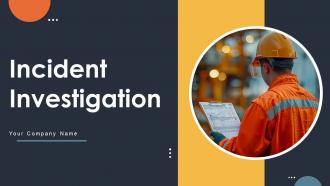
Slide 1: This slide introduces Incident Investigation. State your company name and begin.
Slide 2: This slide represents various methods that assist manufacturing companies to analyze and investigate incidents effectively and develop event safety measures.
Slide 3: This slide presents composition of incident investigation team that assist companies to enhance their risk management with roles and responsibilities.
Slide 4: This slide represents checklist that assist manufacturing companies to conduct effective workplace incident investigation for risk mitigation.
Slide 5: This slide presents various best practices that helps manufacturing companies to enhance their incident investigations and upgrade risk management.
Slide 6: This slide represents incident investigation report that assist companies to document incidents and use them for future risk management.
Slide 7: This slide presents flowchart that assists mining companies to implement incident investigation to identify event severity and take corrective measures.
Slide 8: This slide represents steps that assist manufacturing companies to conduct an effective incident investigation for identifying reasons and take corrective measures.
Slide 9: This slide present employee training schedule for IT companies that assist them to enhance their employee skills in cybersecurity incident analysis and investigation.
Slide 10: This slide represents various tools that assist IT companies in conducting digital forensics to analyze and investigate data breach incidents effectively.
Slide 11: This slide presents incident investigation and management flowchart that assist companies to resolve event by taking corrective measures.
Slide 12: This slide represents various techniques that assist investigator to collect relevant data on incident through worker interviews.
Slide 13: This slide presents action plan that assist construction companies to investigate incident on site and take corrective measure for enhancing workers safety.
Slide 14: This slide represents Incident investigation icon for effective root cause analysis.
Slide 15: This slide presents Cybersecurity incident investigation icon to enhance data protection.
Slide 16: This slide represents Incident investigation icon for enhancing patient safety.
Slide 17: This is a Thank You slide with address, contact numbers and email address.
Incident Investigation Powerpoint Ppt Template Bundles with all 25 slides:
Use our Incident Investigation Powerpoint Ppt Template Bundles to effectively help you save your valuable time. They are readymade to fit into any presentation structure.










FAQs for Incident Investigation Powerpoint
First thing - lock down that scene before anything gets moved around. Interview witnesses separately because honestly, you'll be amazed how different their stories are. Document literally everything and build a timeline while it's all fresh. Don't just look at the obvious stuff though. Yeah, someone might've messed up, but dig into why your systems let it happen. What processes failed? That's where the real answers are hiding. Skip the quick fixes and go after root causes instead. Otherwise you're just putting a band-aid on it and waiting for round two.
Honestly, you've gotta stop looking at just the obvious stuff and keep asking "why" until you find what's actually broken. Gather your facts first - don't just blame whoever screwed up last time (though I get the urge lol). Try that "5 Whys" thing or those fishbone diagrams to trace everything backwards. Here's the key though - focus on fixing the process, not pointing fingers at people. That's where real solutions live. Write it all down too, because I guarantee you'll see the same mess pop up again later and you'll want those notes.
Look, data collection is honestly everything when you're investigating something. Grab witness statements, system logs, photos, timestamps - basically anything you can find. Cast a wide net right away while everything's still fresh in people's minds. You can always sort through irrelevant stuff later, but once data disappears, it's gone for good. The thing is, what people *think* happened and what actually happened are usually pretty different (learned that the hard way). More data means you'll see the real picture instead of just guessing at what went wrong. Without it, you're shooting in the dark.
Pick one person to handle all communication right off the bat - seriously, multiple people giving updates just confuses everyone. Give regular updates even when there's not much to report yet. Document everything you say and when you said it. This saves you from awkward "wait, didn't we already cover this?" moments later. Be honest about what you actually know vs. what you're still investigating. Oh, and make sure you're looping in the right people at each stage - some folks need daily check-ins while others just want the final summary.
Dude, don't jump to conclusions before you've got the full picture - that's like investigation 101. Also resist the urge to blame people right away because then nobody will talk to you. Get multiple perspectives instead of trusting just one person's story. Map out what actually happened first, then dig into the details. Document everything as you go (boring but necessary). Here's the thing though - focus on broken processes, not individual screwups. You're trying to prevent this mess from happening again, not ruin someone's day. Trust me, the blame game kills investigations faster than anything.
Definitely talk to witnesses ASAP - their memories get fuzzy super quick. Get everyone who was around, not just the obvious ones. Sometimes random people notice stuff the main players totally miss. Focus on what they actually saw, not their theories about why it happened (people love to speculate, but that's not helpful right now). Document everything properly so you have it later. Oh, and don't let them compare notes beforehand - you want their raw first impressions, not some group consensus version of events.
Start with log aggregation - Splunk or ELK stack work great. Monitoring platforms like Datadog or New Relic are crucial too. For distributed tracing, Jaeger's solid. Look, centralizing your logs somewhere searchable is like 80% of the battle - can't debug what you can't see, right? Communication tools matter too (Slack works), plus incident management stuff like PagerDuty. Oh, and basic network analyzers and database query tools. I learned this the hard way, but seriously get your logging infrastructure right first. Everything else builds on that foundation.
Look, regulations are basically your roadmap for investigations - they tell you your deadlines, what paperwork you need, who has to be involved, all that stuff. OSHA's the worst about this - they want investigations done within 8 hours for serious incidents, which honestly feels brutal when everything's falling apart. Each industry has its own compliance hoops to jump through too. The trick is baking all these requirements into your normal process from the start. That way you're not running around like crazy trying to hit deadlines when something actually goes wrong. Trust me on this one.
First thing - get a facilitator who wasn't involved in the mess. Trust me on this one, it makes a huge difference. Have everyone map out the timeline together instead of pointing fingers (that kills any chance of actual teamwork). Make sure people feel safe to speak up without getting blamed. Do it over video if you can - texting back and forth just misses too much context. Oh, and start by saying you're there to learn together, not hunt down who screwed up. Frame it right from the beginning and you'll actually get somewhere useful.
Honestly, just stick to the facts and don't assume anything yet. Get info from everywhere - talk to people, grab documents, look at physical stuff. I always have someone double-check my work because we miss things, you know? Oh and don't ask leading questions when you're interviewing people - that'll mess everything up. Document it all super objectively. Politics and personal drama will totally cloud your judgment if you let them. The real trick is figuring out what actually went down versus what everyone *thinks* happened. Before you wrap up, just ask yourself: what proof do I actually have for this conclusion?
So there are a few things I'd track to see if your investigations actually work. First - are you getting repeat incidents? Same problems popping up means you're not hitting the real root cause. Also check your time-to-resolution because honestly, some teams just analyze forever and never fix anything (super frustrating). Track how many recommendations you actually complete vs. the ones that just sit in a folder somewhere. Are incidents getting less severe? That's a good sign. Maybe survey your team too - they'll tell you if the process sucks. But really, incident frequency should drop if you're doing this right.
Look, you gotta be super specific about who's doing what and by when. Skip the vague "we'll improve training" nonsense - I've watched way too many of these turn into expensive paperweights. Map each root cause to actual measurable steps with real deadlines. What training exactly? Which people? What date? Bucket everything into quick wins, system overhauls, and long-term stuff. Focus on the actual failure points you found, not the obvious things everyone's already talking about. Here's the real test though - could some random person grab your plan months later and instantly know what should've happened? That's how you know it's solid.
Look, fairness and keeping things confidential should be your top priorities here. I know it's tempting to jump to conclusions - we all do it - but try not to let your gut feelings take over before you've actually investigated. Everyone deserves respect and privacy during this mess. Be upfront about how you're handling things and what you find, but honestly? Sometimes it's the system that's broken, not just one person screwing up. Write down everything objectively and focus on what you can learn from this rather than who to blame. Most importantly, people need to feel safe telling you what really went down without worrying about getting thrown under the bus later.
Honestly, it all comes down to whether your workplace punishes people for screwing up. If everyone's scared of getting blamed, you'll just get watered-down reports that don't tell you anything useful - classic CYA mode. But when people feel safe admitting mistakes? That's when you get the real story. Teams will dig deeper and actually share what went wrong instead of dancing around it. I've seen it happen both ways, and the difference is night and day. Build that "let's learn from this" vibe instead of pointing fingers everywhere.
Start with a solid incident investigation course - you'll learn the 5 Whys, fishbone diagrams, all that foundational stuff. Interview skills are critical since people get weird and defensive after accidents happen. Documentation training helps too so you don't mess up evidence collection. Oh, and human factors training is honestly a game-changer - once you understand why people screw up under pressure, investigations make way more sense. Basic legal awareness is smart so you know what stays confidential. My cousin did maritime investigations and said that part saved his butt multiple times. Build everything else around your industry's specific risks.
-
Eye-catching PPT designs, outstanding team, and best customer service. I’m a super satisfied customer here!
-
Editable, diversified, compatible with MS PPT and Google Slides, and on top of that finest graphics!! I mean in the words of the famous Ross Geller, “What more do you want!”