


Incident Report Powerpoint Ppt Template Bundles Incident Management





Try Before you Buy Download Free Sample Product
 Impress Your
 Audience
 100%
100% Editable
 Save Hours
 of Time


Our Incident Report Powerpoint Ppt Template Bundles Incident Management are topically designed to provide an attractive backdrop to any subject. Use them to look like a presentation pro.
People who downloaded this PowerPoint presentation also viewed the following :
Content of this Powerpoint Presentation
Slide 1: This slide introduces Incident Report. State your company name and begin.
Slide 2: This slide represents process to write effective workplace incident report which includes steps such as incident identification, information collection, analysis and evaluation, etc.
Slide 3: This slide represents various best practices to write an effective incident report which includes supporting evidence, collecting facts, and collecting data from witnesses.
Slide 4: This slide represents various components of IT incident report which includes summary, timeline, root cause, resolution and recovery, etc.
Slide 5: This slide represents various incident report writing software which includes features such as customizable templates, digital forms, multimedia support, etc.
Slide 6: This slide represents training plan for managers to write effective incident report which includes elements such as sessions, durations, trainer, mode, etc.
Slide 7: This slide represents various challenges of writing an effective report writing which includes incomplete information, subjectivity, and time constraints.
Slide 8: This slide represents report form of general staff incident which includes elements such as employee explanation, witness, and actions taken.
Slide 9: This slide represents report form for network security incident which includes elements such as type of security incident, data sensitivity, etc.
Slide 10: This slide represents form for cybersecurity incident reporting which includes elements such as incident details, incident impact, etc.
Slide 11: This slide represents incident report for workplace employee injury which includes elements such as incident description, injured person information, etc.
Slide 12: This slide represents report form for construction site incident which includes elements such as incident details, incident cause, photo of incident, etc.
Slide 13: This slide represents form of banking customer incident report which includes components such as incident details, customer information, etc.
Slide 14: This slide represents incident report form for workplace security which includes elements such as incident details, type of incident, severity level.
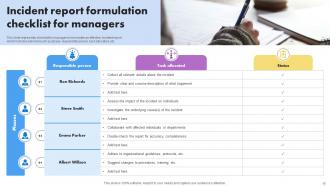
Slide 15: This slide represents checklist for managers to formulate an effective incident report which includes element such as phase, responsible person, task allocated, etc.
Slide 16: This slide represents form for companies to report environmental incident which includes elements such as incident details, actions taken, etc.
Slide 17: This slide represents plan for writing incident report which includes event types, details, person responsible, etc.
Slide 18: This slide represents incident report form for healthcare institutes which includes elements such as incident details, action plan, recommendation, etc.
Slide 19: This slide shows Chemical spill incident report icon.
Slide 20: This slide presents Environmental incident report writing icon.
Slide 21: This slide displays Customer incident report analysis icon.
Slide 22: This slide represents Construction safety incident report icon.
Slide 23: This is a Thank You slide with address, contact numbers and email address.
Incident Report Powerpoint Ppt Template Bundles Incident Management with all 31 slides:
Use our Incident Report Powerpoint Ppt Template Bundles Incident Management to effectively help you save your valuable time. They are readymade to fit into any presentation structure.















FAQs for Incident Report Powerpoint Ppt Template
The incident management lifecycle includes incident identification, logging and categorization, initial assessment and prioritization, investigation and diagnosis, resolution and recovery, and closure with documentation. These stages streamline organizational response by enabling faster detection, systematic troubleshooting, and coordinated recovery efforts, with many enterprises finding that structured processes significantly reduce downtime, minimize business impact, and enhance overall service reliability.
Effective communication improves incident response times by establishing clear escalation protocols, utilizing real-time collaboration tools, and ensuring stakeholder visibility throughout resolution processes. Through centralized communication platforms and automated notifications, organizations streamline coordination between technical teams, management, and affected departments, ultimately reducing mean time to resolution while enhancing transparency and minimizing business disruption.
Documentation serves as the foundation for effective incident management, capturing incident details, response actions, timelines, root causes, and resolution steps. This comprehensive record-keeping enables organizations to conduct thorough post-incident reviews, identify recurring patterns, and develop preventive measures, while ensuring knowledge transfer and compliance requirements are met, ultimately delivering improved response times and organizational resilience.
**INPUT**: How do we measure the success of an incident management process? **OUTPUT**: Incident management success is measured through mean time to resolution, incident volume trends, customer satisfaction scores, first-call resolution rates, and service level agreement compliance. These metrics streamline operational efficiency by identifying process bottlenecks, enhancing response capabilities, and minimizing business disruption, with many organizations finding that comprehensive measurement ultimately delivers improved customer experiences and reduced operational costs.
Common incident management challenges include delayed detection, poor communication between teams, insufficient documentation, unclear escalation procedures, and inadequate post-incident analysis. These issues often result from siloed departments, manual processes, and lack of standardized workflows, with many organizations finding that implementing automated monitoring tools and cross-functional incident response teams significantly reduces resolution times.
Technology streamlines incident management through automated alert systems, AI-powered threat detection, real-time collaboration platforms, and predictive analytics tools. These solutions enable organizations to reduce response times, minimize downtime, and enhance coordination between teams, with many enterprises finding that automated workflows and intelligent routing ultimately deliver faster resolution and improved operational efficiency.
Critical skills for effective incident management teams include technical troubleshooting, clear communication, analytical problem-solving, stress management, and cross-functional collaboration. These competencies enable teams to quickly diagnose issues, coordinate response efforts, and maintain stakeholder confidence during disruptions, with many organizations finding that combining technical expertise with strong communication skills ultimately delivers faster resolution times and improved customer satisfaction.
Incident management integrates seamlessly with ITSM by aligning with problem management, change management, and configuration management processes to ensure comprehensive service delivery. Through shared databases and standardized workflows, organizations streamline resolution times, enhance service quality, and maintain operational efficiency, with many IT departments finding that integrated ITSM frameworks ultimately deliver faster incident response and improved customer satisfaction.
Categorizing and prioritizing incidents enables organizations to allocate resources efficiently, ensure critical issues receive immediate attention, and maintain service level agreements across different business functions. This systematic approach streamlines response times, minimizes operational disruptions, and enhances customer satisfaction by addressing high-impact incidents first, ultimately delivering improved service reliability and strategic operational control.
Organizations ensure continuous improvement in incident management through regular post-incident reviews, metrics analysis, process refinement, staff training, and technology upgrades. By conducting thorough retrospectives, tracking key performance indicators like resolution times, and implementing lessons learned, companies across sectors like healthcare and financial services enhance their response capabilities, reduce downtime, and ultimately deliver more resilient operations.
Common incident management frameworks include ITIL (Information Technology Infrastructure Library), NIST Cybersecurity Framework, ISO 27035, and PCI DSS incident response standards, along with industry-specific guidelines. These frameworks streamline response processes by establishing clear escalation procedures, standardized documentation protocols, and systematic recovery workflows, with many organizations finding that structured approaches reduce downtime, improve communication across teams, and ultimately deliver faster resolution times and enhanced operational resilience.
**INPUT**: How do we handle incidents that escalate beyond initial response? **OUTPUT**: Escalated incidents require structured escalation protocols, expanded response teams, senior management involvement, enhanced communication channels, and additional resource allocation. Organizations like hospitals and financial institutions implement tiered response frameworks that automatically trigger broader stakeholder engagement, cross-functional coordination, and executive decision-making authority, ultimately ensuring faster resolution and minimized business impact.
Training plays a crucial role in incident management by ensuring teams can quickly identify threats, execute response protocols, and minimize downtime through structured procedures. Through regular simulations and skills development, organizations in sectors like healthcare, financial services, and manufacturing enhance response times, improve coordination between departments, and ultimately reduce operational disruptions while maintaining customer trust.
Organizations should track mean time to detection, mean time to resolution, incident volume trends, escalation rates, and customer impact scores to evaluate incident handling effectiveness. These metrics enable businesses to identify bottlenecks, optimize response procedures, and enhance service reliability, with many finding that comprehensive tracking ultimately delivers improved operational efficiency and stronger customer satisfaction across their service delivery.
Incident management processes align with business continuity plans by establishing clear escalation protocols, defining recovery time objectives, and integrating communication channels across both frameworks. This strategic combination enables organizations to seamlessly transition from incident response to continuity operations, ultimately minimizing downtime and ensuring critical business functions remain operational during disruptions.
-
Unique research projects to present in meeting.
-
Happy to incorporate such stunning templates in my presentation. Made my presentation look professional and engaging.