

Information Technology Security Compliance Dashboard Snapshot For Information Technology Security




Try Before you Buy Download Free Sample Product
 Impress Your
Audience
 100%
Editable
 Save Hours
of Time


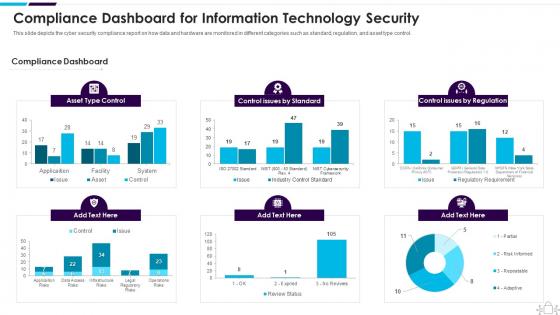
This slide depicts the cyber security compliance report on how data and hardware are monitored in different categories such as standard, regulation, and asset type control.
People who downloaded this PowerPoint presentation also viewed the following :
Information Technology Security Compliance Dashboard Snapshot For Information Technology Security with all 7 slides:
Use our Information Technology Security Compliance Dashboard Snapshot For Information Technology Security to effectively help you save your valuable time. They are readymade to fit into any presentation structure.







FAQs for Information Technology Security Compliance Dashboard Snapshot For
Key regulations governing IT security compliance include GDPR for data protection, HIPAA for healthcare information, SOX for financial reporting, PCI DSS for payment data, and FISMA for federal systems. These frameworks enhance organizational security by establishing standardized protocols, mandatory audit requirements, and comprehensive risk management procedures, with many enterprises finding that strategic compliance ultimately delivers competitive advantage and customer trust in an increasingly regulated digital landscape.
Organizations assess their current IT security compliance status through comprehensive audits, gap analyses, vulnerability assessments, policy reviews, and third-party evaluations against established frameworks like ISO 27001, NIST, or SOC 2. These assessments enable companies to identify security weaknesses, regulatory gaps, and operational vulnerabilities, while establishing baseline measurements for continuous improvement, ultimately delivering enhanced risk management and stronger regulatory positioning.
Risk management serves as the foundation for IT security compliance by identifying vulnerabilities, assessing potential threats, prioritizing security investments, and establishing mitigation strategies across organizational systems. Through comprehensive risk frameworks, organizations streamline compliance efforts, enhance threat detection capabilities, and minimize regulatory violations, with many financial institutions and healthcare providers finding that proactive risk management ultimately delivers stronger security postures and reduced audit complexities.
Businesses should conduct IT security compliance audits annually at minimum, with quarterly assessments for high-risk sectors and monthly monitoring for critical systems like payment processing and healthcare data. Financial institutions and healthcare organizations increasingly implement continuous monitoring alongside formal annual audits, ensuring regulatory adherence while identifying vulnerabilities before they compromise operations, ultimately delivering enhanced security posture and reduced compliance costs.
Organizations face challenges including complex regulatory requirements, resource constraints, evolving threat landscapes, legacy system vulnerabilities, and maintaining documentation across multiple compliance frameworks. These obstacles are particularly pronounced in heavily regulated sectors like healthcare and financial services, where institutions must balance operational efficiency with stringent security mandates, ultimately requiring strategic investment in automated compliance tools and specialized expertise.
Employee training significantly influences IT security compliance by building awareness of regulatory requirements, teaching proper data handling procedures, and establishing consistent security protocols across organizations. Through comprehensive programs, companies reduce human error incidents, strengthen incident response capabilities, and demonstrate due diligence to auditors, with many financial services and healthcare institutions finding that well-trained staff ultimately minimize compliance violations and security breaches.
Compliance automation technologies include security information and event management (SIEM) systems, governance risk and compliance (GRC) platforms, automated vulnerability scanners, policy management software, and continuous monitoring tools. These solutions streamline compliance workflows by automating risk assessments, generating audit reports, and tracking regulatory requirements, with many financial institutions and healthcare organizations finding that automated compliance reduces manual workload while enhancing accuracy.
Data classification significantly impacts IT security compliance by enabling organizations to apply appropriate security controls, establish proper access permissions, and implement targeted protection measures based on data sensitivity levels. Through systematic classification frameworks, companies can streamline audit processes, ensure regulatory adherence across sectors like healthcare and finance, and ultimately reduce compliance risks while enhancing operational efficiency and data governance standards.
Preparing for an IT security compliance assessment involves conducting comprehensive risk assessments, documenting security policies and procedures, reviewing access controls and data handling processes, and ensuring all systems meet regulatory requirements. Organizations should engage cross-functional teams including IT, legal, and operations to identify gaps, implement necessary controls, and establish audit trails, ultimately delivering improved security posture and regulatory confidence.
Cloud service providers ensure compliance with industry standards through comprehensive security frameworks, regular third-party audits, continuous monitoring systems, and robust data encryption protocols. These providers implement SOC 2, ISO 27001, and GDPR requirements by establishing dedicated compliance teams, automated risk assessments, and transparent reporting mechanisms, ultimately delivering enhanced security postures and regulatory confidence for enterprise clients.
IT security compliance and incident response planning work together as complementary frameworks, with compliance standards like SOX, HIPAA, and PCI DSS requiring documented incident response procedures, regular testing, and breach notification protocols. Through strategic integration of these approaches, organizations streamline their security operations, reduce regulatory risks, and accelerate recovery times, ultimately delivering both regulatory adherence and operational resilience.
Businesses can effectively communicate compliance policies through comprehensive training programs, regular workshops, clear documentation, digital dashboards, and role-specific guidelines tailored to different departments. These approaches streamline understanding by combining interactive sessions with accessible resources, ultimately ensuring consistent policy adherence across organizations while enhancing security awareness and reducing compliance risks.
Companies should establish continuous monitoring systems, conduct regular risk assessments, implement employee training programs, maintain detailed documentation, and perform periodic compliance audits. These practices streamline regulatory adherence by automating threat detection, ensuring staff awareness, and creating audit trails, with many organizations finding that proactive compliance management ultimately delivers reduced security incidents and faster regulatory approvals.
International compliance standards like ISO 27001, SOC 2, and GDPR establish broad, globally-recognized security frameworks, while local regulations address specific national requirements, cultural contexts, and regional business practices. Organizations operating across borders must navigate both layers strategically, with many finding that international standards provide foundational security architecture while local regulations ensure market-specific legal compliance, ultimately delivering comprehensive protection and competitive advantage.
Non-compliance creates significant legal liability through regulatory fines, lawsuits, and potential criminal charges, while simultaneously damaging brand reputation and customer trust. Organizations face cascading consequences including lost business opportunities, increased insurance premiums, and competitive disadvantages, with many companies finding that recovery from major compliance failures can take years and substantial financial investment.
-
Wonderful templates design to use in business meetings.
-
Great product with highly impressive and engaging designs.